Understanding the Canadian School Curriculum: A Complete Guide for Parents and Students
A Parent’s Guide to the Canadian Curriculum
Navigating K–12 education in Canada often surprises families relocating from other countries or moving between provinces. Unlike countries with a centralized national ministry, Canada has no single federal department of education. Instead, each of the ten provinces and three territories oversees its own school board standards, learning objectives, and diploma requirements. Despite regional variations, the overall Canadian curriculum and education system consistently ranks among the top performers globally on OECD/PISA assessments. This Canadian curriculum guide breaks down how the Canadian curriculum works, compares key provincial frameworks, explores core subject standards, with a focus on mathematics, and outlines how parents can support student success.
How Is the Canadian School Curriculum Structured?
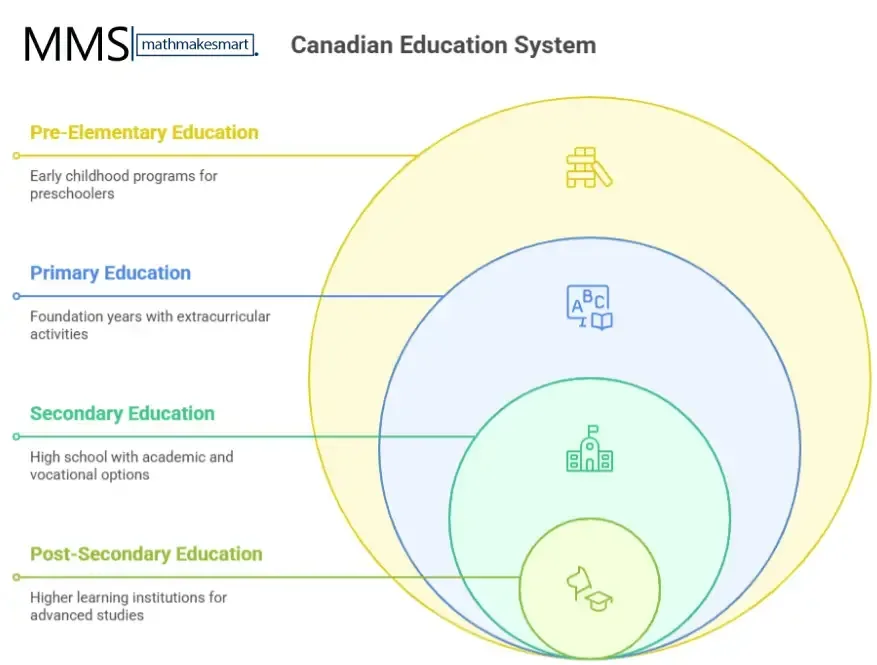
Because education is constitutionally governed at the provincial level, each province establishes its own framework for what students learn from Kindergarten through Grade 12. However, most provinces follow a similar four-tier structure:
- Early Years / Kindergarten (Ages 4–5): Focuses on social-emotional development, language acquisition, and foundational numeracy through play-based and inquiry-driven learning.
- Elementary School (Grades 1–6 or 1–8): Builds core literacy, mathematical reasoning, introductory science, social studies, and health.
- Middle School / Junior High (Grades 6–8 or 7–9): Transitions students toward subject-specific studies and independent problem-solving skills.
- Secondary / High School (Grades 9–12 or 10–12): Focuses on credit-based courses, specialized pathways (university, college, or workplace preparation), and provincial graduation requirements.
Key Characteristics of Canadian Education
- Inquiry-Based Learning: Teachers emphasize critical thinking, research, and application rather than passive memorization.
- Continuous Assessment: Final grades reflect ongoing coursework, projects, quizzes, and presentations, rather than relying solely on a single high-stakes exit exam.
- Inclusion and Diversity: Differentiated instruction and English as a Second Language (ESL) / English Language Learner (ELL) support are integrated into regular classrooms.
Comparing Canada’s Major Provincial Curricula
While the fundamental learning goals remain aligned across the country, subtle distinctions exist among the largest provincial frameworks. You might also like NCEA Explained: The Complete Parent and Student Guide.
| Province | Governing Framework | High School Graduation Pathway | Key Curriculum Focus |
|---|---|---|---|
| Ontario | Ontario Curriculum (Ministry of Education) | Ontario Secondary School Diploma (OSSD): 30 credits + 40 community involvement hours + literacy requirement | Modernized STEM integration, coding in elementary math, and financial literacy. |
| British Columbia | British Columbia Curriculum (BC Ministry) | Dogwood Diploma: 80 credits + provincial Graduation Assessments (literacy and numeracy) | Concept-based, competency-driven model centered on “Core Competencies” (Thinking, Communication, Personal/Social). |
| Alberta | Alberta Curriculum (Alberta Education) | Alberta High School Diploma: 100 credits + Diploma Exams in core Grade 12 subjects | Rigorous academic standards, particularly in mathematics and physical sciences. |
1. Ontario Curriculum
Ontario’s framework emphasizes real-world application. Recent updates to the elementary mathematics curriculum introduced compulsory coding concepts from Grade 1 onward, alongside structured financial literacy units. High school students work toward the OSSD, choosing academic, university, or college-streamed courses depending on their post-secondary goals.
2. British Columbia Curriculum
BC’s curriculum is built on a flexible, competency-focused model known as Know-Do-Understand. Rather than listing endless static facts, BC prioritizes cross-curricular competencies such as critical thinking, creative problem-solving, and personal responsibility.
3. Alberta Curriculum
Alberta is widely recognized for its rigorous STEM expectations and detailed subject outcomes. High school students in Alberta sit for provincial Diploma Exams in key Grade 12 courses, which account for a portion of their final course grade, ensuring consistent standards across districts.
Focus on STEM & Mathematics in Canada
Across all provinces, mathematics education has undergone significant evolution over the past decade. The contemporary Canadian school curriculum moves beyond procedural drills to emphasize deep conceptual understanding, spatial reasoning, and real-world problem-solving. You may also find our guide, ELA Tutoring Guide: What Is English Language Arts and How to Help Your Child, useful.
Common Strands in Canadian Mathematics
- Number Sense & Numeracy: Operations, mental math strategies, fractions, decimals, and ratios.
- Algebra & Patterning: Variable expressions, linear relations, functions, and algorithmic thinking.
- Data Literacy & Probability: Graphing, data interpretation, statistical modeling, and predictive reasoning.
- Geometry & Measurement: Spatial awareness, coordinate geometry, trigonometry, and calculus (in senior high school).
Because mathematical concepts compound year after year, gaps in foundational skills during Grades 6 to 9 can create hurdles when students enter university-track courses in functions, calculus, or physics.
Supporting Student Success: When to Consider Tutoring
While classroom instruction caters to the broad curriculum, individual learning speeds vary. Many students benefit from targeted support to reinforce classroom learning, prepare for provincial assessments, or build confidence in challenging subjects like math.
Benefits of Specialized Canadian Curriculum Tutoring
- Alignment with Local Standards: Working with a dedicated math tutor in Canada ensures that lessons align with the specific expectations of your province’s ministry guidelines.
- Personalized Pacing: One-on-one instruction addresses specific skill gaps without the pressure of a full classroom environment.
- Flexible Learning Options: With online Science tutoring in Canada, students can access expert guidance from home, fitting structured study sessions smoothly around extracurricular schedules.
If your child is working through the Ontario, BC, or Alberta math frameworks and needs structured guidance, exploring dedicated Canadian curriculum tutoring options can make a measurable difference in academic performance and confidence.
How Math Make Smart Can Help
At Math Make Smart, we specialize in tailored Canadian math tutoring designed specifically around provincial curriculum learning outcomes. Whether your child needs help mastering elementary fractions, navigating middle school algebra, or preparing for Grade 12 Advanced Functions and Calculus, our experienced online tutors deliver personalized, step-by-step instruction that aligns directly with Canadian standards. Related reading: SAT vs ACT: Which Should Your Child Take? Complete Guide.
Why Parents Choose Math Make Smart:
- Curriculum-Aligned Instruction: Tutors strictly follow Ontario, Alberta, and BC ministry strands.
- Interactive Online Platform: Engaging online tutoring in Canada that makes complex mathematical concepts intuitive and manageable.
- Focus on Conceptual Clarity: We go beyond memorization to build genuine problem-solving skills that last.
Final Takeaways for Parents and Students
- Know Your Province’s Requirements: Review your provincial ministry website to understand diploma requirements, credit structures, and assessment schedules.
- Track Key Transition Years: Grades 8, 9, and 11 are critical transition points where academic expectations increase significantly.
- Address Skill Gaps Early: Mathematics and language arts build cumulatively; seeking early support prevents frustration down the road.
- Encourage Balanced Learning: While academic rigor is important, Canadian schools heavily value well-rounded development, critical thinking, and healthy extracurricular participation.
Ready to give your child curriculum-aligned support? Book a free trial lesson with a Math Make Smart tutor, or explore our EQAO preparation.
Frequently Asked Questions
Does Canada have a national school curriculum?
No. Education in Canada is managed by each province and territory, so curricula, graduation requirements and assessments vary. Provinces such as Ontario, British Columbia, Alberta and Quebec each set their own standards.
What grades are in the Canadian school system?
Most provinces run from Kindergarten to Grade 12, usually split into elementary and secondary school. Quebec is different: secondary school ends after Secondary V (equivalent to Grade 11), followed by CEGEP.
What do students need to graduate high school in Ontario?
Ontario students need 30 credits (18 compulsory and 12 optional) for the Ontario Secondary School Diploma, along with 40 hours of community involvement and the literacy requirement. Requirements are updated from time to time, so check the current Ontario Ministry of Education rules.
Is math taught differently across provinces?
The core topics are similar, but the order, depth and course names vary. Senior math pathways, such as Ontario's university and college streams or Alberta's Math 30-1 and 30-2, also differ between provinces.
When should my child get a tutor for the Canadian curriculum?
Consider a tutor if grades are slipping, a key subject like math is causing stress, or your child is preparing for senior courses and university applications. A tutor familiar with your province's curriculum is the best fit.