NCEA Is Being Replaced: What the New Qualifications Mean for Your Child's Year Group
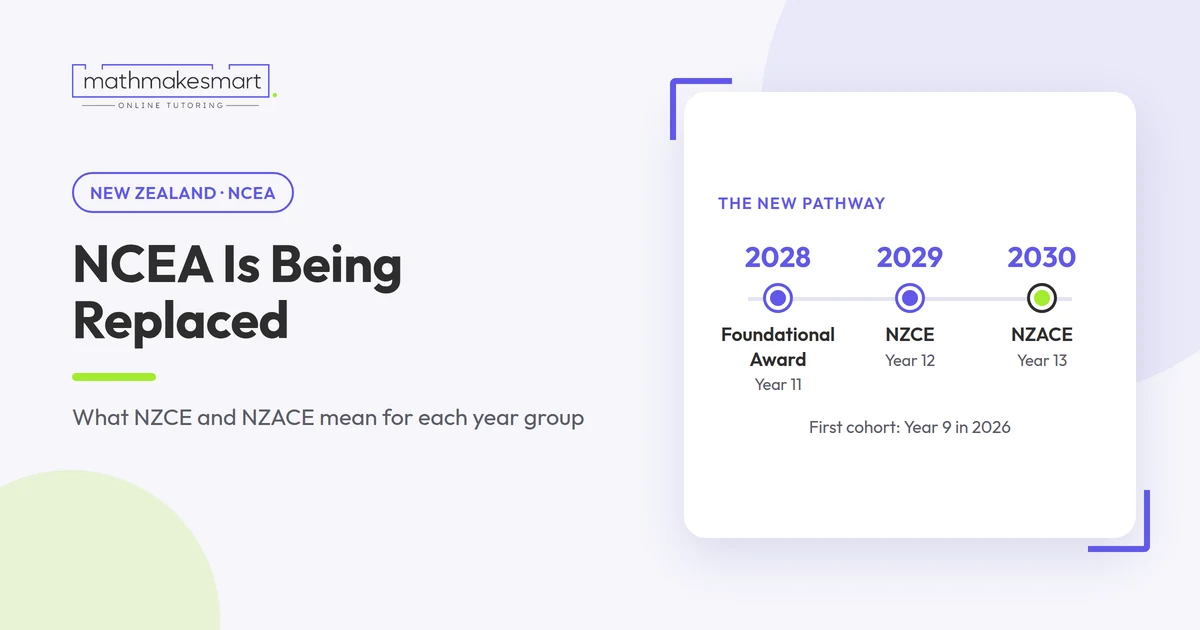
Quick answer: The Government has confirmed that NCEA will be phased out. From 2028, Year 11 students will work toward a Foundational Award in literacy and numeracy. In 2029, Year 12 students will begin the New Zealand Certificate of Education (NZCE), and in 2030, Year 13 students will begin the New Zealand Advanced Certificate of Education (NZACE). The first group to go through the new system is students who were in Year 9 in 2026. Students currently in Year 10 and above will finish under NCEA. The Ministry of Education has said no student will have to switch between systems partway through school.
What has been confirmed
The structure was agreed in March 2026, and the details were announced on 16 May 2026 (Ministry of Education; Beehive release).
Three stages instead of three NCEA levels:
Year 11: New qualification: Foundational Award (literacy and numeracy, benchmarked at Year 11); First year it applies: 2028
Year 12: New qualification: New Zealand Certificate of Education (NZCE); First year it applies: 2029
Year 13: New qualification: New Zealand Advanced Certificate of Education (NZACE); First year it applies: 2030
Subjects instead of credits: The new system is subject-based. In Years 12 and 13, students study at least five subjects a year and need to pass at least three to gain each qualification. Certificates will show which subjects were passed and the grade in each.
Letter grades: Every subject will be graded on a six-point scale from A+ to E. Students need a C or above to pass a subject (Ministry of Education). That's a big change from NCEA's Achieved / Merit / Excellence.
Exams in every subject: Each subject will include internal assessments and an examination. How much the exam counts will depend on the subject.
Literacy and numeracy are the gateway: Students must gain the Foundational Award to earn the new qualifications (Beehive). It isn't needed to move up into Year 12, but it is needed before NZCE or NZACE can be awarded (Ministry of Education).
Core Year 11 subjects: In Year 11, students must study English or Te Reo Rangatira and Mathematics or Pāngarau. From 2028, Science or Pūtaiao also becomes compulsory at Year 11.
What is still being worked out
University Entrance. The May announcement didn't set new University Entrance requirements. The Ministry says NZQA will review UE requirements as part of further work (Ministry of Education). Check the latest guidance before relying on any UE assumption.
Exam weightings for each subject.
Endorsement awards for strong results across five subjects. The broad idea has been announced, but not the criteria.
The full subject list. New subjects such as Civics, Politics and Philosophy, and industry-designed subjects such as Building and Construction, are still being developed.
Not everyone supports the plan. The secondary teachers' union, the PPTA, has questioned whether exams suit every subject and whether there are enough science teachers to make Year 11 science compulsory (1News). Details may change as the design work continues.
Which system applies to my child?
This list uses the year level your child was in during 2026.
Year 13: Qualification pathway: NCEA (finishing this year); What to watch: Unaffected
Year 12: Qualification pathway: NCEA, finishing in 2027; What to watch: Unaffected
Year 11: Qualification pathway: NCEA, finishing in 2028; What to watch: Literacy and numeracy co-requisite rules tighten from 2028 (see below)
Year 10: Qualification pathway: NCEA, finishing in 2029; What to watch: Last NCEA cohort. Make sure the co-requisite is met early
Year 9: Qualification pathway: Foundational Award (2028) → NZCE (2029) → NZACE (2030); What to watch: First cohort in the new system
Year 8 and younger: Qualification pathway: New system; What to watch: Starts on the new pathway from Year 11
Year-to-year progression is calculated from the official start dates. Students who repeat a year, skip a year, or change schools should confirm their pathway with their school.
The detail most families miss: the co-requisite changes in 2028
Students who are still in NCEA must meet the literacy and numeracy co-requisite: 10 literacy credits and 10 numeracy credits, without which no NCEA certificate can be awarded at any level. Our NCEA explained guide covers how this fits into NCEA as a whole.
The part that matters for the transition is timing. Until the end of 2027, students can meet the co-requisite either through the dedicated Common Assessment Activities (CAAs) or through a list of alternative subject standards. From 2028, only the dedicated standards will count (Ministry of Education NCEA site).
That affects students who were in Years 10 and 11 in 2026. They'll still be completing NCEA after 2027, so if they haven't met the co-requisite by then, the alternative route closes.
These assessments aren't a formality. In 2026, by each student's latest attempt, 72.3% met the reading standard, 67.7% met the writing standard, and 63.0% met the numeracy standard (NZQA). Students can attempt them as many times as needed until their final year at school. The numeracy CAA is an online assessment designed to take about 60 minutes, offered in May and September each year, with a standard calculator allowed (NZQA 2026 specifications).
Practical advice: if your child is in Year 10 or 11 and hasn't yet passed all three components, aim to finish them in 2027 while both routes are open.
What the change means for learning
Whatever happens with the final design, some things are already clear.
Literacy and numeracy matter more. In the new system, the Foundational Award is the gateway to NZCE and NZACE. Under NCEA, the co-requisite plays the same role. Students who are secure in reading, writing and everyday maths by the end of Year 10 are well placed in either system.
Exams return to every subject. NCEA allowed some students to build most of their credits through internal assessment. Under the new system, every subject has an exam. Students who struggle with timed conditions will benefit from practising them earlier.
Breadth replaces credit accumulation. Passing three of five subjects at C or better is a different target from collecting credits across many standards. Consistency within a subject will matter more.
How to prepare, by age
Year 8 and 9 (first cohorts): Focus on secure foundations in literacy, numeracy and now science. Reading widely and fluent arithmetic, especially fractions, percentages and interpreting data, are the skills the Foundational Award is built on.
Year 10: Plan to finish the co-requisite in 2027. Ask the school when the next CAA sittings are and whether your child is entered.
Year 11 and 12: Keep going with NCEA as normal, and check the co-requisite is complete.
All year levels: Keep an eye on official updates from the Ministry of Education and NZQA rather than social media summaries. Details are still being confirmed.
When extra support makes sense
Support is most useful when a student has missed a CAA, when numeracy confidence is low going into Year 10, or when a student in either system needs a stronger base in English or Mathematics. Because both NCEA and the new qualifications rest on those core subjects, help with them carries over whichever system your child ends up in.
Math Make Smart offers one-to-one online NCEA preparation as well as maths and English tutoring aligned to the New Zealand Curriculum. You can book a free trial lesson to see if it's the right fit.
Frequently asked questions
Will my child have to switch from NCEA to the new system partway through?
No. The Ministry of Education says no student will need to switch between NCEA and the new qualifications during their schooling.
Is NCEA Level 1 still running?
NCEA continues for students currently in it. For specific Level 1 arrangements at your child's school, ask the school directly, since offerings vary.
What will NZCE and NZACE grades look like?
Each subject will be graded A+ to E, and students need a C or above to pass.
Does the new system affect University Entrance?
Not yet confirmed. NZQA is reviewing University Entrance requirements for the new qualifications. Students finishing under NCEA will use current UE rules.