A-level Maths Explained: Papers, Content and the Large Data Set
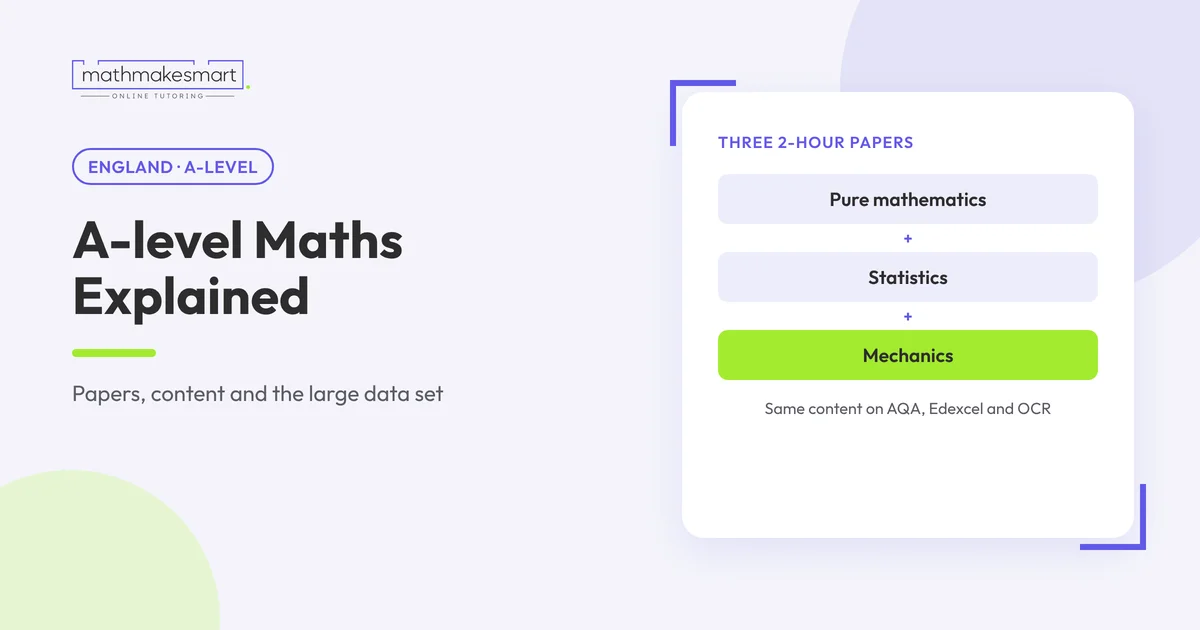
Quick answer: A-level Maths in England has fully prescribed content set by the Department for Education, so AQA, Edexcel and OCR all teach the same material. It's roughly two-thirds pure maths and one-third applied (statistics and mechanics). All three main boards assess it with three 2-hour papers of 100 marks each, though they split the applied content differently. Every student must study a large data set before the exams and use a calculator that can handle statistical distributions.
The content is the same on every board
The DfE sets the A-level Maths content, and it "represents 100% of the content" (DfE subject content). Exam boards can't add or drop topics. That's useful if a student changes school or uses resources from a different board: the maths is the same, only the paper layout differs.
The content falls into three areas:
Pure maths: proof, algebra and functions, coordinate geometry, sequences and series, trigonometry, exponentials and logarithms, differentiation, integration, numerical methods and vectors.
Statistics: sampling, data presentation, probability, statistical distributions and hypothesis testing.
Mechanics: quantities and units, kinematics, forces and Newton's laws, and moments.
Across the qualification, pure and applied content are weighted 2:1 (Pearson Edexcel specification).
Three "overarching themes" run through everything: mathematical argument and proof, problem solving, and modelling (DfE). That's why A-level questions often ask you to show, prove or comment on a model, not just calculate.
How the papers compare
AQA (7357): Paper 1 Pure; Paper 2 Pure + Mechanics; Paper 3 Pure + Statistics
Edexcel (9MA0): Paper 1 Pure 1; Paper 2 Pure 2; Paper 3 Statistics + Mechanics
OCR A (H240): Paper 1 Pure; Paper 2 Pure + Statistics; Paper 3 Pure + Mechanics
Each paper is 2 hours, 100 marks and a third of the A-level on all three boards. Sources: Pearson Edexcel, OCR, and an AQA specification summary.
Why it matters: on Edexcel, all the applied maths sits in one paper, so a student who is weak in mechanics feels it in a single sitting. On AQA and OCR, statistics and mechanics each share a paper with pure.
What is the large data set?
Every specification must require students to become familiar with one or more large, real data sets before their exams (DfE). Each board publishes its own data set, and Edexcel's is pre-released and intended to stay the same for the life of the qualification (Edexcel).
Exam questions can assume you know what's in the data set, such as what the variables mean, the units and the general patterns. Students who've only skimmed it lose easy marks.
How to prepare: spend a few short sessions in Year 12 exploring your board's data set. Make a one-page summary of the variables, units, any odd codes or missing values, and two or three patterns. Review it before the stats paper.
The calculator requirement
The DfE requires calculators that can compute summary statistics, give probabilities from standard distributions (such as binomial and normal), and use an iterative function (DfE). Many basic GCSE scientific calculators can't do all of this. Check before Year 12 starts, and learn the statistics functions early, since fumbling with menus costs time in the exam.
A taste of A-level questions
Pure: differentiation
Find the gradient of y = 3x² − 5x + 2 at x = 2.
dy/dx = 6x − 5. At x = 2: 12 − 5 = 7.
Mechanics: constant acceleration
A particle starts from rest and accelerates at 3 m s⁻² for 4 s. How far does it travel?
s = ut + ½at² = 0 + ½ × 3 × 16 = 24 m.
Statistics: binomial probability
X ~ B(10, 0.5). Find P(X = 5).
P(X = 5) = ¹⁰C₅ × 0.5¹⁰ = 252 ÷ 1024 ≈ 0.246.
Am I ready for A-level Maths?
There's no single national entry requirement; each school or college sets its own. Many ask for a high grade in GCSE Maths, so check the entry requirements where you're applying.
What predicts a good start, in our view, is fluency with Higher-tier GCSE algebra: rearranging formulae, factorising quadratics, solving simultaneous equations and working with indices and surds. A-level builds on the whole GCSE content (DfE), and algebra is where most Year 12 students find the jump.
A practical summer check:
Can you rearrange v² = u² + 2as to make s the subject?
Can you solve x² − 5x + 6 = 0 without a calculator? (x = 2 or x = 3)
Can you simplify (2√3)²? (It's 12.)
If any of these feel shaky, a few weeks of algebra practice before September makes a real difference.
Common mistakes in Year 12
Treating it like GCSE. A-level questions expect written reasoning, not just answers.
Ignoring the large data set until Year 13. It's assessed, and it takes time to know well.
Leaving mechanics or statistics to the end. They're a third of the marks.
Not learning the calculator. The statistics functions save minutes per question.
When extra support might help
Support is worth considering when the jump from GCSE algebra feels steep, when one strand (often mechanics or proof) is falling behind, or when mock grades are below target in Year 13.
A tutor can't guarantee a grade, but can strengthen algebra foundations and work through board-specific past papers. Math Make Smart offers A-level tutoring and online maths tutoring, with a free trial lesson. Students taking sciences too may find our A-level sciences guide useful.
Frequently asked questions
Is A-level Maths the same on every exam board?
The content is the same, set by the DfE. The paper structure differs.
How many exams are there?
Three 2-hour papers, each worth 100 marks.
Do I need a special calculator?
Yes. It must handle summary statistics, statistical distributions and iteration.
What's the large data set?
A real data set published by your exam board that you must study before the exams. Questions can assume you know it.