Combined Science or Triple Science at GCSE? How to Decide
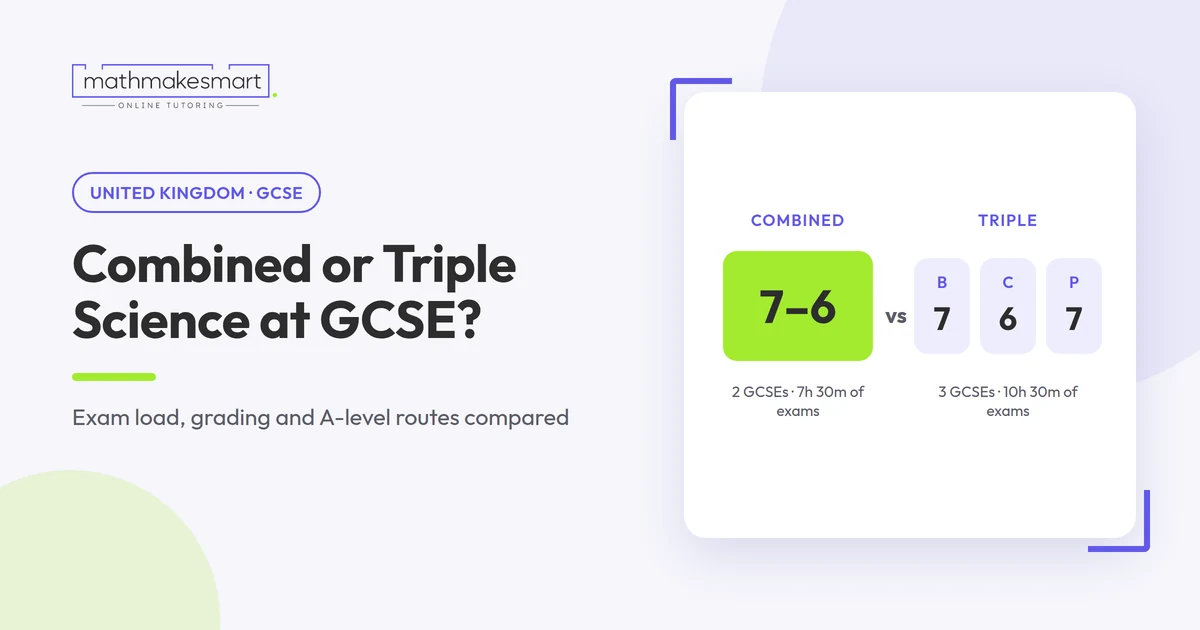
Quick answer: Combined Science gives two GCSE grades and covers all three sciences in less depth. Triple Science (also called separate sciences) gives three GCSEs, one each in Biology, Chemistry and Physics. It covers more content and involves more exam time. Triple suits students who enjoy science and can absorb the extra workload. Combined is a sound qualification that many students use to go on to A-level sciences, though entry requirements vary by sixth form. The right choice depends on your child's interest, current performance and the rest of their timetable, not on prestige.
This guide uses the GCSE system in England, with AQA's specifications as the worked example because AQA is the most widely used board for science. Edexcel and OCR follow the same overall structure but differ in paper lengths and naming. Wales and Northern Ireland have their own arrangements, and Scotland uses National 5 and Highers instead of GCSEs.
What's actually different?
Both routes teach Biology, Chemistry and Physics, and both are offered at Foundation and Higher tier. The difference is how much content is covered and how it's examined.
GCSEs awarded: Combined Science (AQA Trilogy): 2 (a double award); Triple Science (AQA Biology, Chemistry, Physics): 3 (one per science)
Exam papers: Combined Science (AQA Trilogy): 6 (two per science); Triple Science (AQA Biology, Chemistry, Physics): 6 (two per science)
Length of each paper: Combined Science (AQA Trilogy): 1 hour 15 minutes; Triple Science (AQA Biology, Chemistry, Physics): 1 hour 45 minutes
Marks per paper: Combined Science (AQA Trilogy): 70; Triple Science (AQA Biology, Chemistry, Physics): 100
Total exam time: Combined Science (AQA Trilogy): 7 hours 30 minutes; Triple Science (AQA Biology, Chemistry, Physics): 10 hours 30 minutes
Total marks: Combined Science (AQA Trilogy): 420; Triple Science (AQA Biology, Chemistry, Physics): 600
How it's graded: Combined Science (AQA Trilogy): One linked pair, e.g. 6-5; Triple Science (AQA Biology, Chemistry, Physics): Three separate grades, e.g. 7, 6, 6
Sources: AQA Combined Science: Trilogy specification at a glance; Kay Science paper structure guide.
Both routes have six exams in May and June of Year 11. Triple students spend three extra hours in the exam hall, and each paper is 30 minutes longer. Those longer papers give room for more extended questions and topics that aren't in the combined course at all.
How the double award is graded
Combined Science is graded on a 17-step scale from 9-9 down to 1-1. Students get two equal or adjacent grades, such as 7-7, 7-6 or 6-6, but never a gap like 7-5. The grade comes from the student's total marks across all three sciences, not from a separate mark in each (Ofqual).
That has two practical consequences:
A strong science can carry a weaker one. A student who's excellent at Biology but shaky in Physics still gets one combined result, and the Physics weakness never appears as a separate grade.
You can't show a strength in one science. A student who loves Chemistry and wants to show it can't point to a separate Chemistry grade.
With triple science, each subject gets its own grade on the 9 to 1 scale. A 9 in Physics is visible on the certificate even if Biology is a 6.
In both routes, a Higher tier student who misses grade 4 has an "allowed" grade 3 below it. Foundation and Higher tier grades in the overlapping range are designed to be comparable. The GCSE Grades Explained guide covers tiers and boundaries in more detail.
Can you take A-level sciences after Combined Science?
Often, yes. This is where online advice is most likely to overstate things. Many school sixth forms and colleges accept Combined Science for A-level Biology, Chemistry or Physics, usually with a minimum combined grade such as 6-6 or 7-7 alongside a strong Maths grade. Some selective sixth forms prefer or require separate sciences, particularly for Chemistry and Physics.
The only reliable answer is the published entry requirements for the sixth forms your child might apply to. Look them up now, in Year 9. Changing route in Year 10 or 11 is often difficult once timetables are set.
Two points are often missed:
Maths matters as much as science for A-level Physics and Chemistry. A student with a combined 7-7 and a grade 5 in Maths will often find A-level Physics harder than one with a combined 6-6 and a grade 7 in Maths.
The content gap is real, but it can be closed. Students moving from combined to A-level usually need to learn some topics that triple students met at GCSE. Schools are used to this, and it can be covered over the summer.
Our guide to A-level sciences explains what each A-level demands once students get there.
Who decides, the school or the family?
This varies more than most parents expect. In some schools, triple science is a free option choice. In others it takes up one of the option blocks, so choosing it means giving up a subject such as Geography or a language. Some schools put only the top science set on the triple route, and others offer triple to everyone or to no one.
Before options evening, ask the school:
Is triple science offered, and to whom?
Does it take an option block? If so, what would my child give up?
Is it taught in extra lessons, or the same time as combined with faster pacing?
Which tier is my child currently predicted to sit?
What have previous students on each route gone on to study?
The answer to question 3 matters a lot. Triple science taught in the same timetable as combined means a faster pace, which suits some students and overwhelms others.
A framework for deciding
Rather than asking "which is better?", work through these four questions honestly.
1. Does your child actually enjoy science?
Triple means three extra hours of exams and noticeably more content. A student who finds science interesting usually experiences that as more of something they like. A student who finds it a chore experiences it as a burden that can drag down their other subjects.
2. Where are they now?
If your child is working comfortably at grade 6 or above in Year 9 science assessments and is on track for Higher tier, either route is realistic. If they're working at grades 4 to 5, the bigger risk is spreading effort too thinly. Securing a solid combined grade, a good Maths grade and strong options often matters more than a third science GCSE.
3. What might they want at 16 and beyond?
Medicine, veterinary science, engineering and physical sciences tend to favour students with strong science and maths backgrounds. Triple gives a head start in content, but it isn't usually a formal requirement. Check sixth form requirements rather than assuming.
4. What would they give up?
If triple costs an option your child loves, such as Computer Science, Music or a language, that trade-off deserves real weight. GCSEs in subjects a student enjoys are often where their best grades come from.
Three short scenarios
Year 9 student working at grade 7 who wants to study Chemistry or Medicine. Triple is the natural fit if it's available without sacrificing something important.
Year 9 student working at grade 5 who is anxious about science but strong in English and History. Combined is likely the better choice, protecting time for the subjects where they're strongest.
Year 9 student working at grade 6 who likes science but would have to drop a language. It's a genuine judgement call. Look at sixth form requirements for the courses they might take and talk it through with the science department.
Common mistakes
Choosing triple for status. Universities look at A-level results far more than at the number of GCSE science grades. Three grade 5s aren't more impressive than a combined 7-7.
Assuming combined closes doors. For most students, it doesn't. Check specific requirements instead of relying on general claims.
Underestimating Maths. Ofqual's rules require at least 10% of GCSE Biology marks, 20% of Chemistry marks and 30% of Physics marks to assess mathematical skills, and at least 20% across Combined Science (Ofqual, single sciences; Ofqual, combined science). Weak algebra and rearranging formulas cost marks on both routes, especially in Physics.
Ignoring the required practicals. Both routes examine required practical activities in the written papers. Students who treat practicals as "lab time" rather than revision content regularly lose marks.
When extra support helps
Tutoring is worth considering when your child is on the boundary between Foundation and Higher tier, when a weak science is pulling down a combined grade, or when a triple-science student is struggling with the pace of three full specifications. Science tutoring is most useful when it's matched to the specific exam board and tier, so time goes on what will actually be examined.
Math Make Smart offers one-to-one online GCSE science tutoring matched to AQA, Edexcel and OCR specifications, with separate support available in Biology, Chemistry and Physics. If you'd like to see how a lesson works, you can book a free trial.
Frequently asked questions
Is triple science harder than combined science?
It covers more content in each science and has longer exam papers. Grade boundaries are set separately for each qualification, so a grade 7 in triple Physics and a 7-7 in Combined Science both represent strong performance in their own qualification.
Can my child switch from triple to combined in Year 11?
Some schools allow late entry changes, but policies vary and the timetable often makes it hard. Ask the school directly. Entry decisions usually need to be made by early in Year 11.
What grade does my child need in Combined Science for A-level Biology?
It depends on the sixth form. Look up each school or college's published entry requirements.