KS2 SATs Explained: A Parent's Guide to Year 6 Tests and Scaled Scores
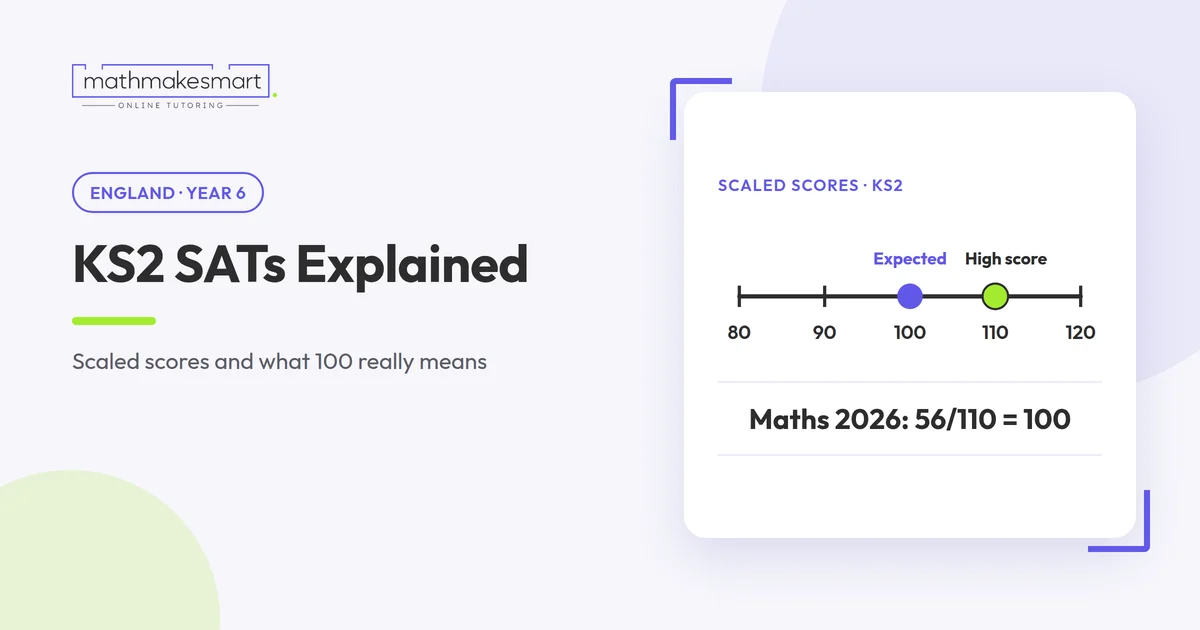
Quick answer: KS2 SATs are national tests taken by Year 6 pupils in England each May. They cover reading, maths, and grammar, punctuation and spelling (GPS). Each child's raw mark is converted to a scaled score from 80 to 120. A score of 100 or more means the child has met the expected standard, and 110 or more is often described as a high score. In 2026, a child needed 56 out of 110 marks in maths to reach 100. Results go to secondary schools, but they don't decide which school a child gets into.
What are KS2 SATs?
"SATs" is the common name for the end of Key Stage 2 national curriculum assessments. They take place in the summer term of Year 6, when most children are 10 or 11. They apply in England only. Schools in Wales, Scotland and Northern Ireland assess pupils differently.
The tests are set and marked externally by the Standards and Testing Agency (STA). Writing and science are assessed by teachers instead of a test.
Reading: test (one paper)
Maths: tests: one arithmetic paper and two reasoning papers
Grammar, punctuation and spelling: tests: one grammar and punctuation paper, one spelling paper
Writing: teacher assessment
Science: teacher assessment
How scaled scores work
Each test has a different number of raw marks, and papers vary a little in difficulty from year to year. To make results comparable across years, the STA converts raw marks into scaled scores between 80 and 120 using a new table each year (GOV.UK 2026 scaled score tables).
The key number is 100, which represents the expected standard. A child who scores 100 or more has "met the expected standard". A child below 100 hasn't yet met it in that subject.
How many marks did a child need in 2026?
These figures come from the official 2026 conversion tables:
Maths (110 raw marks): 56 marks for a scaled score of 100; 94 marks for 110
Reading (50 raw marks): 25 marks for 100; 39 marks for 110
Grammar, punctuation and spelling (70 raw marks): 34 marks for 100; 55 marks for 110
Source: GOV.UK — Scaled scores at key stage 2.
Two things stand out:
The expected standard is about half marks. In maths, 56 out of 110 is just over 50%. A child doesn't need to get most questions right to reach 100.
High scores need far more. Going from 100 to 110 in maths took another 38 marks, from 56 to 94. That's why only a minority of children reach 110.
These thresholds change each year, so a 2026 table can't predict exactly what a child will need in 2027.
How did children do nationally in 2026?
The Department for Education published the 2026 national figures on 10 September 2026 (GOV.UK — KS2 attainment 2026). The share of pupils meeting the expected standard was:
Reading: 75%
Maths: 75%
Grammar, punctuation and spelling: 74%
Writing (teacher assessment): 73%
Science (teacher assessment): 82%
Reading, writing and maths combined: 63%
The average scaled score was 106 in reading and 105 in maths. The combined reading, writing and maths figure rose from 62% in 2025 to 63% in 2026.
That combined figure is lower than any single subject because a child has to meet the standard in all three. A child who is strong in maths but working towards the standard in writing doesn't count towards it.
So what is a "good" SATs score?
It depends on the child. Some useful ways to read a score:
100 or above: the child has met the expected standard for the end of primary school.
Around 110 or above: a high score. Schools sometimes use "high score" or "greater depth" for this group, but "greater depth" is a teacher-assessment term used for writing.
Below 100: the child hasn't yet met the standard in that subject. It's a signal about where to focus, not a verdict on the child.
A child's score is one snapshot from one week in May. Teachers' day-to-day knowledge of a child is often more useful.
What SATs do and don't decide
This is where a lot of worry comes from, so it's worth being clear.
SATs don't:
decide whether a child passes or fails primary school
decide secondary school places in most areas (state school admissions follow each local authority's criteria)
appear on a child's GCSE certificates
SATs can:
be passed to the child's secondary school, which may use them, alongside its own tests, to plan sets or extra support
feed into school performance measures that the DfE publishes
If your child is applying to a grammar school, that's a separate process with its own 11+ test, usually taken at the start of Year 6.
A closer look at the maths papers
The maths test has three papers:
Paper 1: Arithmetic. Straight calculations with no context, including long multiplication, long division, fractions and percentages. On the 2-mark long multiplication and long division questions, a correct method can earn 1 mark even if the final answer is wrong.
Papers 2 and 3: Reasoning. Problems in context, such as reading a table, working out change, or explaining why an answer is right.
A worked arithmetic example
Question: 3/4 of 248
Method: Find one quarter first, then multiply by three.
248 ÷ 4 = 62
62 × 3 = 186
Answer: 186
Many children try to multiply 248 by 3 first (744) and then divide by 4 (186). That works too, but it means handling a bigger number. Teaching a child to choose the easier route saves time across the paper.
Where children typically lose marks
Rushing arithmetic. Paper 1 rewards accuracy. A quick check, such as estimating that 3/4 of 248 must be a bit less than 200, catches many slips.
Not reading the whole question. Reasoning questions often ask for two things, such as "how much change, and which coins".
Missing units. If the question asks for an answer in cm or £, the answer should say so.
Gaps in times tables. Fast recall of multiplication facts supports almost every question on the arithmetic paper. Year 4 pupils already take the Multiplication Tables Check.
How to help your child prepare
You don't need to turn Year 6 into a year of tests. Small, steady habits help most.
Ask the school what it's doing. Most schools run practice papers in the spring term. Knowing their timetable stops you duplicating work.
Keep times tables fresh. Five minutes a few times a week does more than an hour on Sunday.
Use past papers sparingly. The STA publishes past test materials on GOV.UK. One paper under relaxed conditions shows where the gaps are; ten papers in a row mostly adds stress.
Read together. The reading test rewards children who read widely and can explain why a character acted a certain way.
Keep perspective. Children pick up on adult anxiety. Calm, matter-of-fact talk about the tests tends to help.
When extra support might help
Extra help is worth thinking about if your child's teacher has said they're working towards the expected standard in maths, if they're losing confidence with fractions or written methods, or if they're doing well and would benefit from being stretched before secondary school.
A tutor can't promise a score, but can work on the specific gaps a child has and practise the question styles in a low-pressure way. Math Make Smart offers online maths tutoring for the UK curriculum, with a free first lesson, so you can book a free trial lesson and see whether it suits your child.
Frequently asked questions
When are KS2 SATs taken?
In May of Year 6. In 2027 the tests run from Monday 10 May to Thursday 13 May: grammar, punctuation and spelling on Monday, reading on Tuesday, maths papers 1 and 2 on Wednesday and maths paper 3 on Thursday (GOV.UK).
When do parents get the results?
Schools can view results from Tuesday 6 July 2027, and parents should receive them by the end of the summer term.
Can a child resit SATs?
No. There's no resit. A child who is absent may be able to take a missed test up to 5 school days later, if the school gets approval from the STA. Secondary schools often run their own baseline tests in Year 7.
Are SATs the same in Wales and Scotland?
No. KS2 SATs are only taken in England.