Alberta Diploma Exams Explained: Weighting, Dates and How to Prepare for Math 30-1
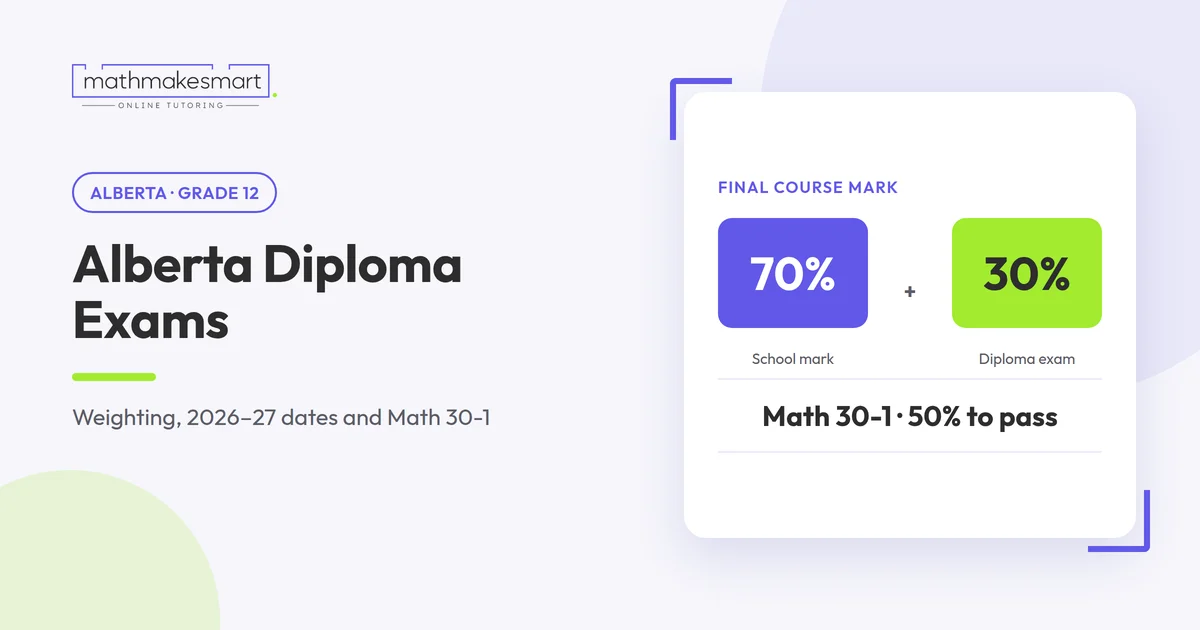
Quick answer: Alberta diploma exams are provincial exams for Grade 12 courses such as Math 30-1, Math 30-2, English 30-1 and the 30-level sciences. The diploma exam counts for 30% of the final course mark, and the school-awarded mark counts for 70%. A student needs a final mark of at least 50% to pass. Exams are written in five sessions a year, from November to August, and a student who rewrites keeps the higher mark.
What are diploma exams?
Diploma exams are set by Alberta Education for selected Grade 12 courses. They give a common, province-wide measure of what students have learned. They're only written in Alberta. Other provinces have their own graduation requirements and exams.
Diploma exams are offered in these courses (Alberta Education):
Biology 30, Chemistry 30, Physics 30, Science 30
English Language Arts 30-1 and 30-2
Français 30-1 and French Language Arts 30-1
Mathematics 30-1 and 30-2
Social Studies 30-1 and 30-2
How the diploma exam affects the final mark
The final course mark is a blend. The diploma exam has been weighted at 30% since September 1, 2023 (Alberta Education):
Final mark = 70% × school-awarded mark + 30% × diploma exam mark
Worked example
A Math 30-1 student has a school mark of 82% and writes 64% on the diploma exam.
0.70 × 82 = 57.4
0.30 × 64 = 19.2
57.4 + 19.2 = 76.6%
The diploma exam pulled the final mark down by 5.4 points from the school mark. Universities often look at final marks in Math 30-1 and English 30-1 for admission, so that gap can matter.
Now suppose the same student writes 78% instead:
0.30 × 78 = 23.4
57.4 + 23.4 = 80.8%
Every 10 points on the diploma exam moves the final mark by 3 points. The school mark still carries most of the weight, but the exam is enough to change an admissions average.
Passing the course
A student needs a final combined mark of at least 50% to pass the course (Alberta Education). It's the blended mark that counts, so a weak exam can be offset by a strong school mark, and the reverse.
2026–27 diploma exam sessions
Alberta runs five sessions in the 2026–27 school year (Alberta Education — 2026–27 general information bulletin):
November 2026: October 29 – November 6, 2026
January 2027: January 14 – 28, 2027
April 2027: April 6 – 14, 2027
June 2027: June 11 – 28, 2027
August 2027: August 3 – 11, 2027
Most students write in January (after a first-semester course) or June (after a second-semester or full-year course). The other sessions suit students who are rewriting or finishing a course on a different timeline.
Exams are now written digitally. Results appear on myPass, Alberta's online student portal, approximately three weeks after the exam (Alberta Education).
Rewriting a diploma exam
Students can rewrite a diploma exam to try to raise their mark. Rewrites are registered and paid for in myPass, and the fee is non-refundable. A student's transcript shows the highest diploma exam mark and the highest school-awarded mark they have earned (Alberta Education). Rescoring is different: a rescored mark becomes the final exam mark even if it's lower than the original.
A rewrite makes most sense when:
the final mark is just below a university admission cut-off
the student was ill or underprepared on the day
the student has kept studying and can show real improvement
Check registration deadlines and the current fee on myPass before planning a rewrite.
Inside the Math 30-1 diploma exam
Math 30-1 is the course most universities require for science, engineering and business programs. Its diploma exam follows a published blueprint (Alberta Education — Mathematics 30-1 information bulletin).
Format
Part A: 32 machine-scored questions (multiple-choice and numerical-response); 75% of the exam
Part B: 3 equally weighted written-response questions; 25% of the exam
The exam is designed to take 3 hours, and students may use up to 6 hours. One approved graphing calculator is allowed. The formula sheet is available on screen, and a paper copy is also permitted.
Content weighting
Relations and Functions: 53–58%
Trigonometry: 27–33%
Permutations, Combinations and Binomial Theorem: 14–18%
Relations and Functions is more than half the exam. That unit covers transformations, inverses, polynomial, radical and rational functions, and exponential and logarithmic functions. A student who is shaky on function transformations will feel it across many questions.
A sample-style question
Question: Solve log₂(x) + log₂(x − 2) = 3.
Method:
Combine the logs: log₂(x(x − 2)) = 3
Rewrite in exponential form: x(x − 2) = 2³ = 8
Expand: x² − 2x − 8 = 0
Factor: (x − 4)(x + 2) = 0, so x = 4 or x = −2
Check: log₂(−2) is undefined, so x = −2 is rejected.
Answer: x = 4
Check: log₂(4) + log₂(2) = 2 + 1 = 3 ✓
Rejecting the extraneous root is exactly the sort of step written-response questions reward. Students who skip the check often lose marks even with correct algebra.
Math 30-2
Math 30-2 suits students heading to programs that don't need calculus-ready math. Its diploma exam has its own blueprint, set out in the Mathematics 30-2 information bulletin.
Common mistakes in diploma preparation
Leaving review to the last week. The exam covers the whole course. Functions taught in September are still tested in January.
Not using released items. Alberta Education publishes released items for Math 30-1 and 30-2 on its writing diploma exams page, and practice tests on its digital exam platform. They show the real question style.
Ignoring numerical-response format. These answers are entered as numbers, often rounded a specific way. Practising the format saves careless mark losses.
Not knowing the calculator. Students should be fluent with their approved graphing calculator before exam day, not learning it during the exam.
Running out of time when time isn't the issue. Students have up to 6 hours. The bigger risk is rushing. Slowing down and checking work is usually worth it.
When extra help makes sense
Support can help when a student's school mark is solid but practice-exam marks are lower, when one unit (often functions or trigonometry) is holding them back, or when they're planning a rewrite and want a structured plan.
A tutor can't guarantee a diploma mark, but can work through released items, explain the reasoning behind written responses, and target weak units. Math Make Smart offers Alberta diploma exam preparation online, with a free first lesson, so you can book a free trial lesson and see if it's a good fit.
Frequently asked questions
How much is the diploma exam worth in Alberta?
30% of the final course mark. The school-awarded mark is 70%.
Can I fail the course if I fail the diploma exam?
Not automatically. You pass if your blended final mark is 50% or higher.
Do universities see my diploma exam mark?
Universities usually use the final course mark, which includes the diploma exam. Check each university's admission requirements.
Where do I find my results?
On myPass, around three weeks after you write.