Alberta Math 30-1 vs 30-2: Which Should You Take?
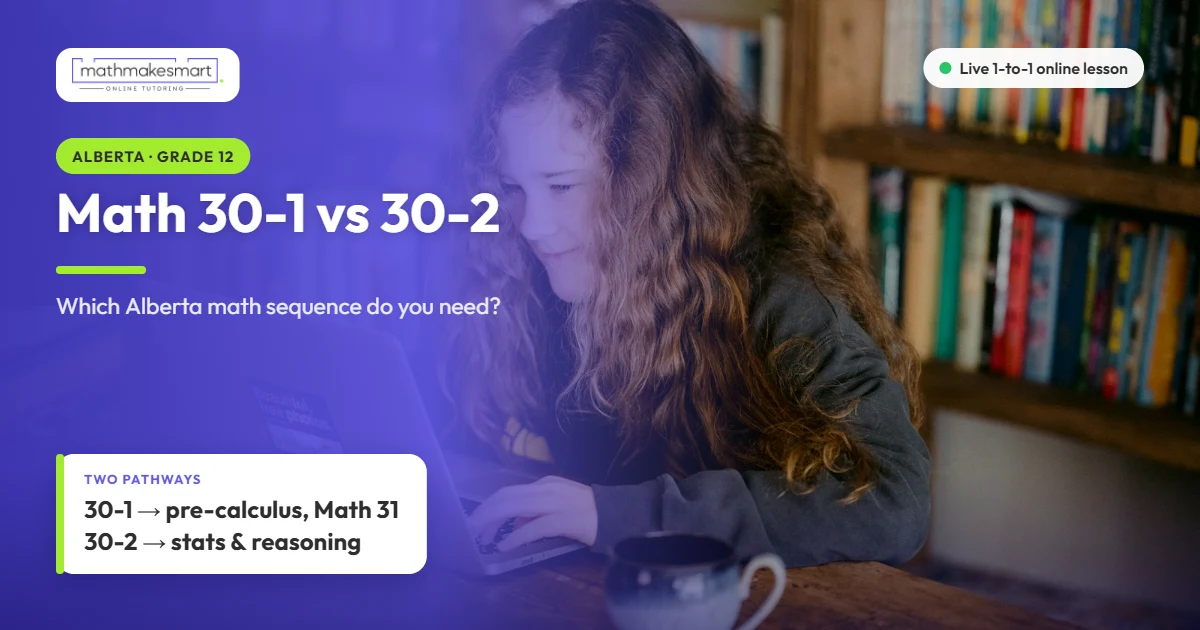
Quick answer: Math 30-1 is Alberta's pre-calculus course, mainly algebraic, for students heading into engineering, mathematics, sciences and other programs that need calculus. Math 30-2 covers algebraic and non-algebraic topics like statistics and reasoning, for students going to university, college or technical institute who don't need calculus. Most colleges and universities accept Math 30-2 for many programs, but calculus-based programs need 30-1. Students can move from 20-2 to 20-1, or 30-2 to 30-1, after completing the earlier course.
The three Alberta math sequences
From Edmonton Public Schools' guidance (EPSB — Choosing your math program):
-1 sequence (10C, 20-1, 30-1, and Math 31): for post-secondary programs such as engineering, mathematics and sciences
-2 sequence (10C, 20-2, 30-2): for post-secondary study in diverse fields that don't need calculus
-3 sequence (10-3, 20-3, 30-3): for entering the workforce or apprenticeships
Students need a 20-level math credit to graduate in Alberta (EPSB).
Math 30-1 vs 30-2
Math 30-1 is a pre-calculus course with mostly algebraic topics. It's a co-requisite for Math 31 (calculus) and may be required for post-secondary calculus courses.
Math 30-2 covers algebraic and non-algebraic topics such as statistics and reasoning. It's for students going to university, college or a technical institute who don't need calculus skills.
Both are 30-level courses, and both have a diploma exam worth 30% of the final mark. See our Alberta diploma exams guide.
Will 30-2 get me into university?
Often, yes. EPSB says "most colleges and universities accept Math 30-2 for many of their programs." It also notes that a higher grade in 30-2 may help admission more than a pass in 30-1 for programs that accept either (EPSB).
But programs that need calculus, such as engineering, sciences, mathematics and many business programs, typically require 30-1, and sometimes Math 31.
Requirements differ by institution and program. Always check the admission requirements of each program you're considering.
A taste of each course
A 30-1-style question: logarithms
Solve 2ˣ = 32.
32 = 2⁵, so x = 5.
Solve 3ˣ = 20, to two decimal places.
x = log 20 / log 3 ≈ 1.3010 / 0.4771 ≈ 2.73.
A 30-2-style question: probability
A bag has 4 red and 6 blue marbles. Two are drawn without replacement. What's the probability both are red?
(4/10) × (3/9) = 12/90 = 2/15 ≈ 0.133.
30-1 leans on algebra and functions; 30-2 puts more weight on statistics, probability and reasoning.
How to choose
Aiming for engineering, sciences, math or calculus-based business: 30-1 (and maybe Math 31)
Aiming for arts, humanities, education or social sciences: 30-2 is often accepted; check each program
Undecided but strong in algebra: 30-1 keeps more doors open
Finds algebra hard and prefers statistics and reasoning: 30-2
Heading to a trade or the workforce: 30-3 may fit
This is MMS editorial guidance. Talk to your school counselor before finalizing.
Can you switch?
Yes. EPSB says students can move from 20-2 to 20-1, or from 30-2 to 30-1, after completing the earlier course (EPSB). It means an extra course, so plan ahead if a program needs 30-1.
Common mistakes
Choosing 30-2, then finding a program needs calculus. Check requirements early.
Assuming 30-1 is always better. For many programs, a strong 30-2 grade is the better choice.
Ignoring Math 31. Some programs recommend or require it.
Leaving algebra gaps from 20-1. They show up quickly in 30-1.
When extra help makes sense
Support can help when 20-1 algebra is slipping, when a student wants to switch from -2 to -1, or when diploma exam preparation is needed.
A tutor can't guarantee a grade, but can strengthen algebra, functions and reasoning skills. Math Make Smart offers online math tutoring for Canadian curricula and Alberta diploma exam support, and you can book a free trial lesson. For Ontario's equivalent choice, see MCR3U vs MCF3M.
Frequently asked questions
What's the difference between Math 30-1 and 30-2?
30-1 is pre-calculus and mainly algebraic; 30-2 includes statistics and reasoning and is for programs that don't need calculus.
Is Math 30-2 accepted by universities?
Many programs accept it. Calculus-based programs usually need 30-1.
Can I switch from 30-2 to 30-1?
Yes, after completing 30-2.
Do both have diploma exams?
Yes. Each diploma exam is worth 30% of the final mark.