Ontario Grade 9 Math (MTH1W): What's Taught and How the EQAO Test Counts
Quick answer: In Ontario, every Grade 9 student takes the same math course, MTH1W. There are no longer separate academic and applied versions. During the course, students write the EQAO Grade 9 Assessment of Mathematics: an online test in two sessions of about 60 minutes each, with a calculator allowed. Under current ministry policy the result counts for at least 10% and up to 30% of the final course mark, so it matters, but it isn't the whole grade. Students do best when they're confident with algebra, linear relations and the course's newer topics, coding and financial literacy.
This guide is about Ontario. Other provinces have different Grade 9 courses and assessments. Alberta, British Columbia and the others each set their own curriculum.
What MTH1W is, and why it changed
Ontario used to stream students in Grade 9. The "academic" course (MPM1D) led toward university-track math, and the "applied" course (MFM1P) toward college and workplace pathways. Students had to choose at age 13 or 14, and that choice could narrow their options later.
MTH1W replaced both with one de-streamed course that all students take together. The idea is that every student keeps every pathway open going into Grade 10. For families, the practical effect is that classes now mix students with very different starting points. Teachers have to differentiate within the room, and some students who would previously have been in applied math find the pace challenging, especially in algebra.
What the course covers
MTH1W is organised into strands. One of them, Mathematical Thinking and Making Connections, runs through everything rather than being taught as a separate unit. The content strands are:
Number: What it looks like in class: Powers and exponent rules, rational numbers, proportional reasoning
Algebra: What it looks like in class: Expressions and equations, linear relations, and coding
Data: What it looks like in class: Collecting and representing data, identifying trends, using data to make decisions
Geometry and Measurement: What it looks like in class: Relationships among measurements, area, surface area and volume, design problems
Financial Literacy: What it looks like in class: Interest, budgeting, comparing financial options
Strand list from the course structure as described by Connect Education; check your child's course outline for their school's unit order.
Two parts of the course often surprise parents.
Coding is part of algebra
Students read short programs, predict what they'll do and change them for new situations. The goal isn't to become a programmer. It's to use code as another way of representing mathematical relationships, much like a table or a graph.
Here's the kind of reasoning involved:
savings = 0
for week in range(1, 5):
    savings = savings + 15
print(savings)
A student should be able to say that this adds $15 a week for four weeks and prints 60, and then change it to model 52 weeks (which gives 780). Connecting that to the linear relation S = 15w is exactly the kind of link MTH1W wants students to make.
Linear relations carry a lot of weight
Linear relations sit at the centre of Grade 9 algebra and lead directly into Grade 10. A typical problem:
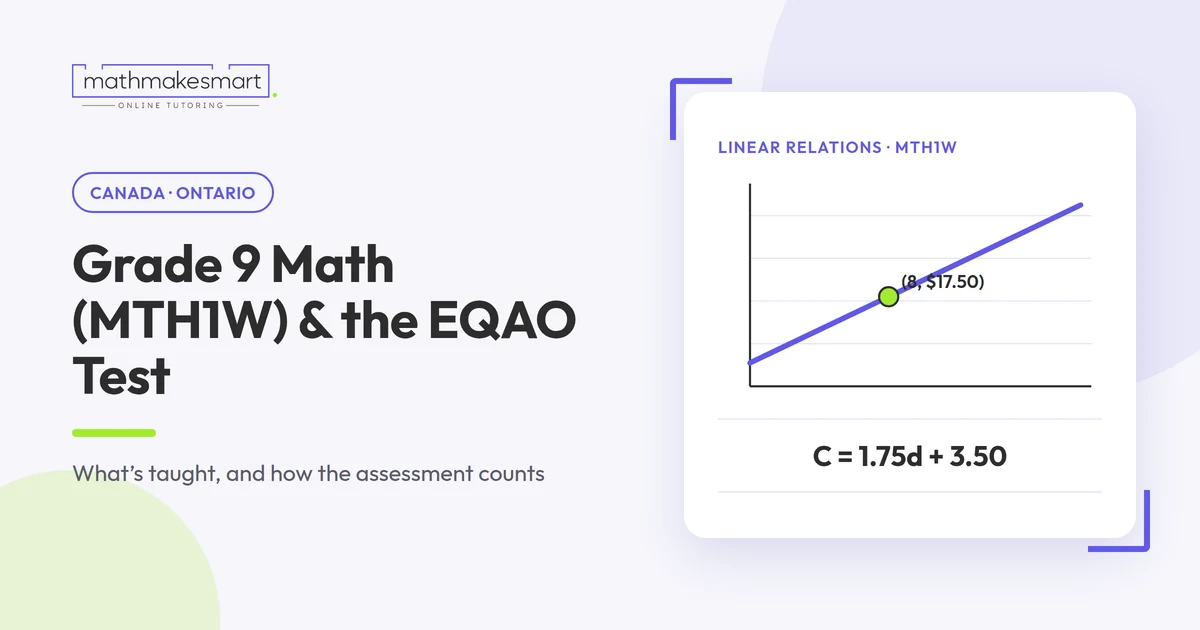
A taxi charges a $3.50 base fare plus $1.75 per kilometre. Write an equation for the cost, find the cost of an 8 km trip, and find how far you could travel for $24.50.
Equation: C = 1.75d + 3.50
8 km: C = 1.75(8) + 3.50 = 14.00 + 3.50 = $17.50
For $24.50: 24.50 = 1.75d + 3.50 → 1.75d = 21.00 → d = 12 km
Students who can move between the words, the equation, a table and a graph of a problem like this are well placed for both the course and the EQAO assessment.
How the EQAO Grade 9 assessment works
The Education Quality and Accountability Office (EQAO) runs the provincial Grade 9 math assessment. According to EQAO's parent guide and assessment FAQ:
It's online and split into two sessions, Session A and Session B, each designed to take about 60 minutes.
There are 54 questions. 50 count toward the student's result and four are field-test questions.
It uses a multi-stage adaptive design, so later questions depend on how the student performed earlier.
Students may use a scientific or graphing calculator.
Sessions can be written back to back or on different days, as scheduled by the school.
Students write it each time they're enrolled in the course, and it's given in the semester the student takes MTH1W.
Does EQAO count toward the final mark?
Yes. EQAO's 2025 parent guide states that, from September 2024, results "will count for at least 10% and up to a maximum of 30% of a student's final course mark" (EQAO). Several Ontario education sites report that the weighting was set at 20% for 2026–27 as part of wider changes to final evaluations. Confirm the current weighting with your child's school, which will state it in the course outline.
To see what that means, imagine a student whose term work is 78% and whose EQAO result is converted to 70%. If EQAO counts for 20%:
0.80 × 78 + 0.20 × 70 = 62.4 + 14.0 = 76.4%
Exactly how schools convert an EQAO result into a percentage is set locally. The numbers above show the effect of weighting, not any school's conversion formula.
The takeaway is that a weak EQAO result can lower a final mark by a few points, but it rarely decides the course on its own. Steady term work still counts for most of the grade.
How Ontario students are doing
In 2024–25, 58% of students in English-language schools met the provincial standard (Level 3 or 4), up from 54% the year before. About 133,500 students fully participated. EQAO also found that only 51% of students think they're good at math, while 86% believe a person can always get better at it (EQAO provincial highlights, 2025).
That gap between confidence and belief in improvement is worth noticing. Most students accept that math skill can be built. Fewer believe they personally have it yet.
How to prepare, month by month
Before Grade 9 (the summer after Grade 8)
Focus on fluency, not new content. The most common weak spots coming into MTH1W are fractions and integers without a calculator, solving one- and two-step equations, and reading graphs. Twenty minutes a few times a week does more than a summer workbook rushed in August.
The first month of the course
Watch for early signs: homework that takes far longer than expected, a first unit test well below your child's usual level, or "I understand it in class but can't do it at home". The first algebra unit sets the pace for the rest of the course, so gaps are much easier to close in week four than in week twelve.
Four to six weeks before the EQAO assessment
Practise in a digital format, because the real assessment is on screen.
Practise with the calculator your child will actually use on the day.
Mix question types across strands rather than revising one unit at a time, since the assessment draws from the whole course.
Review financial literacy and coding specifically. Students often skim them because they feel less like "real math", and they're easy marks to lose.
The week of the assessment
Normal sleep, normal routine. Cramming adds stress without much benefit for a skills-based adaptive test.
Common mistakes
Treating EQAO as the only thing that matters. It's significant, but term work makes up most of the final mark.
Ignoring the newer strands. Coding and financial literacy questions are usually straightforward if they've been practised, and costly if they haven't.
Over-relying on the calculator. Calculators are allowed, but students who can't estimate or check an answer mentally often don't notice when they've entered something wrong.
Waiting for the report card. By midterm, a gap in algebra can affect every unit that follows.
When a tutor makes sense
One-to-one help is most useful when a student is falling behind in the first algebra unit, when they've lost confidence after Grade 8, or when they're strong in some strands but consistently losing marks in one or two. A tutor who knows the Ontario course can work from the student's actual outline and the strands the EQAO assessment draws on.
Math Make Smart offers online math tutoring for Canadian students and dedicated EQAO preparation for Ontario families. You can book a free trial lesson to see whether it suits your child.
Frequently asked questions
Can my child fail MTH1W because of EQAO alone?
It's unlikely. With EQAO counting for between 10% and 30% of the final mark, most of the grade comes from term work.
Is the EQAO Grade 9 test the same for every student?
No. It's adaptive, so students see different question sets depending on their earlier answers. Everyone is scored on the same provincial scale.
Does MTH1W lead to both university and college math courses?
Yes. Being de-streamed, MTH1W is designed to keep all Grade 10 math pathways open.
When will we get the EQAO results?
Schools receive individual student reports after their administration window and pass them on. EQAO publishes provincial, board and school results by the end of September of the following school year.