Junior Cycle Maths Explained: Course, CBAs, Grades and How to Prepare
Quick answer: Junior Cycle Maths runs over First to Third Year and covers four content strands: Number, Geometry and Trigonometry, Algebra and Functions, and Statistics and Probability. A unifying strand of problem-solving runs through all four. Students complete classroom-based assessments (CBAs) in Second and Third Year and sit a written exam at Higher or Ordinary Level in June of Third Year. The exam grade uses descriptors from Distinction (85% or above) down to Not Graded. The level and grade matter less for points than for setting up Leaving Cert Maths, where the level a student can manage really does affect CAO points.
How the course is structured
The Junior Cycle Mathematics specification, published by the NCCA, is built around a unifying strand that "permeates" four contextual strands:
Number: operations, fractions, decimals, percentages, indices and proportional reasoning
Geometry and Trigonometry: constructions, theorems, coordinate geometry and right-angled triangle trigonometry
Algebra and Functions: expressions, equations, patterns and functions, and their graphs
Statistics and Probability: collecting, representing and interpreting data, and the language of chance
The specification is designed for at least 240 hours of class time across the three years. That's roughly a full class period most school days.
What sets this course apart from older maths syllabuses is how much it asks students to explain and apply, not just calculate. Questions are often set in a context and expect students to justify an answer in words.
The classroom-based assessments
The specification sets out two CBAs, each carried out over about three weeks in class:
CBA 1: Mathematical Investigation: When: End of Second Year; What students do: Follow the problem-solving cycle on a question: define it, plan, carry it out, interpret and communicate the findings
CBA 2: Statistical Investigation: When: End of first term, Third Year; What students do: Follow the statistical enquiry cycle: pose a question, collect and analyse data, interpret results
CBAs are assessed by the class teacher and reported on the student's Junior Cycle Profile of Achievement (JCPA). They're reported separately from the exam grade and don't change it.
The specification also describes a written Assessment Task worth 10% of the State exam marks, but it isn't currently required. Under Department of Education Circular 0062/2026, students sitting Junior Cycle in 2027 and 2028 must complete at least one CBA in each subject (schools decide whether to do one or two), don't sit Assessment Tasks, and the final exam counts for 100% of the grade. Ask your child's school whether they're doing one maths CBA or both.
Getting the most out of the CBAs
Students often treat CBAs as projects that "don't count". That misses the point. The skills a good Statistical Investigation builds, such as choosing a sensible question, picking the right graph and explaining what the data does and doesn't show, are exactly what the June paper's statistics questions reward.
The June exam
Students sit one written maths exam in June of Third Year, at either Higher or Ordinary Level. In 2026 the Junior Cycle written exams ran from 3 to 15 June, and results were issued on 7 October (Citizens Information).
What the grades mean
Since 2025, Junior Cycle subjects use these grade descriptors:
Distinction: Percentage: 85% or more
Higher Merit: Percentage: 70% to under 85%
Merit: Percentage: 55% to under 70%
Achieved: Percentage: 40% to under 55%
Partially Achieved: Percentage: 20% to under 40%
Not Graded: Percentage: Under 20%
Source: Citizens Information. Before 2025, Distinction and Higher Merit began at 90% and 75%.
If you have older children, keep that change in mind. A 2024 Higher Merit and a 2026 Higher Merit don't have the same lower boundary.
Higher or Ordinary Level?
Junior Cycle results don't carry CAO points, so the level choice is lower-stakes than at Leaving Cert. But it affects what comes next. Many schools use Junior Cycle level and performance when placing students into Leaving Cert maths classes. Students who take Ordinary Level in Third Year can find the jump to Higher Level in Fifth Year steep, because Higher Level Leaving Cert Maths builds on Higher Level Junior Cycle algebra and functions.
A practical guide:
Working comfortably at Higher Level in Second Year, even with a few weak topics? Stay at Higher. Gaps in Second Year are usually fixable.
Consistently below 40% on Higher Level tests by the middle of Third Year, despite steady effort? Talk to the teacher about Ordinary Level. A solid Merit at Ordinary can be better for confidence than a struggle at Higher.
Unsure? Ask what proportion of your child's class sits Higher, and what the teacher sees in your child's day-to-day work rather than one test.
For why the Leaving Cert level matters for points, including the 25 bonus points for Higher Level Maths, see our guide to CAO points.
The kind of maths students are asked to do
Here are three short examples in the style of Junior Cycle questions, with checked answers.
Algebra: Solve 3(x − 2) = 2x + 5.
3x − 6 = 2x + 5 → x = 11. Check: 3(11 − 2) = 27 and 2(11) + 5 = 27 ✓
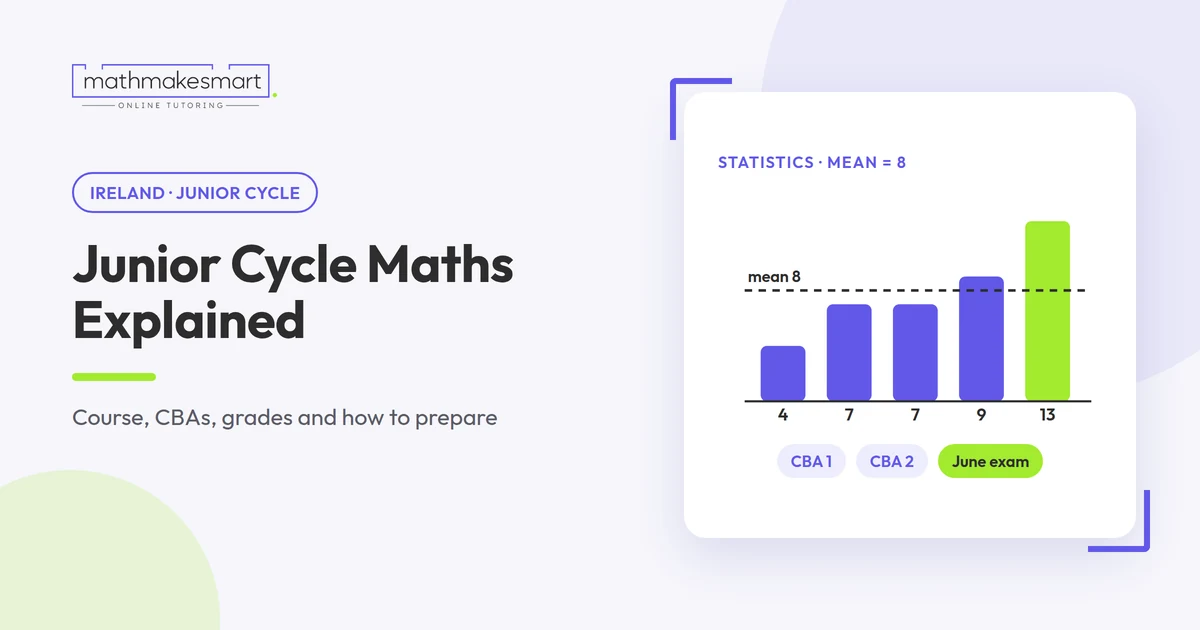
Statistics: The number of books five students read last term was 4, 7, 7, 9 and 13. Find the mean, median, mode and range.
Mean = 40 ÷ 5 = 8. Median = 7. Mode = 7. Range = 13 − 4 = 9.
A Higher Level question might then ask: "Which average best represents the group, and why?" The median and mode are both 7, but the mean is pulled up to 8 by the one student who read 13. A student who can say that in a sentence earns the communication marks.
Probability: A bag holds 3 red and 5 blue counters. One is picked at random. What's the probability it's red?
3 ÷ (3 + 5) = 3/8.
The pattern is the same throughout: getting the calculation right is only half the answer, and explaining the reasoning in words gets the rest of the marks.
A three-year plan
First Year: build number sense
The biggest predictor of later difficulty is shaky arithmetic: fractions, negative numbers and percentages without a calculator. First Year is the cheapest time to fix these. Short, regular practice works better than long sessions.
Second Year: algebra and the first CBA
Algebra becomes central, and the Mathematical Investigation takes place at the end of the year. If your child starts saying "I don't get letters in maths", act now. Algebra problems compound quickly.
Third Year: consolidate and practise
From October, the focus moves to the Statistical Investigation and then to the exam. Past papers from the State Examinations Commission (available on examinations.ie) are the most reliable practice material. Mark them honestly against the official marking schemes, which show exactly where marks are given for method and explanation.
Common mistakes
Learning methods without words. Many marks depend on a written justification. Practise writing one-sentence explanations.
Skipping geometry theorems. Higher Level students are expected to know and apply specific theorems. They're predictable marks if learned, and hard to bluff if not.
Treating CBAs as separate from the exam. The skills overlap a lot, especially in statistics.
Choosing Ordinary Level too early. A difficult term in Second Year isn't a verdict. Many students recover with targeted help.
When extra support helps
Grinds are worth considering when algebra gaps appear in Second Year, when a student is on the boundary between Higher and Ordinary Level in Third Year, or when a student who's strong at calculation keeps losing marks on explanation. One-to-one support works best when it follows the student's own syllabus and textbook rather than a generic programme.
Math Make Smart offers online maths grinds for Irish students and Junior Cycle preparation matched to the Irish specification. You can book a free trial lesson to see if it's a good fit.
Frequently asked questions
Do Junior Cycle Maths results count for CAO points?
No. CAO points come from the Leaving Certificate only. Junior Cycle results matter for placement and for building the foundations of Leaving Cert Maths.
Can my child change level at Leaving Cert?
Yes. Leaving Cert level is chosen separately, and students can and do move between levels. Moving up from Ordinary to Higher is harder, though, because Higher Level Leaving Cert assumes Higher Level Junior Cycle content.
Are calculators allowed in the Junior Cycle Maths exam?
Check the current instructions on the State Examinations Commission's exam papers and your school's guidance, since rules for specific papers can change.
What happens if my child misses a CBA?
Talk to the school. Arrangements for absence are handled locally and recorded on the JCPA.