Leaving Cert Maths Paper 1 vs Paper 2: What's on Each and How to Revise
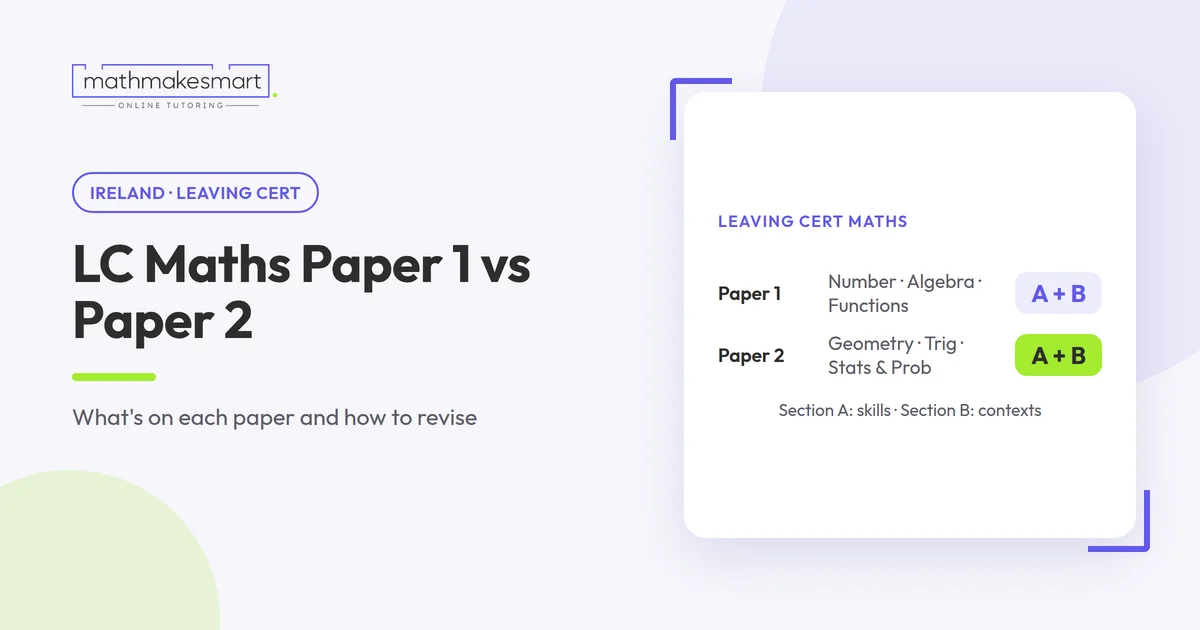
Quick answer: At Higher and Ordinary Level, Leaving Cert Maths has two papers. Paper 1 mainly covers Number, Algebra and Functions, including calculus. Paper 2 mainly covers Geometry, Trigonometry, Statistics and Probability. Each paper has a Section A (concepts and skills) and a Section B (contexts and applications). Foundation Level has a single paper. A new Leaving Cert Maths specification is being developed, but it won't apply until at least 2028, so current students sit the existing syllabus.
How the exam is structured
The Leaving Certificate Mathematics syllabus is organised into five strands (Curriculum Online — LC Mathematics):
Statistics and Probability
Geometry and Trigonometry
Number
Algebra
Functions
At Higher and Ordinary Level, these strands are split across two papers. At Higher Level, each paper lasts 2 hours 30 minutes and is worth 300 marks, split equally between Section A and Section B (150 marks each), so the two papers carry equal weight (SEC 2025 Higher Level Paper 1).
Section A and Section B
Each paper has two sections (Curriculum Online):
Section A: Concepts and Skills. Shorter questions that test whether a student knows and can use a method.
Section B: Contexts and Applications. Longer questions, often set in a real-world context, which may draw on several topics in one question.
Section B is where many students lose marks. The maths may be familiar, but the question doesn't say which method to use.
What's on Paper 1?
Paper 1 is built mainly around Number, Algebra and Functions.
Number: complex numbers, sequences and series, financial maths (compound interest, depreciation, loans), indices, proof by induction
Algebra: expressions, equations and inequalities, simultaneous equations, cubic and quadratic equations, the factor theorem
Functions: graphs of functions, transformations, differentiation and its applications, integration and area under a curve
Calculus usually appears on Paper 1 and is one of the heaviest areas at Higher Level.
A worked Paper 1 example
Question: Find the coordinates of the turning points of f(x) = x³ − 3x² − 9x + 5.
Method:
Differentiate: f′(x) = 3x² − 6x − 9
Set f′(x) = 0: 3x² − 6x − 9 = 0 → x² − 2x − 3 = 0 → (x − 3)(x + 1) = 0
So x = 3 or x = −1.
Find the y-values: f(3) = 27 − 27 − 27 + 5 = −22; f(−1) = −1 − 3 + 9 + 5 = 10
Answer: Turning points at (−1, 10) and (3, −22).
To classify them, use f″(x) = 6x − 6. f″(−1) = −12 < 0, so (−1, 10) is a local maximum. f″(3) = 12 > 0, so (3, −22) is a local minimum.
What's on Paper 2?
Paper 2 is built mainly around Geometry, Trigonometry, Statistics and Probability.
Geometry: coordinate geometry of the line and circle, constructions, theorems and proofs, enlargements
Trigonometry: sine and cosine rules, area of a triangle, radians, trigonometric identities and equations, 3D problems
Statistics and Probability: counting and probability, the normal distribution, hypothesis testing, confidence intervals, data analysis
Statistics questions on Paper 2 often need written explanation, such as interpreting a confidence interval in context.
A worked Paper 2 example
Question: In triangle ABC, |AB| = 8 cm, |AC| = 5 cm and angle BAC = 60°. Find |BC|.
Method: Use the cosine rule.
|BC|² = 8² + 5² − 2(8)(5)cos 60°
= 64 + 25 − 80 × 0.5
= 89 − 40 = 49
Answer: |BC| = 7 cm
Does it matter which paper a topic is on?
Mostly, it matters for planning. Strands can overlap, and the State Examinations Commission isn't bound to a fixed topic list per paper. A Section B question might combine algebra with a context from another strand. So it's sensible to treat the split as a guide for organising revision, not a promise about where a topic will appear.
Is the Leaving Cert Maths syllabus changing?
A new Leaving Cert Maths specification is being developed as part of senior cycle redevelopment. In October 2026, it was reported that the new specification is delayed until at least 2028, a public consultation is open until November, and an additional assessment component is planned (Irish Examiner, 2 October 2026). The revised course had originally been planned for fifth-year students from September 2027.
What this means now:
Students sitting the Leaving Cert in 2027 take the current two-paper exam.
Details of the new specification, including its extra assessment component, are proposed, not final.
Families should check NCCA and Department of Education announcements for confirmed start dates.
How to revise for both papers
A practical approach that uses the paper split:
Map the strands to your calendar. Alternate Paper 1 and Paper 2 topics week by week so neither paper gets left until May.
Start with Section A skills. If you can't differentiate or apply the cosine rule quickly, Section B questions become much harder.
Do Section B questions untimed first. Work out which method a context question needs. Speed comes later.
Use past papers by strand, then by paper. The SEC publishes past papers and marking schemes. Early on, pick out all the calculus or probability questions. Closer to the exam, sit full papers under time.
Read the marking schemes. They show where method marks are given, which matters for partial credit.
Keep a mistakes list. Note each error type, such as a sign error or a forgotten unit, and review it before each paper.
Common mistakes
Skipping proof questions. Proof by induction and geometry theorems can be learned, and they reliably come up.
Treating statistics as easy. Interpreting hypothesis tests and confidence intervals in words costs marks if it's vague.
Using degrees when radians are needed. Check calculator mode in trigonometry and calculus questions.
Leaving blanks. Partial work often earns marks under SEC marking schemes. An attempt is better than nothing.
Choosing Higher or Ordinary Level
The CAO points scale awards 25 bonus points for a H6 or higher in Higher Level Maths (CAO). That makes Higher Level attractive for students who are close to the line. But Ordinary Level suits students who would struggle with the pace and depth of Higher Level calculus and statistics. A teacher's view of a student's mocks is usually the best guide.
When extra support might help
Support can help when a student is fine in class but freezes on Section B questions, when one strand (often calculus or statistics) is dragging marks down, or when they're deciding between Higher and Ordinary Level.
A tutor can't guarantee a grade, but can help a student practise reading context questions, fix gaps in core skills and build a revision plan. Math Make Smart offers online maths tutoring for the Irish curriculum and Leaving Certificate preparation, with a free first lesson. You can book a free trial lesson to see if it suits you.
Frequently asked questions
Is calculus on Paper 1 or Paper 2?
Usually Paper 1, under the Functions strand.
Is statistics on Paper 1 or Paper 2?
Usually Paper 2.
How many papers does Foundation Level have?
One.
When does the new maths syllabus start?
Not before 2028, according to October 2026 reports. Check NCCA for confirmed dates.