NCEA Level 1 Maths Explained: The Four Standards and How to Prepare
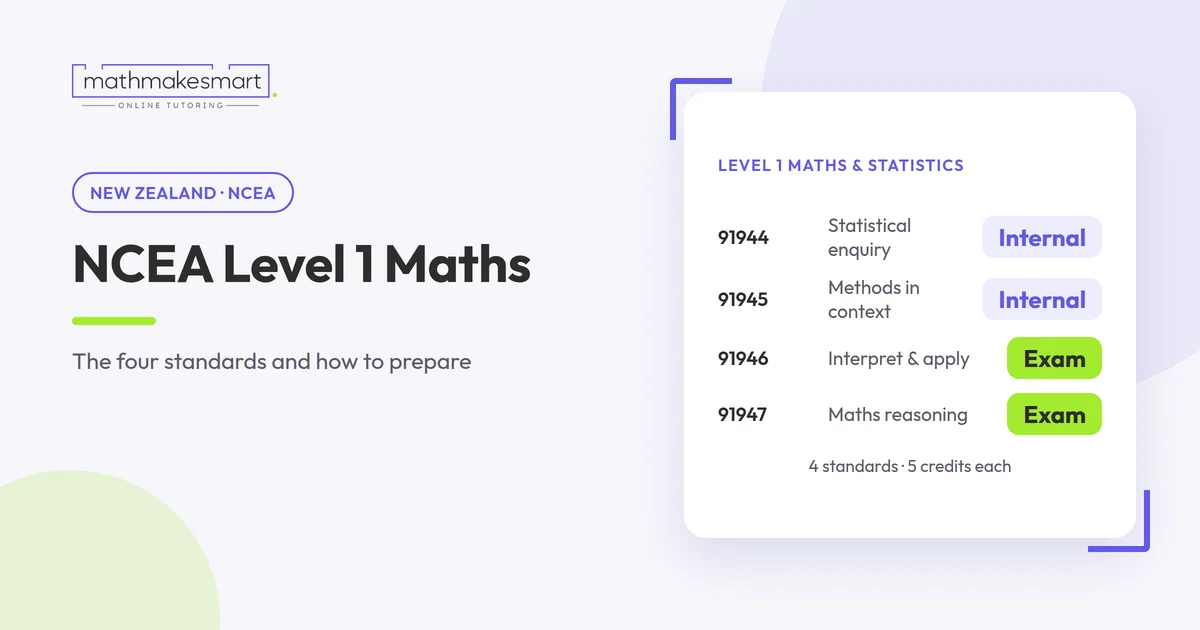
Quick answer: NCEA Level 1 Mathematics and Statistics has four achievement standards, each worth 5 credits. Two are internally assessed by the school: 91944 (statistical enquiry) and 91945 (maths methods in an Aotearoa New Zealand or Pacific context). Two are external exams at the end of the year: 91946 (interpreting and applying mathematical and statistical information in context) and 91947 (mathematical reasoning). NCEA continues for students currently in Year 10 and above. A new qualification system starts in 2028.
The four Level 1 Maths and Statistics standards
91944: Explore data using a statistical enquiry process. 5 credits, internal
91945: Use mathematical methods to explore problems that relate to life in Aotearoa New Zealand or the Pacific. 5 credits, internal
91946: Interpret and apply mathematical and statistical information in context. 5 credits, external
91947: Demonstrate mathematical reasoning. 5 credits, external
Source: NZQA — Mathematics and Statistics.
Each standard can be graded Achieved, Merit or Excellence, or Not Achieved.
Internal standards: 91944 and 91945
Internal standards are assessed by the school during the year, usually through a task or project.
91944: Statistical enquiry. Students pose a question about data, collect or use a data set, display it, and draw conclusions. Merit and Excellence come from depth: linking findings back to the question and context, and discussing the limits of the data.
91945: Maths methods in context. Students use mathematical methods to explore a problem related to life in Aotearoa New Zealand or the Pacific. The context matters; strong work explains why a method suits the situation.
Tips for internals
Read the assessment schedule your teacher provides. It shows what Merit and Excellence look like.
Explain your thinking in writing. Internal grades often depend on explanation, not just correct answers.
Meet the deadlines. Missed internals are hard to recover.
External standards: 91946 and 91947
The two externals are sat in NZQA's end-of-year exam period.
91946: Interpret and apply mathematical and statistical information in context
This exam is a printed paper with a resource booklet and three questions, each with several parts (NZQA assessment specifications). The resource booklet holds data such as infographics, displays and media articles, and isn't released before the exam. Students read that information and use maths and statistics to make decisions or judgements in context.
Worked example (91946 style):
A phone plan costs $25 per month plus $0.10 per text after the first 100 texts. Ana sends 340 texts in a month. What's her bill?
Texts over the limit: 340 − 100 = 240
Extra cost: 240 × $0.10 = $24
Total: $25 + $24 = $49
For Merit or Excellence, a student might also compare this with an unlimited plan and explain which is better for Ana, with reasons.
91947: Demonstrate mathematical reasoning
This exam has three questions covering number and algebra (such as equations, inequalities, simultaneous equations, graphs and rate of change) and measurement and geometry (such as Pythagoras and trigonometry in 2D and 3D, similar shapes, surface area and volume). A formula sheet is provided (NZQA assessment specifications). The emphasis is on reasoning: showing how and why a method works.
Worked example (91947 style):
A rectangle has length (x + 5) cm and width x cm. Its area is 84 cm². Find its dimensions.
Set up: x(x + 5) = 84
Expand and rearrange: x² + 5x − 84 = 0
Factor: (x + 12)(x − 7) = 0
So x = 7 or x = −12. A width can't be negative, so x = 7.
Answer: Width 7 cm, length 12 cm. Check: 7 × 12 = 84 ✓
Explaining why x = −12 is rejected is the sort of reasoning that moves an answer toward Merit or Excellence.
What to bring
Students need a ruler and an approved calculator for both externals (NZQA assessment specifications). Check NZQA's approved-calculator list before the exam.
Literacy and numeracy co-requisite
To gain NCEA Level 1, students also need to meet the literacy and numeracy co-requisite (or have met it already). This is separate from the four maths standards. Our guide to the NCEA replacement and what it means by year group covers the co-requisite and the 2028 changes in more detail.
How Achieved, Merit and Excellence differ
In broad terms:
Achieved: uses appropriate methods correctly.
Merit: uses methods with relational thinking, linking ideas and explaining steps.
Excellence: uses extended abstract thinking, generalising and justifying clearly.
The exact wording for each standard is in NZQA's standard documents. Exam marking follows those descriptions, so practising explanation pays off as much as practising calculation.
How to prepare for the externals
Use NZQA past papers and schedules. NZQA publishes past exams and assessment schedules for these standards. Note that 91946 and 91947 are newer standards, so there are fewer past papers than for older Level 1 standards.
Practise reading a resource booklet. For 91946, the skill is finding the right information quickly and using it correctly.
Write your reasoning out. For 91947, a correct number with no working rarely earns Merit or Excellence.
Know the formula sheet. Know what's on it so you don't waste time searching.
Do timed practice in the last few weeks. Before that, focus on accuracy and explanation.
Common mistakes
Answering without context. In 91946, the answer needs to link back to the situation, such as "So the unlimited plan is cheaper for Ana."
Skipping checks. Substitute answers back in, as in the area example above.
Rounding too early. Keep full calculator values until the final step.
Leaving questions blank. Partial reasoning can still earn credit.
When extra support might help
Support can help when a student is finding algebra or reasoning hard, when they're consistently getting Achieved but want Merit or Excellence, or when they need help preparing for the end-of-year exams.
A tutor can't guarantee an NCEA grade, but can help a student practise explanation, close gaps and work through past papers. Math Make Smart offers online NCEA preparation, with a free first lesson. You can book a free trial lesson to see if it's a good fit.
Frequently asked questions
How many credits is NCEA Level 1 maths worth?
The four standards are worth 5 credits each, 20 in total.
Which Level 1 maths standards are exams?
91946 and 91947.
Is NCEA being replaced?
Yes, from 2028. Students currently in Year 10 and above continue with NCEA.
Is a formula sheet provided?
Yes, for 91947.