NCEA Level 3 Calculus or Statistics? Choosing for University Entrance
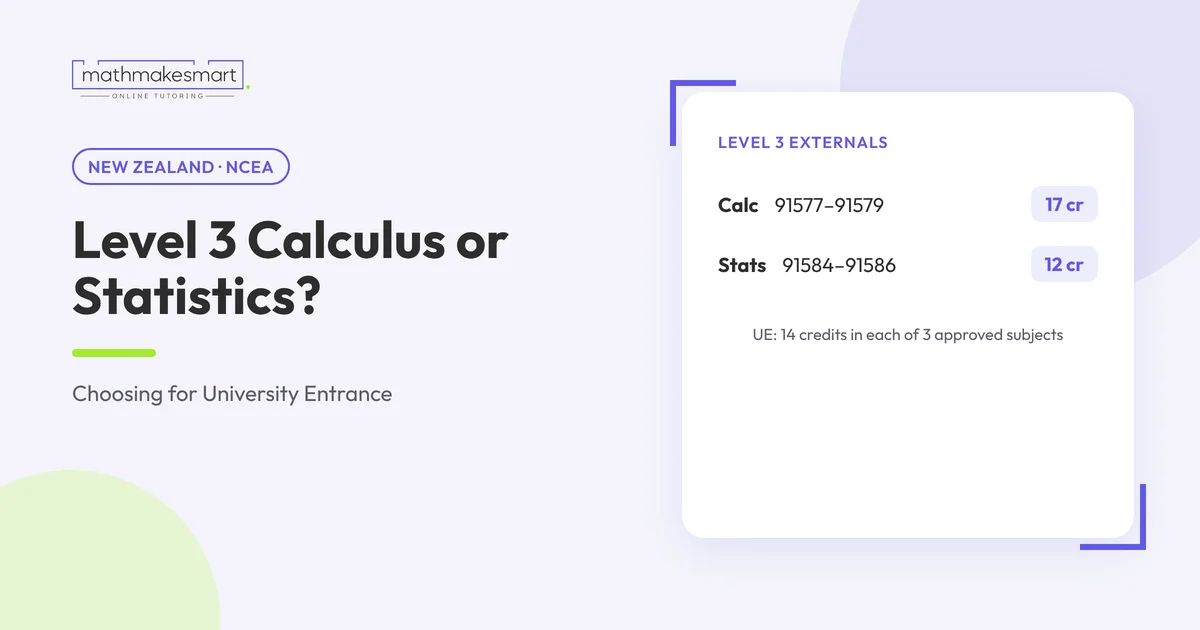
Quick answer: Both Calculus and Statistics are approved subjects for University Entrance (UE). UE needs NCEA Level 3, 14 credits in each of three approved subjects, plus literacy and numeracy requirements. Calculus suits students heading for engineering, physical sciences or maths. Statistics suits a wider range of degrees, including commerce, health and social sciences. Some students take both. Before choosing, check the specific degree's subject recommendations, as some university programs expect Calculus.
What University Entrance needs
To gain UE, students currently need (NZQA — University Entrance):
NCEA Level 3
14 credits at Level 3 in each of three approved subjects
10 literacy credits at Level 2 or above: 5 in reading and 5 in writing
10 numeracy credits at Level 1 or above, through the co-requisite standards (32406 or 32412) or certain achievement standards
NZQA notes that a review of UE requirements will inform any future changes, so check the current rules each year. Our numeracy co-requisite guide covers the numeracy part.
Calculus and Statistics as UE subjects
NZQA lists the approved standards for each subject (NZQA — UE subjects):
Calculus: 91573–91579, 91587
Statistics: 91580–91586
Mathematics/Pāngarau: 91573–91587
The overlap trap
Notice that the Mathematics subject list includes the standards from both Calculus and Statistics, and the Calculus and Mathematics lists share standards. NZQA's page doesn't spell out how overlapping standards are counted. Students relying on maths subjects for more than one of their three UE subjects should ask their school's NCEA coordinator to check the plan, so they're sure of reaching 14 credits in each of three subjects.
The external standards
Both subjects have three end-of-year external standards, sat on printed paper with a Formulae and Tables Booklet. NZQA recommends a graphing calculator; candidates without one are disadvantaged (NZQA — Calculus specification; NZQA — Statistics specification).
Calculus externals (17 credits)
91577: complex numbers, 5 credits
91578: differentiation, 6 credits
91579: integration, 6 credits
Statistics externals (12 credits)
91584: evaluate statistically based reports, 4 credits
91585: probability concepts, 4 credits
91586: probability distributions, 4 credits
Two things follow:
Calculus externals alone add up to 17 credits, more than the 14 needed for UE in that subject, if the student achieves all three.
Statistics externals total 12 credits, so students also need credits from internal Statistics standards to reach 14.
These figures are from NZQA's next-year assessment specifications; check your school's course outline for this year's standards.
What each subject feels like
Calculus: differentiation
Find the gradient of y = sin(2x) at x = 0.
dy/dx = 2cos(2x). At x = 0: 2cos(0) = 2.
Calculus is algebra-heavy and abstract. Students who enjoyed Level 2 algebra and graphs usually cope well.
Statistics: probability
A fair die is rolled twice. What's the probability of getting at least one six?
P(no six) = (5/6)² = 25/36, so P(at least one six) = 1 − 25/36 = 11/36 ≈ 0.306.
Statistics is more about interpreting data, probability and writing clear conclusions in context. Students who are strong readers and writers often do well.
How to decide
Aiming for engineering, physics, maths or similar degrees: consider Calculus (often with Statistics as well).
Aiming for commerce, health sciences, psychology or social sciences: consider Statistics, and check whether the degree recommends Calculus.
Enjoyed Level 2 algebra and graphs: consider Calculus.
Prefer data, context and written explanation: consider Statistics.
Strong in both and keeping options open: consider both, with a careful plan for UE credits.
Before deciding, look up the subject recommendations for the specific degree on the university's website. Some programs list Calculus as recommended or required preparation even when UE itself doesn't require it.
Common mistakes
Not checking how credits count. Ask your school to confirm your UE subject plan.
Ignoring internals in Statistics. The externals alone don't reach 14 credits.
Sitting exams without a graphing calculator. NZQA notes students without one are disadvantaged.
Choosing on reputation, not fit. Pick the subject that matches the degree and the student's strengths.
When extra support might help
Support is worth considering when Level 2 algebra gaps are making Calculus hard, when Statistics written answers aren't reaching Merit or Excellence, or when a student taking both needs help balancing the workload.
A tutor can't guarantee grades or UE, but can work on the specific standards a student finds hardest. Math Make Smart offers online NCEA tutoring and online maths tutoring, and you can book a free trial lesson. For how NCEA works overall, see our NCEA guide for parents and students.
Frequently asked questions
Is Calculus a UE-approved subject?
Yes. So is Statistics.
How many credits do I need in each UE subject?
14 credits at Level 3 in each of three approved subjects.
Can I take both Calculus and Statistics?
Yes. Ask your school to check how your standards count toward your three UE subjects.
Do I need a graphing calculator?
NZQA recommends one for the externals and notes students without one are disadvantaged.