The NCEA Numeracy Co-requisite: What's in the Assessment and How to Prepare
Quick answer: The NCEA numeracy co-requisite is assessed through unit standard 32406, a 10-credit, digital assessment that usually takes about 60 minutes. Students answer multiple-choice and short-answer questions about everyday situations, using a ruler and calculator. It's graded Achieved or Not Achieved. There are two assessment events each year; in 2026 they ran 18–29 May and 7–18 September. Most students first sit it in Year 10, and they can re-attempt it if they don't achieve.
What the co-requisite is
To gain an NCEA certificate, students need to meet the literacy and numeracy co-requisite as well as earning credits. NZQA develops and marks a set of dedicated co-requisite standards, each graded Achieved or Not Achieved (NZQA Insights Paper, June 2026). For numeracy in English-medium schools, that standard is 32406: Apply mathematics and statistics in a range of everyday situations.
Our NCEA guide for parents and students explains how the co-requisite fits into NCEA as a whole. For changes from 2028, see what the NCEA replacement means by year group.
What's in the assessment
The format is set out in NZQA's 2026 assessment specification (NZQA — 32406 specification 2026):
Standard: 32406, Version 4
Credits: 10
Delivery: digital, as a Common Assessment Activity (CAA), in one session
Length: designed to take about 60 minutes; schools may allow more time
Questions: multiple-choice and short-answer
Contexts: everyday situations, such as home, whānau, workplace, community and personal projects
Equipment: ruler and calculator (a basic calculator is enough)
Working: only answers are needed, not working
2026 events: 18–29 May and 7–18 September
Two details are easy to miss:
Only the answer is marked. There are no method marks, so an arithmetic slip costs the whole question. Checking matters more than in a normal maths test.
Numeric answers follow the box format. Short-answer boxes accept whole numbers, or decimals where the box allows. Read each box's instructions.
Generative AI and tools like Grammarly aren't allowed, and students may use only the resources supplied in the assessment.
What NZQA's data says about who struggles
NZQA's June 2026 Insights Paper looks at results since 2023 (NZQA Insights Paper). A few findings are useful for families:
Year 10 is when most students start. In 2025, 75% of enrolled Year 10 students took part.
Re-attempts are common, and they're harder. Students averaged about 1.3 attempts at numeracy. Re-attempts achieve at lower rates, which is one reason September results are usually lower than May results.
There's a large gap by school. In 2025, numeracy achievement was 80.1% at schools with fewer socio-economic barriers and 40.0% at schools with more barriers.
A group needs much more support. Since 2023, 5,356 students had not achieved numeracy after four or more attempts.
The practical message: a student who doesn't achieve in May should use the months before September to build skills, not simply sit it again unchanged.
The maths that comes up
The questions use everyday mathematics and statistics. Typical skills include:
Percentages: discounts, GST, and percentage change.
Rates and unit prices: comparing value for money.
Measurement: reading scales, converting units, area and perimeter.
Time: timetables and durations.
Reading data: tables, graphs and simple statistics.
Example 1: a discount
A jacket costs $80. It's 25% off. What's the sale price?
25% of $80 = $20, so the sale price is $80 − $20 = $60.
Example 2: best value
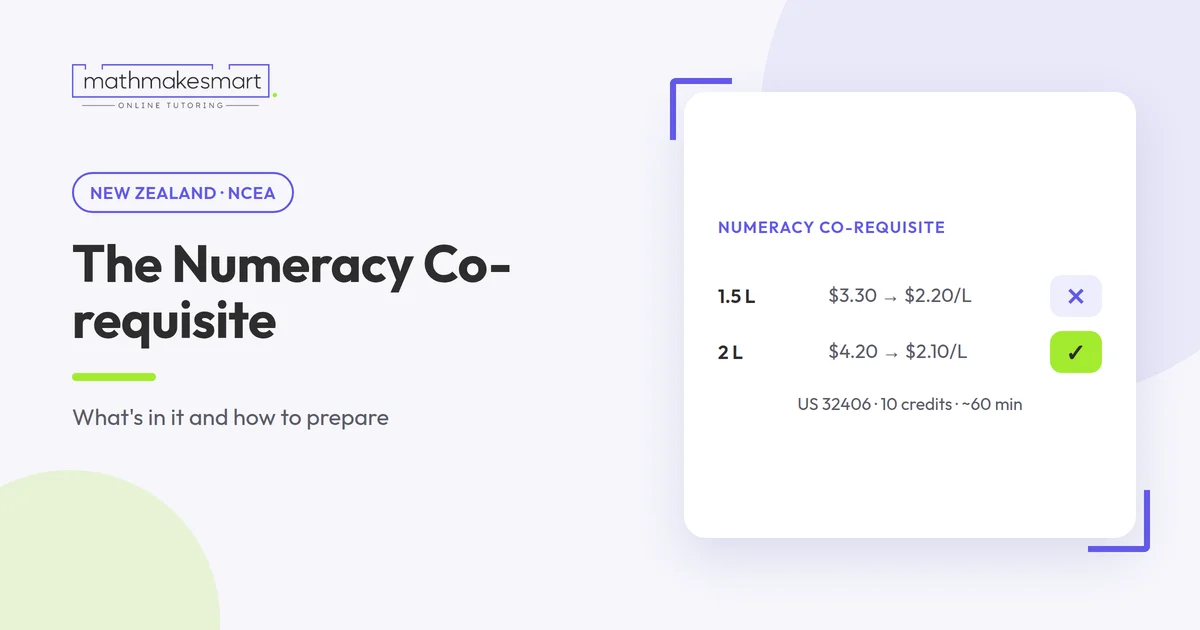
Juice comes in a 1.5 L bottle for $3.30 or a 2 L bottle for $4.20. Which is better value?
1.5 L: $3.30 ÷ 1.5 = $2.20 per litre
2 L: $4.20 ÷ 2 = $2.10 per litre
The 2 L bottle is better value.
These are original examples, not official questions. NZQA's own past papers are the best practice material.
How to prepare
NZQA publishes past assessments, exemplars, assessment schedules and reports for 32406 (NZQA — 32406 resources). They're free and show the real format.
A practical plan for the six weeks before an event:
Week 1: Do a recent past paper without a time limit. Mark it with the assessment schedule.
Weeks 2–3: Work on the topics that cost the most marks, such as percentages or unit conversions.
Week 4: Practise reading longer contexts: underline what's being asked and the numbers you need.
Week 5: A second past paper in about 60 minutes.
Week 6: Review errors and practise checking answers with estimation.
Build in a checking habit
Because only answers are marked, a quick estimate can save a question. For the juice example: $4.20 for 2 L is about $2 a litre, and $3.30 for 1.5 L is more than $2 a litre. That rough check confirms the answer before submitting.
Practise on a screen
The assessment is digital. Students who've only practised on paper sometimes lose time navigating. Doing at least one practice paper on a device helps.
Common mistakes
Rushing the reading. Everyday contexts include extra information. Find what's actually being asked.
Calculator slips with no check. With no method marks, estimate first.
Wrong units. If the answer is in cm and you calculated in mm, convert before entering.
Re-sitting without new practice. Use the time between events to fix the gaps.
When extra support might help
Support is worth considering if a student hasn't achieved numeracy on a first attempt, if anxiety or reading the contexts is the barrier, or if a Year 10 student wants to go into their first attempt confident.
A tutor can't guarantee an Achieved result, but can work through past papers and the specific skills a student is missing. Math Make Smart offers online NCEA tutoring, and you can book a free trial lesson to see if it's a good fit. For Level 1 maths standards, see our guide to NCEA Level 1 Maths.
Frequently asked questions
How many credits is the numeracy co-requisite?
10, through unit standard 32406.
Is a calculator allowed?
Yes. A ruler and calculator are required.
When are the assessments?
There are two events a year. In 2026 they ran 18–29 May and 7–18 September. Check NZQA or your school for 2027 dates.
What happens if my child doesn't achieve?
They can re-attempt at a later event. Use the time in between to practise.
Is the numeracy co-requisite the same as NCEA Level 1 Maths?
No. They're separate. Level 1 Maths and Statistics has its own achievement standards.