The Year 4 Multiplication Tables Check: What Parents Need to Know
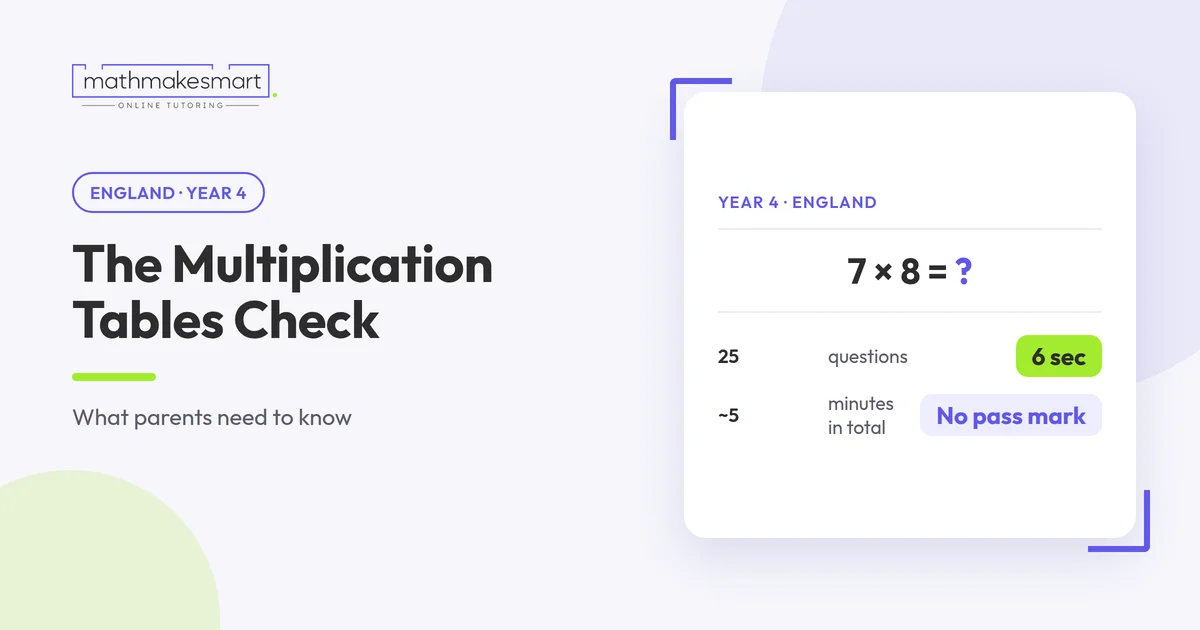
Quick answer: The multiplication tables check (MTC) is a short on-screen test taken by Year 4 pupils in state-funded schools in England each June. Children answer 25 times-tables questions, with 6 seconds for each, covering tables up to 12 × 12. It takes about 5 minutes. There's no pass mark. Schools use the results to spot children who need more support, and teachers share each child's score with parents. In 2027, schools must run the check in the two weeks from Monday 7 June 2027.
How the check works
The MTC is short and tightly timed (GOV.UK — information for parents):
It's taken on screen, on a computer or tablet.
Children first try 3 practice questions.
They then answer 25 questions, with 6 seconds for each.
The questions cover the times tables up to 12.
The whole thing takes about 5 minutes.
There's no pass mark.
The check is statutory for Year 4 pupils in state-funded schools in England (DfE methodology). Pupils in independent schools and children who are home educated don't take it. Schools in Wales, Scotland and Northern Ireland don't use it.
When is it in 2027?
Schools must give the check within the two-week period starting Monday 7 June 2027 (GOV.UK — primary assessments: future dates). Each school picks the day, so ask your child's teacher. The same GOV.UK page notes that primary assessment arrangements are under review after the Curriculum and Assessment Review, so check for updates.
Can a child be excused?
A headteacher can decide a pupil shouldn't take the check, for example if they're absent for the whole check window, can't take part even with access arrangements, or are working well below the expected level for times tables. Access arrangements are available for children with special educational needs or English as an additional language (DfE methodology). Talk to the school if you're unsure what applies to your child.
What do the results show?
The most recent published national results are for the June 2025 check (DfE — MTC attainment 2024/25, published 20 November 2025):
The average score was 21.0 out of 25, up from 20.6 in 2024.
37% of pupils scored full marks (25 out of 25), up from 34%.
25 was the most common score, across every region.
So what's a "good" score? There's no official grade, but the national figures give useful context. A child scoring around 21 is in line with the national average. A child scoring well below that probably has a group of facts they can't yet recall quickly, which is worth knowing about by the end of Year 4.
Why 6 seconds changes how you should practise
This is the part most guides skip. Six seconds is enough time to recall a fact, read the question and type the answer. It isn't really enough to work one out.
Take 7 × 8. A child who counts up in sevens (7, 14, 21, 28, 35, 42, 49, 56) will often run out of time. A child who just knows 56 answers in a second or two.
That's why the MTC is designed around what the national curriculum calls recall of multiplication facts up to 12 × 12 (DfE methodology). Practice should aim at making facts automatic, not just at getting them right eventually.
Recall versus strategy: both matter, in order
Strategies still have value. They're how children learn facts in the first place. For example:
× 9: 9 × 6 is 10 × 6 minus 6, which is 60 − 6 = 54.
× 4: double, then double again. 4 × 7 → 14 → 28.
× 12: 12 × 7 is 10 × 7 plus 2 × 7, which is 70 + 14 = 84.
Use strategies to learn a fact, then practise until the child doesn't need the strategy any more. That last step is what the check rewards.
Which facts cause the most trouble?
Children usually find the 2s, 5s and 10s easy early on. The facts that tend to stay slow are in the 6s, 7s, 8s, 9s and 12s, and especially the ones that don't have an easy pattern, such as 6 × 8, 7 × 8 and 8 × 12.
There's a helpful shortcut here. Because 7 × 8 is the same as 8 × 7, the 144 facts in a 12 × 12 grid shrink to far fewer that a child really needs to learn. Once a child knows the 1s, 2s, 5s, 10s and 11s, and the square numbers, the remaining "hard" facts are a fairly short list. Find those and practise them most.
A practice plan for the spring term
This is a suggested routine, not an official one. Little and often works far better than long sessions (5–10 minutes a day).
Weeks 1–2: Find out what's secure. Ask 20–30 mixed facts and note any that take more than about 3 seconds or are wrong.
Weeks 3–6: Practise the slow facts in small groups of four or five. Use a strategy to learn each fact, then quick-fire recall.
Weeks 7–9: Mix the new facts with known ones. Add a gentle time limit.
Weeks 10–12: Short timed sets of 25 questions, with a few seconds for each, to get used to the pace.
Some low-effort ideas that fit into a day:
Car or walk quizzes. Three or four facts at a time.
"Fact of the day." One tricky fact on the fridge, used several times.
Reverse questions. "What times 8 makes 56?" builds the division link too.
Short, timed, online practice. Many schools use times-tables apps; ask what your child's school uses so practice matches.
Keep it low pressure
The MTC has no pass mark, and results aren't used to rank individual children. Children who feel anxious about a timer tend to freeze. Keep practice light and quick, and stop while it's still fun. Our guide to overcoming maths anxiety has more ideas.
Why times tables matter beyond Year 4
Quick recall frees up working memory for harder maths. In Year 6, the KS2 arithmetic paper includes long multiplication, long division and fractions, and every one of those depends on multiplication facts. Our guide to KS2 SATs and scaled scores explains how that paper is marked. For families considering grammar schools, times-tables fluency also matters in the 11+, which we cover in our 11+ preparation guide.
Common mistakes parents make
Practising only in order. Reciting "one seven is seven, two sevens are fourteen…" doesn't build random-order recall, which is what the check tests.
Long sessions. Five minutes a day beats an hour at the weekend.
Focusing on the easy tables. Find the slow facts and spend most of the time there.
Making the check a big event. A calm child performs better.
When extra support might help
Support is worth considering if your child is still counting up for most facts in the spring of Year 4, if they get anxious under a timer, or if gaps in times tables are making other maths harder.
A tutor can't promise a score, but can find the specific facts a child is missing and build recall in short, low-pressure sessions. Math Make Smart offers online maths tutoring for the UK curriculum, and you can book a free trial lesson to see if it's a good fit.
Frequently asked questions
Is there a pass mark for the MTC?
No.
Will I be told my child's score?
Yes. Your child's teacher shares the score with you.
Which tables are covered?
Times tables up to 12 × 12.
How long does the check take?
About 5 minutes, with 6 seconds for each of the 25 questions.
Do independent schools take part?
No. The check is statutory for Year 4 in state-funded schools in England.