How the ATAR Is Calculated: Scaling Explained for Australian Families
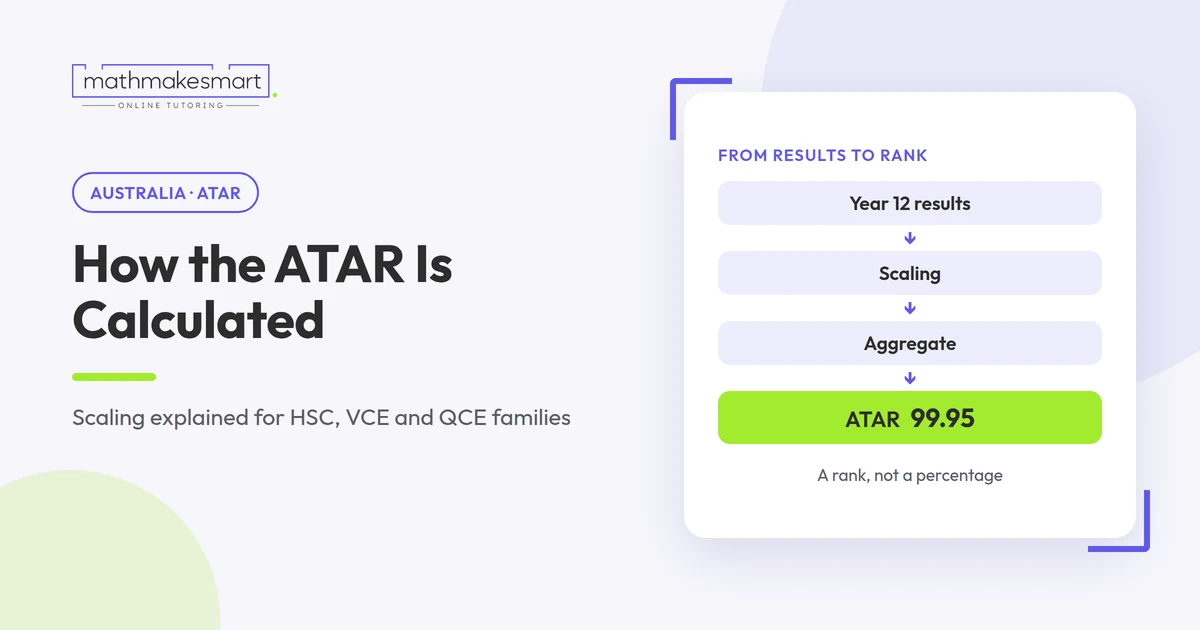
Quick answer: The ATAR isn't a mark out of 100. It's a rank, from 0.00 to 99.95, showing where a student sits compared with everyone their age in their state. To produce it, each state's admissions centre scales Year 12 results so that subjects can be compared fairly, adds the scaled results into an aggregate using state-specific rules, and converts that aggregate into a rank. Scaling adjusts for how strong each subject's cohort is, not for how "hard" the subject is. That's why choosing subjects only because they "scale well" often backfires.
What the ATAR actually measures
The Australian Tertiary Admission Rank is used by universities to compare applicants. An ATAR of 80.00 means a student ranked higher than about 80% of their age group, not that they averaged 80%.
The comparison group matters. In NSW, the ATAR "ranks you among your entire age group", meaning all 16 to 20-year-olds in the state, not just students who finished Year 12 (UAC). Because that wider group includes people who left school early, students who actually receive an ATAR score well above 50 on average. UAC says the average ATAR "is usually around 70.00" (UAC), and the median ATAR in NSW in 2025 was 70.75 (UAC 2025 scaling report). An ATAR in the 60s is not "below average" among Year 12 graduates, even though it can sound that way.
The scale runs from 0.00 to 99.95 in steps of 0.05. There is no ATAR of 100 (UAC).
Who calculates it
Each state or territory runs its own calculation through its admissions centre:
NSW and ACT: Calculated by: UAC; Senior certificate: HSC (NSW), ACT Senior Secondary Certificate
Victoria: Calculated by: VTAC; Senior certificate: VCE
Queensland: Calculated by: QTAC; Senior certificate: QCE
Western Australia: Calculated by: TISC; Senior certificate: WACE
South Australia and Northern Territory: Calculated by: SATAC; Senior certificate: SACE / NTCET
Tasmania: Calculated by: University of Tasmania; Senior certificate: TCE
Source: Australian Tertiary Admission Rank overview. Queensland moved from the OP to the ATAR in 2020.
The ATAR is designed to be comparable across states. UAC notes that an 85.00 in NSW or the ACT is equivalent to an 85.00 elsewhere (UAC). The route to that number differs, though.
Step one: scaling
Imagine two subjects. In one, the students who choose it are, on average, very strong across all their other subjects. In the other, the cohort is weaker overall. A raw mark of 80 in the first subject is harder to earn than an 80 in the second, because the competition is tougher.
Scaling corrects for that. VTAC explains that some subjects are harder to score highly in "not because some studies are inherently harder or easier", but "because some studies attract a more competitive cohort of students" (VTAC). Each admissions centre compares how students in a subject performed in their other subjects, and adjusts. Subjects with a strong cohort scale up. Subjects with a weaker cohort scale down.
Every state's stated aim is the same: students should be "neither advantaged nor disadvantaged" by the subjects they choose (UAC; QTAC).
The scaling myth
You'll often hear "take Specialist Maths, it scales up" or "avoid that subject, it scales down". Scaling results do vary between subjects. But a student who takes a high-scaling subject they struggle in, and earns a low mark, usually ends up worse off than if they'd taken a subject they're good at. Scaling adjusts a result. It doesn't create one.
A better rule: choose subjects your child is genuinely good at and that keep their likely university courses open. Many degrees have prerequisite or assumed-knowledge subjects, most often a particular level of maths, and those should come first.
Step two: the aggregate, which differs by state
This is where the details change from one state to another.
NSW and ACT (HSC)
The ATAR is based on an aggregate of scaled marks in 10 units: the best 2 units of English plus the best 8 units from the student's remaining courses. Students need to complete at least four subject areas to be eligible (UAC). Extension courses count as additional units. For example, Mathematics Extension 1 counts as 1 unit alongside Mathematics Advanced. Scaled marks aren't reported to students, and for most courses they're lower than the HSC mark itself.
Victoria (VCE)
VTAC builds the aggregate from the primary four: the best scaled result from the English group (English, EAL, Literature or English Language) plus the next three highest scaled study scores. Up to two increments are then added, each worth 10% of a fifth or sixth scaled study score (VTAC).
Here's an illustrative example (the scaled scores are made up):
English: Scaled score: 35; Counts as: 35.0
Mathematical Methods: Scaled score: 32; Counts as: 32.0
Chemistry: Scaled score: 30; Counts as: 30.0
Psychology: Scaled score: 28; Counts as: 28.0
5th study (10%): Scaled score: 27; Counts as: 2.7
6th study (10%): Scaled score: 25; Counts as: 2.5
Aggregate: Counts as: 130.2
The fifth and sixth studies only add 10% of their value each, so they can nudge an ATAR but can't rescue a weak primary four. Students with very full timetables sometimes take a sixth study for little benefit. That's worth talking through with the school.
Queensland (QCE)
QTAC uses the best five ATAR-eligible results. These can be five General subjects, or four General subjects plus one Applied subject or a completed VET qualification at Certificate III or higher. Students must pass an English subject with at least a C to be eligible, but English only counts toward the aggregate if it's among their best five scaled results (QTAC).
WA, SA/NT and Tasmania
The principle is the same (scaled results, aggregate, rank), but the rules on how many subjects count, bonus or increment arrangements, and English requirements are set by TISC, SATAC and the University of Tasmania. Check the current guide from your state's admissions centre before Year 11 subject selection.
Step three: from aggregate to rank
Each state ranks its students by aggregate and places them on the percentile scale described above. That's why ATARs are only released after all results are processed, and why the same aggregate can give a slightly different ATAR from one year to the next.
What this means for subject choice
Use these questions, in this order:
Which university courses is your child considering? Check the prerequisites and assumed knowledge first. Maths level is the most common requirement.
Where are they strongest? A high result in a subject they're good at usually does more for an ATAR than an average result in a subject chosen for scaling.
Is the workload realistic? A timetable full of demanding subjects can lower results across the board.
Are they meeting the English rule for their state? Every state has one, but the rules differ.
Common mistakes
Reading the ATAR as a percentage. It's a rank. A student with an ATAR of 75 didn't "get 75%".
Choosing subjects only for scaling. Scaling is a correction, not a bonus.
Dropping maths too early. Many science, engineering, commerce and health degrees assume a particular level of senior maths. Dropping it in Year 11 can close options that are hard to reopen.
Assuming interstate rules are the same. A family moving from Victoria to Queensland, for instance, will find that both the number of subjects counted and the English rule are different.
Forgetting about alternative entry routes. Many universities offer adjustment factors, early-offer schemes and pathway programs. The ATAR matters, but it's rarely the only way in.
When extra support makes a difference
Because results are compared within each subject, small improvements in a subject where a student is close to a higher band can move their scaled result, and so their aggregate. Targeted help tends to work best when it's matched to the state syllabus and the specific assessment format, whether that's HSC exams, VCE SACs and exams, or QCE internal and external assessment.
Math Make Smart offers one-to-one online support for senior students: HSC preparation, VCE preparation, QCE preparation, and WACE, SACE and TCE support, along with senior maths tutoring. You can book a free trial lesson to see whether it suits your child.
Frequently asked questions
What's the highest ATAR?
99.95.
Is an ATAR of 50 average?
Not among students who receive an ATAR. Because the comparison group includes people who didn't finish Year 12, the average among students who receive an ATAR is usually around 70. In NSW in 2025 the median was 70.75.
Does Specialist Maths or Extension 2 guarantee a high ATAR?
No. These subjects often scale well because their cohorts are strong, but a low result in them still produces a low scaled score.
Can my child see their scaled marks?
In NSW, scaled marks aren't reported to students. Other states publish varying levels of scaling information. Check your admissions centre's annual scaling report.