AP Scores Explained: What a 3, 4 or 5 Means for College Credit
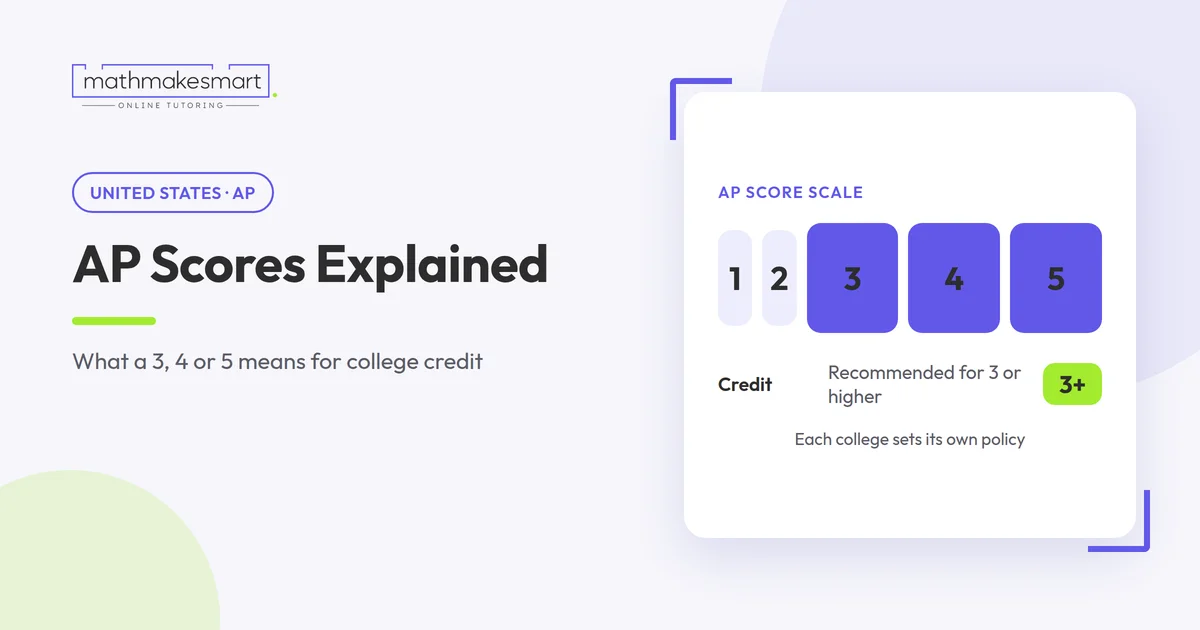
Quick answer: AP exams are scored from 1 to 5. The College Board and the American Council on Education recommend that colleges give credit for a 3 or higher, but each college sets its own policy. Many selective colleges ask for a 4 or 5, some subjects need a higher score than others, and a few colleges give placement instead of credit. The only way to know what your score is worth is to check the policy of the specific college you're applying to.
What each AP score means
Every AP exam is reported on the same five-point scale. The College Board describes each score in terms of how well prepared a student is for the matching college course:
Score 5: Extremely well qualified
Score 4: Well qualified
Score 3: Qualified
Score 2: Possibly qualified
Score 1: No recommendation
Descriptions as summarised in Wikipedia's AP exams overview, which follows the College Board's wording.
A 3 is designed to mean a student could do the work of an introductory college course. That's why the College Board and the American Council on Education (ACE) recommend that colleges award credit for AP scores of 3 or higher. It is a recommendation, not a rule.
Who decides whether a score earns credit?
The college does. This is the point most parents miss. The College Board sets and scores the exam, but each college or university decides:
which AP exams it accepts at all
the minimum score for each subject
what you get: credit hours, placement into a higher course, or both
how many AP credits count toward a degree in total
Even the College Board's own guidance shows that credit can depend on the subject. In some subjects, such as Chemistry, Music Theory and world languages, its tables suggest more credit for a 4 or 5 than for a 3 (College Board).
Three ways the same score can play out
Take a student who scores a 4 on AP Calculus AB:
College A gives credit for Calculus I with a 3 or higher. The student skips Calculus I and starts in Calculus II.
College B needs a 4. The student gets the same result as at College A.
College C gives no credit, but lets students with a 4 or 5 take a placement test to skip Calculus I. The student still needs to sit the college's own test.
None of these is unusual. That's why "Is a 4 good?" has no single answer. It's good everywhere as evidence of strong work, but what it's worth depends on where the student goes.
How to check a college's AP policy
The College Board runs an AP Credit Policy Search where colleges list their rules. To use it well:
Search each college on your list, not just your first choice.
Look for the subject, the minimum score, and the course equivalent (for example "MATH 151, 4 credits").
Check the college's own registrar or admissions page too. Policies change, and the college's site is the final word.
Note whether AP credit counts toward your major or only toward general electives. Some programs, especially engineering and nursing, accept AP credit for electives but still require their own versions of core courses.
Some states also have statewide AP credit policies for public colleges, which set a minimum credit standard across the state system (College Board statewide policies).
When AP exams happen and when scores arrive
AP exams run over two weeks in May. Regular testing begins on the second Monday of May (AP exams overview).
Scores are released in July in the student's College Board account (AP Students). Students choose which colleges receive their scores; colleges don't see them automatically.
So what is a "good" AP score?
It depends on what you want the score to do.
For college credit: a 3 often works at public universities; a 4 or 5 is safer for selective colleges and for subjects like Chemistry or Calculus.
For admissions: scores of 4 and 5 show you can handle college-level work. A 3 is still a pass. Some students choose not to send a 1 or 2, which they're allowed to do under the College Board's score-sending options.
For skipping courses in your major: aim for the score your target program lists. Skipping the wrong course can leave gaps, so some students retake an introductory class even with credit.
Choosing AP courses with credit in mind
Credit is a useful bonus, but it shouldn't be the only reason to take an AP class. A practical way to choose:
Start with the subjects you'd study anyway. An AP class in a subject you enjoy is more likely to end in a 4 or 5.
Check one or two target colleges' policies before committing to a heavy AP schedule.
Watch the workload. Three demanding AP classes in one year can lower grades across the board. Your transcript grade still matters more for admissions than the exam score.
Build the math path early. AP Calculus and AP Statistics depend on strong algebra. A student who struggles with functions in Algebra II will find AP Calculus much harder.
AP Calculus AB or BC?
Calculus BC covers everything in AB plus extra topics, such as series and parametric equations. Students who take BC also receive a Calculus AB subscore from 1 to 5 alongside their BC score (College Board). BC suits students who are strong in Precalculus and want to go further. AB suits students who want a solid foundation without the extra pace.
Common mistakes families make
Assuming a 3 guarantees credit. It doesn't. Check each college.
Ignoring the major. Credit that counts as an elective may not let a student skip a required course in their program.
Taking too many APs at once. Strong grades in fewer classes usually do more for admissions than weaker grades in many.
Starting test prep in April. AP exams cover a full year of content. Steady practice from midyear works better than cramming.
When extra help makes sense
Support is most useful when a student understands the classwork but loses marks on the exam's free-response questions, or when a gap from an earlier course, often algebra, is holding them back in AP Calculus, AP Physics or AP Chemistry. A tutor can't promise a 5, but can help a student practise the question styles, timing and written explanations the exam rewards.
Math Make Smart offers one-to-one online AP exam preparation in math and science subjects, plus online math tutoring for the algebra and precalculus that AP courses build on. The first lesson is free, so you can book a free trial lesson and see if it fits before committing.
Frequently asked questions
Is a 3 on an AP exam passing?
Yes. A 3 is described as "qualified", and the College Board and ACE recommend colleges award credit for a 3 or higher. Whether your college actually does is up to that college.
Do colleges see all my AP scores?
Colleges receive the scores you choose to send. You can also withhold a score from a specific college for a fee ($10 per score per college) or cancel a score permanently (College Board).
Can I retake an AP exam?
Yes, in a later year. Both scores stay on your record unless you withhold or cancel one through the College Board.
Do AP scores affect my high school GPA?
The exam score doesn't. Your grade in the AP class does, and many schools weight AP classes in GPA calculations. Ask your school how it handles weighting.