Leaving Cert Applied Maths: Is It Right for You, and How Does the Modelling Project Work?
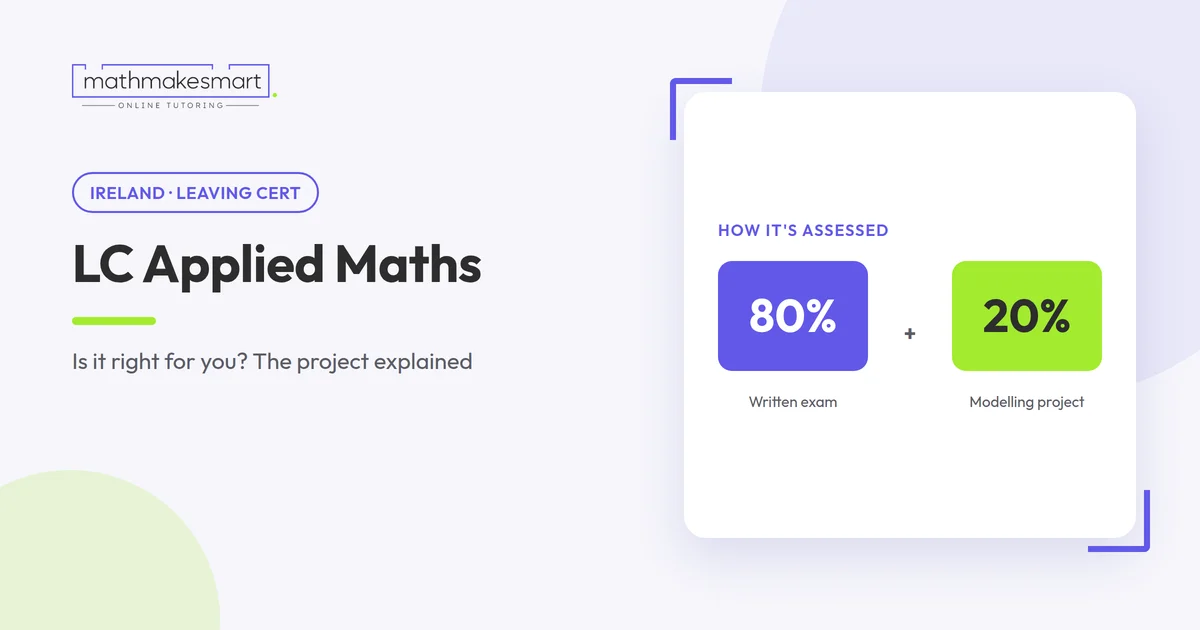
Quick answer: Leaving Cert Applied Mathematics is a separate subject from Maths. It's assessed through a written exam worth 80% and a modelling project worth 20%, at Higher and Ordinary Level. The current specification was introduced in September 2021 and first examined in 2023. The project is done in Sixth Year, in school, based on a brief the SEC issues each year, with no more than 20 hours of work. Applied Maths suits students who are strong in Maths, enjoy problem solving and are comfortable applying ideas to physical and real-world situations.
What Applied Maths is
Applied Maths uses mathematics to model and solve problems about motion, forces, networks, decisions and change. It overlaps with parts of Physics and with LC Maths, but it's its own subject with its own grade.
The current specification was introduced in schools in September 2021, assessed by a modelling project and an examination paper (NCCA). 2023 was the first year the new course was examined (Institute of Education).
It's offered at Higher and Ordinary Level (Curriculum Online).
How it's assessed
Written examination: 80%, sat in June of Sixth Year
Modelling project: 20%, completed in Sixth Year and submitted in spring
Source: NCCA guidance for the modelling project.
The modelling project, step by step
The brief
The SEC issues a common brief each year for both Higher and Ordinary Level, after mid-term in Sixth Year (NCCA guidance). The 2024 brief, for example, was about rollercoasters: energy changes and the forces on the ride and its passengers (SEC 2024 brief).
Students don't state a level when they submit. The project is graded against the standard of the level they sit in the written exam.
The rules
The work is done in school, under teacher supervision, in no more than 20 hours (NCCA guidance). Background research can be done independently.
In 2024, the report was capped at 900 words (not counting references, equations, diagrams and graphs) and 20 images, with no videos (SEC 2024 brief). Check the current year's brief, as limits can change.
All sources must be referenced, including any AI-generated material, and the work must be authenticated by the student, teacher and school.
How it's marked
The 2024 project was marked out of 100 (SEC 2024 brief):
Introduction and research: 20 marks
The modelling process: 50 marks
Interpretation of results: 15 marks
Communication and innovation: 15 marks
Half the marks go to the modelling process itself. That's the key planning point: a project with an impressive introduction but a thin model will lose most of its marks.
The modelling cycle
The NCCA describes four stages, and notes they don't have to run in a strict order (NCCA guidance):
Formulating problems: choosing a focused question you can answer.
Translating problems into mathematics: setting assumptions and variables.
Computing and interpreting solutions.
Evaluating and reporting solutions: testing whether the model makes sense, then improving it.
What a focused model looks like
The biggest risk with the project is choosing a question that's too broad. "How does a rollercoaster work?" is a topic, not a model. "What's the maximum speed at the bottom of a 40 m drop if friction is ignored, and how much does friction reduce it?" is a question you can model, test and improve in 20 hours.
Here's the kind of first model that question leads to, under the assumption of no friction:
Energy conservation: mgh = ½mv², so v = √(2gh).
With g = 9.8 m/s² and h = 40 m: v = √(2 × 9.8 × 40) = √784 = 28 m/s.
That's the first loop of the cycle. The second loop adds friction or air resistance, compares the results, and discusses which assumptions matter most. That evaluation is where the higher marks are.
A taste of the written exam
The written paper tests the same modelling ideas through set questions. Here's a simple kinematics example of the kind the course builds on:
Question: A car starts from rest and accelerates uniformly at 2 m/s² for 5 seconds. Find its final speed and the distance travelled.
v = u + at = 0 + 2 × 5 = 10 m/s
s = ut + ½at² = 0 + ½ × 2 × 25 = 25 m
Higher Level questions go much further, but they reward the same habits: state the model, show the steps, and check that the answer is physically sensible.
Is Applied Maths right for you?
There's no single right answer, but this framework helps:
Comfortable at Higher Level Maths and enjoy problem solving: worth serious consideration.
Also take Physics: a good fit, as many ideas overlap.
Struggle with algebra and functions in Maths: likely to be hard; strengthen Maths first.
Dislike open-ended projects: worth thinking about, since 20% is a modelling project.
Want a subject very similar to Maths: not quite; it's more applied and more physical.
Two practical checks before choosing:
Ask whether your school offers it. Not every school does, and some run it outside the timetable.
Look at a recent paper and project brief. The SEC publishes past papers; reading one is the fastest way to know whether the style suits you.
Common mistakes
Choosing a project question that's too broad. Narrow it until you can build, test and improve a model.
Spending most of the 20 hours on research. Research is worth 20 marks; the modelling process is worth 50.
Not evaluating the model. Saying what your assumptions ignore, and how that affects the answer, is part of the marks.
Going over the word limit. Penalties may apply.
Treating it as extra Maths. The exam rewards modelling and interpretation, not just calculation.
When extra support might help
Support is useful when a student is strong in Maths but finds the step from a real situation to equations difficult, when a project model isn't developing beyond the first loop, or when exam answers lose marks for unclear working.
A tutor can't write the project (it must be the student's own, authenticated work), but can help with the underlying maths and with practising exam questions. Math Make Smart offers Leaving Certificate grinds and online maths grinds, and you can book a free grind to see if it suits you. For the main Maths exam, see our guide to LC Maths Paper 1 and Paper 2.
Frequently asked questions
How much is the Applied Maths project worth?
20% of the final grade. The written exam is worth 80%.
Is there a different project for Higher and Ordinary Level?
No. There's one common brief, but it's graded against the level you sit.
How long do you get for the project?
No more than 20 hours, completed in school in Sixth Year.
Can you use AI for the project?
Any AI-generated material must be referenced, and the work must be your own and authenticated by your school. Check the current brief for the rules.