The New Leaving Cert Physics: The 40% Investigation Explained
Quick answer: A revised Leaving Cert Physics specification was introduced in schools in September 2025, as one of the first subjects in senior cycle reform. It's assessed through a written exam worth 60% and an additional assessment component worth 40%: an investigation combining research on an issue with an experiment. The SEC publishes an investigation brief each year, students spend about 20 hours on it, and they submit a digital report in Year 2 of the course. The same brief is used for Higher and Ordinary Level.
What's changed
Physics is one of seven subjects with revised specifications from the 2025/26 school year, alongside Biology, Chemistry, Business, Arabic, Latin and Ancient Greek (Department of Education).
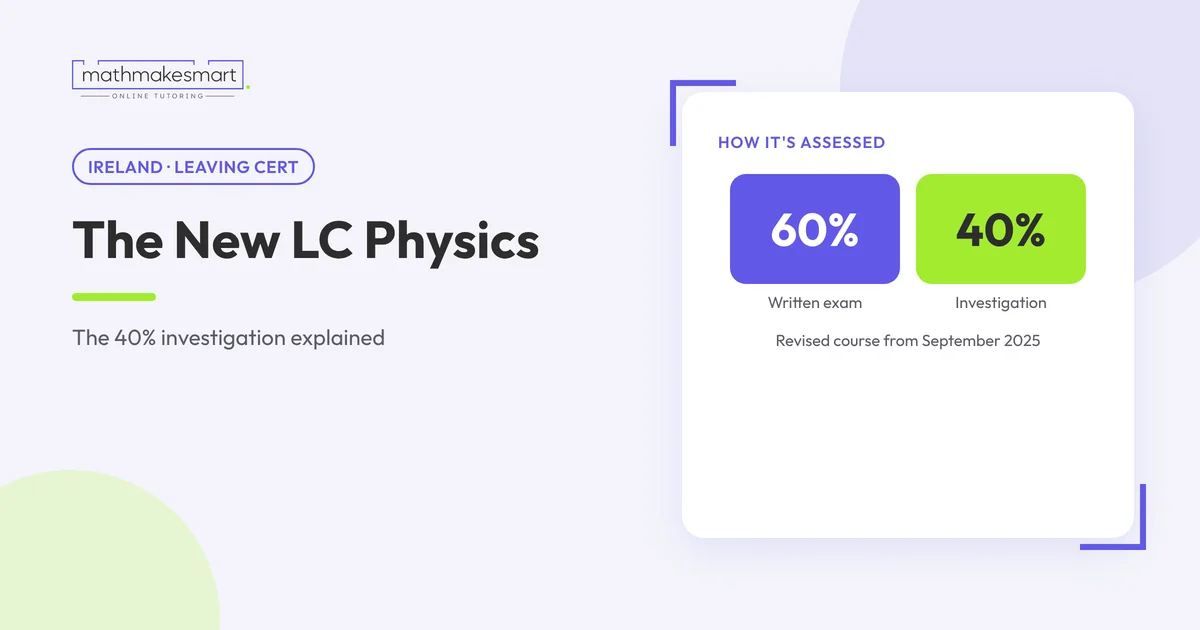
The biggest change is assessment. Each new and revised subject now includes an additional assessment component (AAC) worth at least 40% of the marks, assessed externally by the State Examinations Commission (Department of Education). For Physics, the split is:
Written examination: 60%
Additional assessment component (investigation): 40%
Source: NCCA — Physics additional assessment component guidelines.
Students who started Fifth Year in September 2025 are the first group on the revised course. Students in other year groups should check with their school which specification they're following.
How the investigation works
The NCCA guidelines set out the main features (NCCA):
What it is: an investigation that includes research on an issue and an experiment.
The brief: the SEC publishes an investigation brief each year, in term 2 of Year 1 of the course.
Time: students work on it for approximately 20 hours, across six stages.
Submission: a digital report in a format set by the SEC, submitted in Year 2.
Levels: the brief is common to Higher and Ordinary Level. The work is assessed at the level the student sits in the written exam.
What this means in practice
Physics used to be judged almost entirely in one written exam. Now 40% depends on work done over months. That suits students who plan steadily, and it means good lab habits matter, not just exam technique.
Planning the investigation
The guidelines describe six stages but don't fix a method for every brief. A sensible way to plan the 20 hours:
Understanding the brief: pick a narrow, testable question within the brief.
Research: find the physics behind it and note sources as you go.
Planning the experiment: choose variables, equipment and how many repeats you'll take.
Collecting data: record raw data carefully, with units and uncertainties.
Analysing: graph the data and find relationships.
Evaluating and reporting: discuss errors, limitations and what you'd change.
This is our suggested way to organise the time. Follow your teacher's plan and the current SEC brief.
An example of the analysis skill
Suppose an investigation measures how the period of a pendulum depends on its length. Theory says T = 2π√(L/g). For L = 0.80 m and g = 9.8 m/s²:
T = 2π√(0.80 ÷ 9.8) = 2π × 0.2857 ≈ 1.80 s
Plotting T² against L should give a straight line through the origin, with gradient 4π²/g. Using a straight-line graph to check a relationship, and then commenting on how close the data comes, is exactly the kind of analysis an investigation rewards.
What's still to be confirmed
Some details aren't published in the sources above, and families should watch for them:
the exact submission date each year
the marking criteria for the investigation
the format of the written exam under the revised specification
Check announcements from the SEC and your school. Treat anything you read elsewhere about these as unconfirmed until the SEC publishes it.
Common mistakes to avoid
Choosing a question that's too broad. A focused question you can test well beats an ambitious one you can't finish.
Leaving the report to the end. Write up each stage as you go.
Not recording uncertainties. Evaluation marks depend on discussing the quality of your data.
Forgetting the exam is still 60%. The investigation matters, but the written paper is still the larger share.
When extra support might help
Support is useful when a student finds the physics concepts or the maths behind them hard, when graphing and data analysis are a weak point, or when exam preparation is slipping while the investigation takes up time.
The investigation must be the student's own work, so a tutor can't write it. A tutor can help with the underlying physics, data analysis and exam practice. Math Make Smart offers online Physics grinds and Leaving Cert grinds, and you can book a free grind. For a similar modelling project in maths, see our Applied Maths guide.
Frequently asked questions
When did the new Leaving Cert Physics start?
In schools from the 2025/26 school year.
How much is the investigation worth?
40%. The written exam is 60%.
How long do students spend on it?
About 20 hours.
Is it different for Higher and Ordinary Level?
The brief is the same, but the work is assessed at the level the student sits in the exam.