Core Maths: The Post-16 Maths Option for Students Not Taking A Level Maths
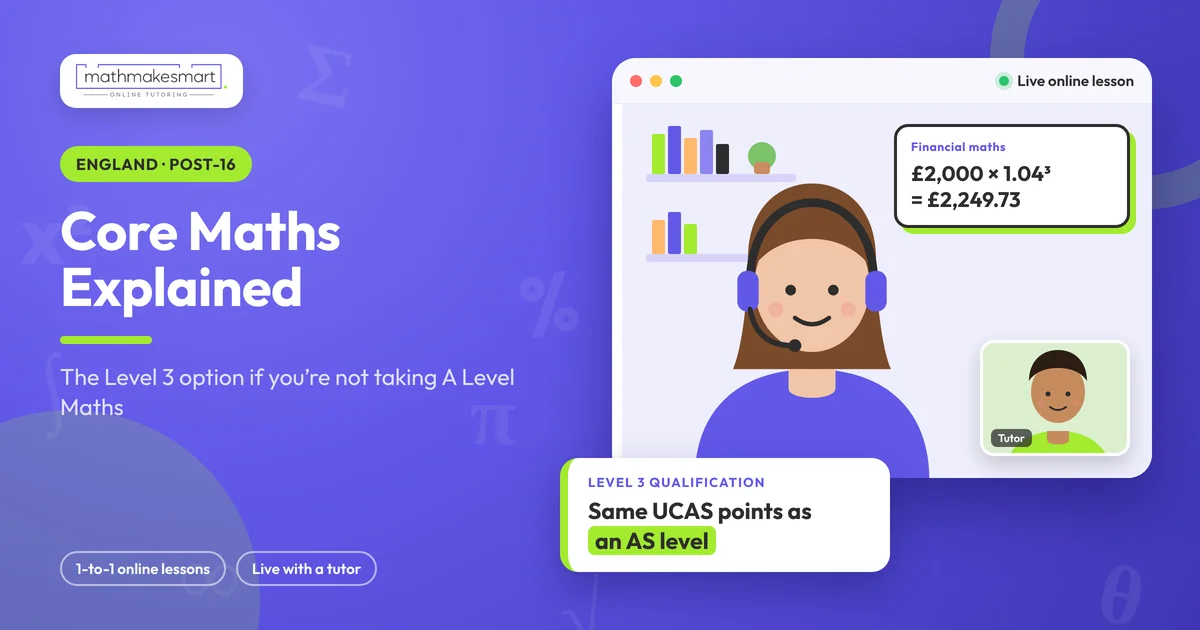
Quick answer: Core Maths is a Level 3 maths qualification for sixth-form and college students who passed GCSE Maths at grade 4 or above but aren't taking AS or A Level Maths. It's the same size as an AS level and carries the same UCAS tariff points as an AS level. It focuses on using maths in real situations: data, risk and probability, financial maths, estimation and modelling. It's graded A to E.
Who Core Maths is for
The Advanced Mathematics Support Programme (AMSP) says Core Maths is for students who have passed GCSE Mathematics at grade 4 or better and are not taking AS or A Level Maths (AMSP).
That's a big group. Many students take subjects with real maths content (psychology, biology, geography, economics, business, sociology) without taking A Level Maths. Core Maths is designed to support exactly those subjects.
The qualifications on offer
AMSP lists four Level 3 Core Maths certificates (AMSP):
AQA Level 3 Certificate in Mathematical Studies
Pearson Edexcel Level 3 Certificate in Mathematics in Context
OCR Level 3 Certificate in Core Maths A (MEI)
OCR Level 3 Certificate in Core Maths B (MEI)
Schools choose the board, so check which one your sixth form or college offers.
Size and UCAS points
Size: equal to an AS level, graded A–E (AMSP).
UCAS points: the same as an AS level (AMSP), which the NCETM describes as "around 40% of the UCAS points of an A level" (NCETM).
Teaching time: the NCETM says it's "expected to be taught in half the time" of an A level.
Universities differ in how they use Core Maths. Some mention it in entry requirements or offers; many simply count it as an extra Level 3. Check each course you're interested in.
What's taught
All Core Maths qualifications include (AMSP):
interpreting solutions in the context of the problem
sources of error and bias
working with data
risk and probability
variation in statistics
exponential functions for growth and decay
Most also cover percentage change, interpreting graphs, financial maths, standard units, Fermi estimation, the Normal distribution, correlation versus causation, and making and evaluating modelling assumptions.
Example: financial maths
£2,000 is saved at 4% compound interest per year. How much is there after 3 years?
2,000 × 1.04³ = 2,000 × 1.124864 = £2,249.73.
A Core Maths question usually goes further: how does this compare with a 5% account that charges a £50 fee? (2,000 × 1.05³ − 50 = £2,265.25, so the 5% account still wins over three years.)
Example: Fermi estimation
Roughly how many hours of video do the students in a 1,000-pupil school watch in a week?
Assume about 2 hours a day, every day: 1,000 × 2 × 7 ≈ 14,000 hours.
The answer isn't the point. Core Maths rewards stating assumptions clearly and judging whether the estimate is sensible.
Core Maths vs A Level Maths
Level: both are Level 3
Size: Core Maths is the same size as an AS level; A Level Maths is a full A level
Content: Core Maths is applied (data, finance, risk, estimation, modelling); A Level Maths covers pure maths, statistics and mechanics
New content: Core Maths has "considerably less" than A level (NCETM)
Best for: Core Maths suits students using maths in other subjects; A Level Maths suits students heading for maths-heavy degrees
You can't usually take both, because Core Maths is designed for students who aren't taking AS or A Level Maths. For the full A level picture, see our A Level Maths guide.
Is Core Maths worth it?
It's often worth considering if:
you got a grade 4 or above at GCSE and want to keep your maths sharp
your A levels include psychology, biology, geography, economics or business, which all use data and statistics
you'd like extra UCAS points without the workload of a full A level
It may be less useful if your timetable is already full, or if a course you're aiming for needs A Level Maths specifically, because Core Maths won't replace it.
This is MMS editorial guidance.
Common mistakes
Assuming Core Maths replaces A Level Maths. It doesn't. Courses that require A Level Maths still need it.
Treating it as GCSE again. It's Level 3, with new applied content.
Skipping the reasoning. Marks often depend on explaining assumptions and interpreting answers in context.
Not checking the exam board. Content and assessment differ between AQA, Pearson and OCR.
When extra support might help
Support is worth considering when GCSE gaps (percentages, algebra, graphs) are slowing progress, when a student finds open-ended problems hard to start, or when a student wants to strengthen statistics for their other subjects.
A tutor can't guarantee a grade, but can rebuild GCSE foundations and practise applied problems. Math Make Smart offers online maths tutoring in the UK and A Level support, and you can book a free trial lesson. Still at GCSE? Our Level 2 Further Maths guide covers another option for strong students.
Frequently asked questions
What grade do I need to take Core Maths?
A pass at GCSE Maths, grade 4 or above.
How many UCAS points is Core Maths worth?
The same as an AS level.
Can I take Core Maths and A Level Maths together?
Usually not. It's designed for students who aren't taking AS or A Level Maths.
How is Core Maths graded?
A to E.