QCE Mathematical Methods: How It's Assessed Under the 2025 Syllabus
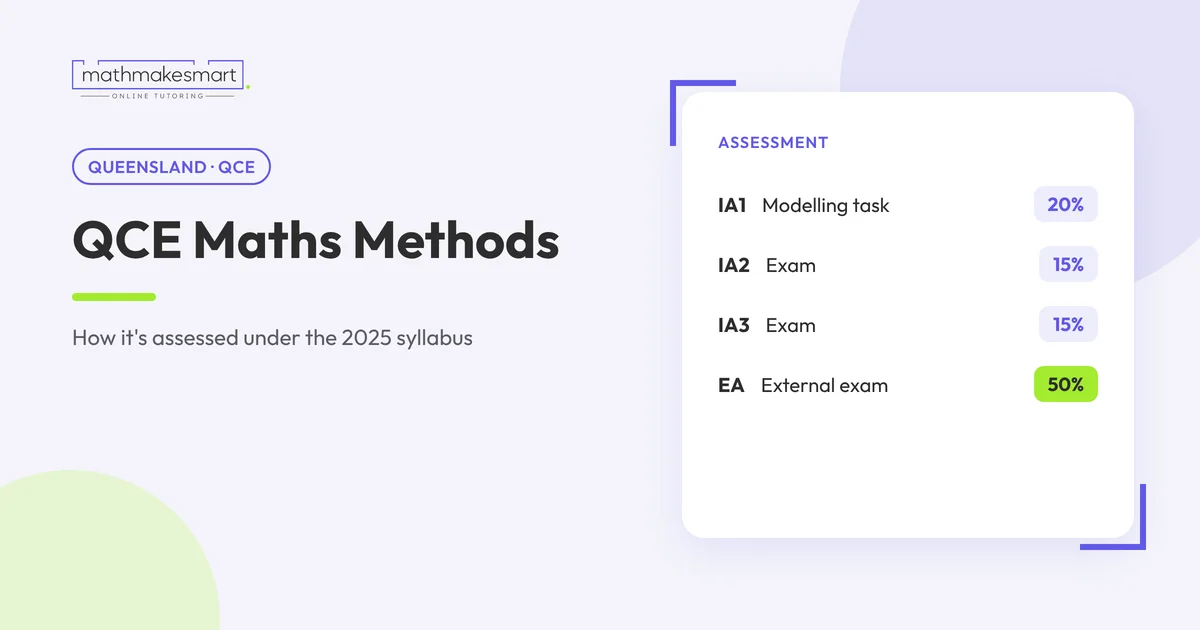
Quick answer: In Queensland, QCE Mathematical Methods is assessed through four pieces in Units 3 and 4: a problem-solving and modelling task (IA1, 20%), two internal exams (IA2 and IA3, 15% each), and an external exam set and marked by the QCAA (50%). The external exam has two papers: Paper 1 is technology-free and Paper 2 allows an approved graphics or scientific calculator. A new syllabus (2025 v1.0) began in 2025.
How results are calculated
For General subjects in the QCE, internal and external results are added to give a mark out of 100. In most subjects, internal assessment is worth 75%, but in mathematics and science subjects the external exam is worth 50% (QCAA — Calculating results).
For Methods, that breaks down as (QCAA — Mathematical Methods 2025 syllabus):
IA1: problem-solving and modelling task (PSMT), 20%
IA2: examination, short response, 15%
IA3: examination, short response, 15%
EA: external examination, combination response, 50%
The internal results are added together and aren't changed by the external result (QCAA).
The external exam: two papers
The external exam is developed and marked by the QCAA and has two papers, each with 5 minutes perusal and 90 minutes working time (QCAA syllabus):
Paper 1 (25%): technology-free, with the QCAA formula book only; short response, including multiple choice
Paper 2 (25%): technology-active, with an approved graphics calculator (no CAS) or scientific calculator; short response, including multiple choice
Because each paper is a quarter of the final result, students can't rely on the calculator. They need algebra and calculus fluent enough to do by hand.
A technology-free example
Differentiate y = x²e^x.
Product rule: dy/dx = 2x·e^x + x²·e^x = e^x(x² + 2x).
A technology-active example
A continuous random variable X is normally distributed with mean 50 and standard deviation 5. Find P(X < 55).
z = (55 − 50) ÷ 5 = 1, so P(X < 55) = P(Z < 1) ≈ 0.841. A graphics calculator gives this directly from the normal distribution function.
The problem-solving and modelling task (IA1)
The PSMT is worth 20%. Students get 3 hours of class time plus time out of class, and the response is up to 10 A4 pages or 2000 words (QCAA syllabus).
It rewards a full modelling process: understanding the problem, making assumptions, building and solving a model, then evaluating whether the answer makes sense and what its limits are. Students who stop at the calculation tend to miss the evaluation marks.
A practical approach:
Restate the problem in your own words and list your assumptions.
Build the simplest model that could work, then refine it.
Check your solution against the real context.
Write the evaluation as you go, not at the end.
The internal exams (IA2 and IA3)
Each is a supervised short-response exam worth 15%, with 5 minutes perusal and 90 minutes working time (QCAA syllabus). Schools set these, so the topics follow the unit being taught. Ask your school for the assessment calendar.
What the 2025 syllabus covers
The 2025 v1.0 syllabus has four units (QCAA):
Unit 1, Surds, algebra, functions and probability: quadratics, binomial expansion, cubics, functions, trigonometric functions, probability
Unit 2, Calculus and further functions: exponentials, logarithms, introduction to differentiation and its applications
Unit 3, Further calculus and introduction to statistics: differentiating exponential, log and trig functions; integration; discrete random variables
Unit 4, Further calculus, trigonometry and statistics: further integration, sine and cosine rules, the normal distribution, sampling and interval estimates
Version 1.0 was released in January 2024 for planning, with implementation starting in 2025. Older past papers were written for the previous syllabus, so check which topics still apply before using them.
Common mistakes
Over-relying on the calculator. Paper 1 is technology-free and worth 25%.
Treating the PSMT like a test. The evaluation and justification carry real marks.
Using old past papers without checking. The syllabus changed in 2025.
Leaving Unit 1 and 2 skills behind. Units 3 and 4 build directly on them.
When extra support might help
Support is worth considering when calculus or probability isn't sticking in Units 1 and 2, when a student struggles to write up the PSMT clearly, or when technology-free accuracy is costing marks.
A tutor can't guarantee a result, but can build by-hand fluency and help practise both paper types. Math Make Smart offers QCE tutoring, and you can book a free trial lesson. For other states, see our guides to VCE maths and HSC maths.
Frequently asked questions
How much is the QCE Methods external exam worth?
50% of the subject result.
Can I use a calculator in the external exam?
Not in Paper 1. In Paper 2, an approved graphics calculator (no CAS) or a scientific calculator is allowed.
What's the PSMT?
The problem-solving and modelling task, IA1, worth 20%.
When did the new syllabus start?
Implementation began in 2025.