VCE Maths Explained: General vs Methods vs Specialist
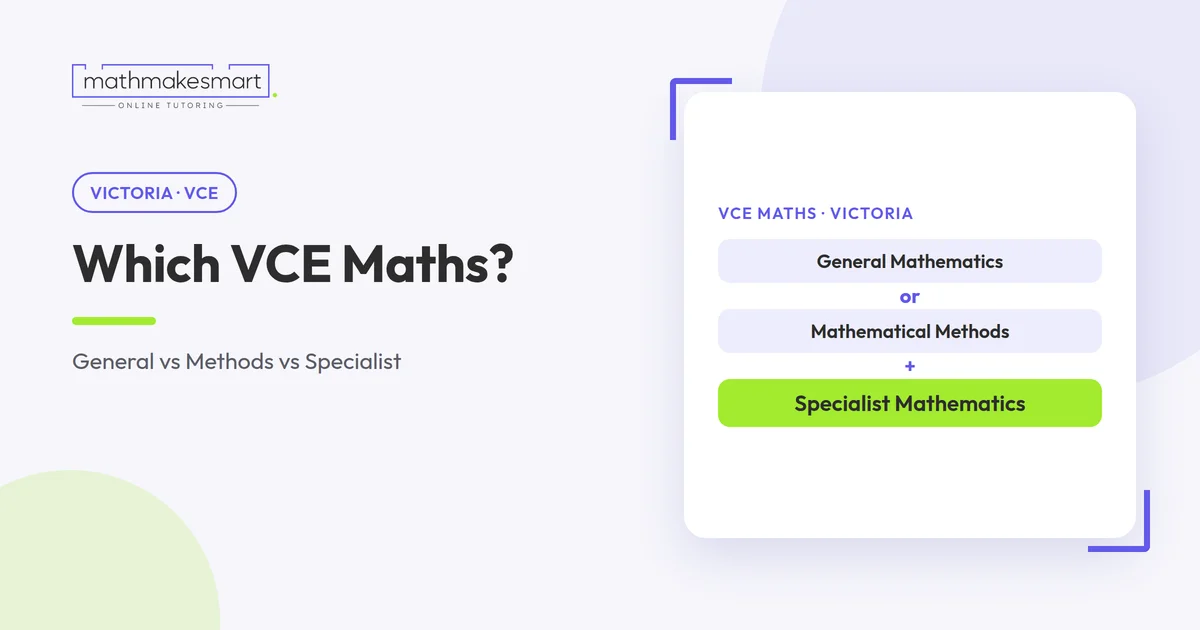
Quick answer: In Victoria's VCE, the main senior maths options are General Mathematics, Mathematical Methods and Specialist Mathematics (Foundation Mathematics is also offered). General Maths focuses on practical topics such as data, finance, networks and matrices. Methods is the calculus-based course most science, engineering and commerce degrees look for. Specialist goes further and is usually taken alongside Methods, because Methods Units 3 and 4 contain assumed knowledge for Specialist Units 3 and 4. The right mix depends on Year 10 results, enjoyment of algebra, and the prerequisites of courses you might apply for.
The courses at a glance
This guide covers Victoria only. New South Wales has a different set of courses, which we cover in our HSC maths guide.
Foundation Mathematics: everyday and workplace maths, for students who want a practical course without heavy algebra.
General Mathematics: data analysis, recursion and finance, matrices and networks, for students who want a solid, applied maths result.
Mathematical Methods: functions, calculus and probability, for students who need calculus for future study.
Specialist Mathematics: proof, complex numbers, vectors, further calculus, mechanics and statistics, for students who are strong in Methods and enjoy harder maths.
The current VCE Mathematics study designs have been accredited for Units 1 to 4 from 2023 (VCAA).
Methods and Specialist: how they fit together
Most students who take Specialist Units 3 and 4 also take Methods Units 3 and 4 at the same time. The VCAA describes Methods 3 and 4 as containing assumed knowledge for Specialist 3 and 4, and notes it is expedient to assume and use results and techniques from Methods (VCAA — Specialist planning).
In practice, that means:
Specialist without Methods is very unusual and very hard.
A student who is struggling in Methods should be cautious about adding Specialist.
Can you take General and Methods together?
Yes, some students do, especially if they want two maths subjects without the workload of Specialist. Check your school's timetable and advice, as schools organise these combinations differently.
How Specialist Maths is assessed
The Specialist Units 3 and 4 study score is built from school-assessed coursework and two end-of-year exams (VCAA — Specialist assessment; VCAA exam specifications):
Unit 3 School-assessed Coursework: 20%
Unit 4 School-assessed Coursework: 20%
Examination 1 (20%): 15 minutes reading and 1 hour writing; 40 marks; no technology; formula sheet provided
Examination 2 (40%): 15 minutes reading and 2 hours writing; 80 marks; approved CAS technology plus a scientific calculator; one bound reference; 20 multiple-choice questions plus 60 marks of short and extended answers
Methods follows a similar two-exam pattern: a shorter technology-free exam and a longer exam where CAS technology and a bound reference are allowed. Check the current VCAA Methods examination specifications for exact details.
Why the two exams need different preparation
Examination 1 is technology-free, so algebra fluency matters most. Students need to differentiate, integrate and manipulate expressions accurately by hand.
Examination 2 allows CAS, so the challenge shifts to knowing what to ask the calculator and interpreting the output. Students who practise only by hand often run out of time in Exam 2; students who rely on CAS for everything struggle in Exam 1.
A technology-free example
Question: Differentiate y = x³ − 4x² + 7 and find the gradient at x = 2.
dy/dx = 3x² − 8x
At x = 2: 3(4) − 8(2) = 12 − 16 = −4
This is the kind of quick, accurate working an Examination 1 paper expects without a calculator.
Choosing your VCE maths: a decision framework
Finds Year 10 algebra hard and wants a practical subject: consider General (or Foundation).
Is solid in Year 10 algebra and needs calculus for future study: consider Methods (often with General as a second maths).
Is strong in Methods-style work and enjoys challenge: consider Methods + Specialist.
Is aiming for engineering, physics or mathematics at university: check prerequisites; many expect Methods, and some recommend Specialist.
Three checks before deciding:
University prerequisites. Look up the actual courses you're considering on VTAC and university sites. Many list Methods as a prerequisite; some list Specialist as recommended.
Year 10 results in algebra and functions. These are the best predictor of how Methods will feel.
The whole subject load. Two demanding maths subjects plus several heavy sciences is a lot.
A note on scaling
ATAR scaling often comes up in VCE maths discussions. Scaling is real, but choosing a course only because it may scale well is risky. A strong result in a course a student can manage usually helps more than a weak result in a harder one. Our ATAR guide explains how scaling works.
Common mistakes
Taking Specialist without being secure in Methods. The courses build on each other.
Practising only with CAS. Examination 1 doesn't allow technology.
Ignoring the bound reference. Exam 2 allows one. Building a well-organised reference through the year is part of preparation, not a last-week job.
Choosing on scaling alone. Pick the course that fits the student's strengths and goals.
When extra support might help
Support is worth considering when a student is between two options in Year 10, when Methods algebra or calculus isn't sticking in Year 11, or when a Specialist student wants help with proof and harder problems.
A tutor can't guarantee a study score or ATAR, but can work on specific gaps and help a student practise both technology-free and CAS-active questions. Math Make Smart offers VCE tutoring online, and you can book a free trial lesson to see if it's a good fit.
Frequently asked questions
Do I need Methods to do Specialist?
Methods Units 3 and 4 contain assumed knowledge for Specialist Units 3 and 4, and most Specialist students take both. Check your school's rules.
Is a calculator allowed in VCE Specialist exams?
Not in Examination 1. In Examination 2, approved CAS technology and a scientific calculator are allowed.
How much is school-assessed coursework worth in Specialist?
20% for Unit 3 and 20% for Unit 4.
Is General Maths a "bad" choice?
No. It's the right course for many students and counts toward the ATAR like any other study.