The Enhanced ACT Math Section: What Changed and How to Prepare
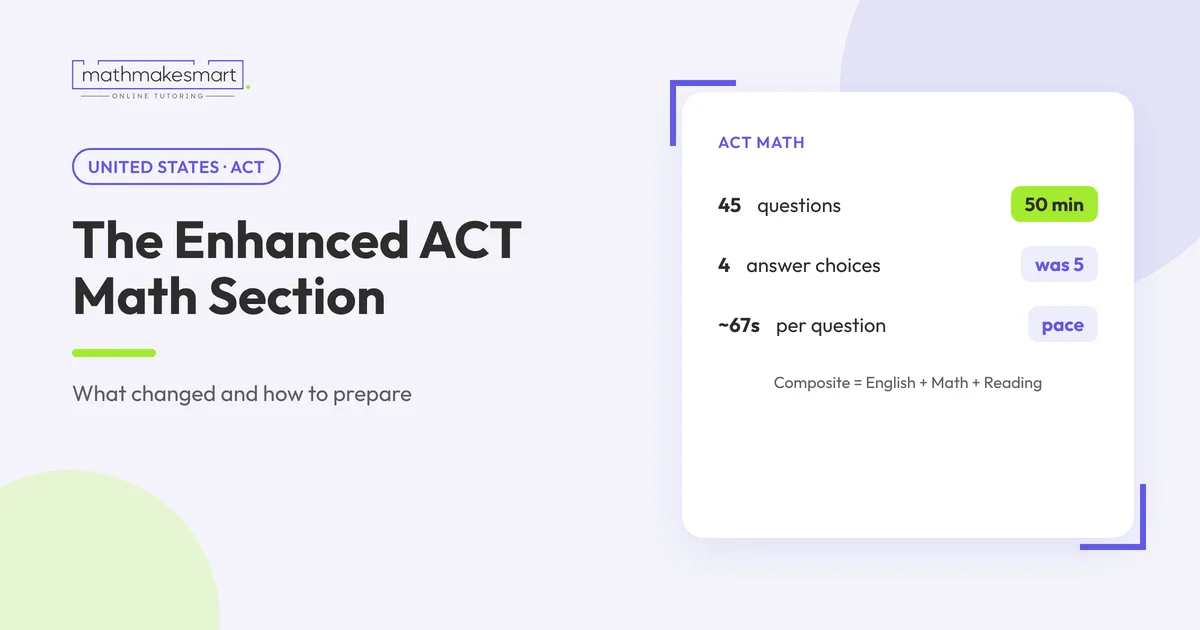
Quick answer: On the enhanced ACT, the Math section has 45 questions in 50 minutes, and each question now has four answer choices instead of five. A calculator is allowed on Math only. Science is now an optional add-on, and the composite score comes from English, Math and Reading. The whole test is about 75 minutes shorter than the older version, with 44 fewer questions. That gives you roughly 67 seconds per math question, more than the older format allowed.
What changed in the enhanced ACT
ACT describes the main changes like this (ACT — The Enhanced ACT Explained; ACT test overview):
Math: 45 questions, 50 minutes
Answer choices: 4 per question (previously 5)
English: 50 questions, 35 minutes
Reading: 36 questions, 40 minutes
Science: Optional add-on, 40 questions, 40 minutes
Writing: Optional add-on
Composite: English, Math and Reading
Overall: About 75 minutes shorter, 44 fewer questions
Students who take Science also receive a separate science score and a STEM score. The enhanced test is available for national test dates, with state, district and international testing moving to it from spring 2026 (ACT).
What this means for Math
More time per question
50 minutes for 45 questions is 3,000 seconds ÷ 45 ≈ 67 seconds per question. That's still quick, but it's a real step up from the older format. The extra time rewards students who check their work rather than rush.
Four choices instead of five
With one fewer wrong option, eliminating two choices leaves a 50/50. Elimination is now a stronger tactic. If you can rule out answers that are the wrong sign, the wrong size or the wrong units, you often don't need to finish the whole calculation.
The composite no longer needs Science
Because Science is optional and doesn't count toward the composite, Math now carries a third of the composite. A one-point gain in Math moves the composite more than it did when there were four scored sections. Check whether the colleges you're applying to want the Science score before deciding to skip it.
A pacing plan for 50 minutes
Questions on the ACT Math section tend to get harder as you go, so time shouldn't be spread evenly.
Questions 1–15: About 10 minutes
Questions 16–30: About 15 minutes
Questions 31–45: About 20 minutes
Review: About 5 minutes
This is our suggested split, not an ACT rule. Adjust it after your first timed practice test.
The important point is to bank time early. Students who spend a minute and a half on question 8 often run out before the harder questions at the end.
Two worked examples
Example 1: elimination with four choices
If 4x − 7 = 21, what is the value of x?
A) 3.5 B) 7 C) 14 D) 28
Add 7 to both sides: 4x = 28. Divide by 4: x = 7 (B).
A quick check: 4 × 7 − 7 = 28 − 7 = 21 ✓. Choice D (28) is the value of 4x, a common trap, so always re-read what the question asks for.
Example 2: estimating to save time
A jacket costs $64 and is discounted by 15%. What is the sale price?
A) $49.00 B) $54.40 C) $56.00 D) $60.40
15% of 64 is 9.6, so the sale price is 64 − 9.6 = $54.40 (B).
You can also estimate: 15% of $64 is a bit under $10, so the answer is a bit over $54. Only B fits. That's the kind of check that takes seconds.
Using a calculator on ACT Math
A permitted calculator can be used on the Math test only (ACT). Check ACT's calculator policy before test day, because some models aren't allowed. Practise with the calculator you'll bring, and don't use it for arithmetic you can do faster in your head.
A five-week preparation plan
Week 1: Take a full timed official practice test. Sort every missed math question by topic.
Week 2: Algebra: linear equations, inequalities, systems and functions.
Week 3: Geometry and trigonometry: area, angles, right-triangle trig, coordinate geometry.
Week 4: Statistics, probability and number: percentages, ratios, averages and simple probability.
Week 5: Two timed Math sections using the pacing plan, then a second full test.
The most useful habit is reviewing why you missed a question: a content gap, a careless error or running out of time each needs a different fix.
Common mistakes on ACT Math
Spending too long early. The harder questions are at the end, so save time for them.
Answering the wrong quantity. Many traps give the value of an intermediate step.
Not using elimination. With four choices, ruling out two often settles it.
Skipping official practice. ACT's own practice tests are the closest match to the real format.
When extra help makes sense
Support is most useful when a student's Math score has stalled across practice tests, when timing is the main problem, or when a gap in Algebra 2 or trigonometry keeps costing points.
A tutor can't guarantee a score, but can target weak topics and help with pacing. Math Make Smart offers online ACT prep, and you can book a free trial lesson. If you're still choosing between tests, start with our SAT vs ACT comparison, or see how the other test works in our digital SAT Math guide.
Frequently asked questions
How many questions are on the enhanced ACT Math section?
45, in 50 minutes.
How many answer choices do ACT math questions have now?
Four.
Is ACT Science still required?
No. It's an optional add-on and doesn't count toward the composite.
Can I use a calculator?
Yes, on the Math test only, as long as it's permitted under ACT's calculator policy.