Finding the Area of a Triangle (3 Methods)
How to Find the Area of a Triangle
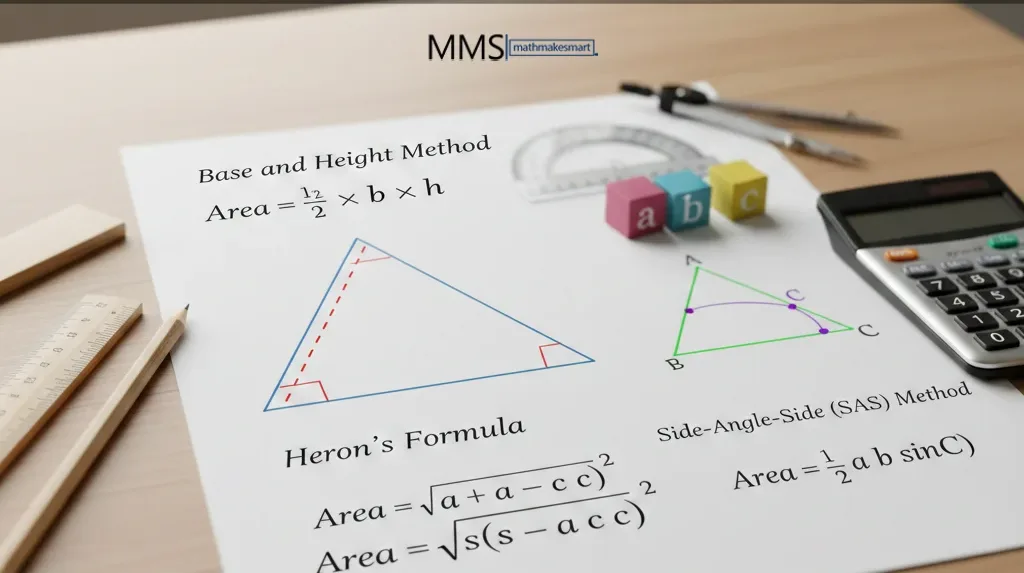
Let’s look at the types of triangles and the methods for finding the area of a triangle. First we cover the types of triangles by sides and by angles, then we show the three most common ways to find the area, each with a worked example. The math tutors at Math Make Smart teach these problems every day, and our tutoring services are highly rated by parents on Trustpilot.
Types of Triangles
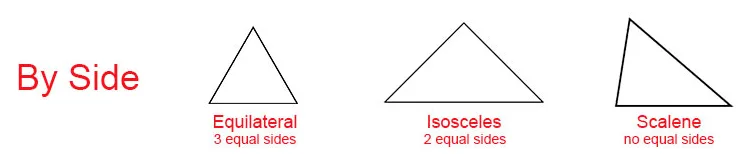
By Sides
- Equilateral – all 3 sides equal
- Isosceles – 2 sides equal
- Scalene – all sides different
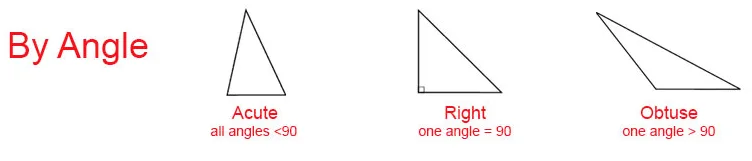
By Angles
- Acute – all angles < 90°
- Right – one angle = 90°
- Obtuse – one angle > 90°
Method 1: Base × Height (Most Common)
Formula: A = ½ × base × height
The height must be perpendicular to the base.
Example: Triangle with base = 10 cm, height = 6 cm
- A = ½ × 10 × 6
- A = 30 cm²
Method 2: Heron’s Formula (Using 3 Sides)
Use Heron’s formula when you know all three side lengths but not the height.
Formula: A = √[s(s-a)(s-b)(s-c)]
Where:
- a, b, c = lengths of the three sides
- s = semi-perimeter = (a+b+c)/2
Example: Triangle with sides 5 cm, 6 cm, 7 cm
- s = (5+6+7)/2 = 9
- A = √[9(9-5)(9-6)(9-7)]
- A = √[9 × 4 × 3 × 2]
- A = √216
- A ≈ 14.70 cm²
Method 3: Two Sides and the Included Angle
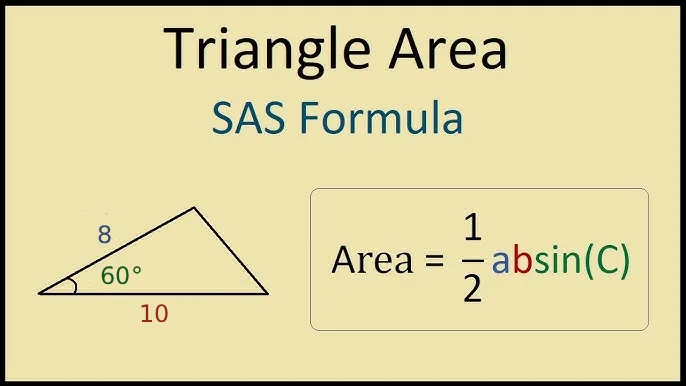
Formula: A = ½ × a × b × sin(C)
Where a and b are two sides, C is the angle between them.
Example: Triangle with sides 8 cm, 10 cm, angle between them = 60°
- A = ½ × 8 × 10 × sin(60°)
- A = ½ × 8 × 10 × 0.866
- A ≈ 34.64 cm²
Which Method Should You Use?
| You know | Use |
|---|---|
| Base and perpendicular height | A = ½ × b × h |
| All three sides | Heron’s formula |
| Two sides and the angle between them | A = ½ab sin C |
Keep practising with our guides to the area of a square, the area of a circle and the area of the shaded region. Need more help? Book a free trial lesson with one of our math tutors.
Conclusion
There are three main ways to find the area of a triangle, and the right one depends on what you're given. Use ½ × base × height when you know the perpendicular height. Use Heron's formula when you only know the three sides. Use ½ab sin C when you know two sides and the angle between them.
Check which measurements the question gives you before you start, and always give your answer in square units. With a bit of practice, picking the right method becomes second nature.
Frequently Asked Questions
What is the basic formula for the area of a triangle?
Area = ½ × base × height, where the height is the perpendicular distance from the base to the opposite vertex. A triangle with a base of 8 cm and a height of 5 cm has an area of 20 cm².
When should I use Heron's formula?
Use Heron's formula when you know all three side lengths but not the height. First find s, half the perimeter, then use Area = √[s(s − a)(s − b)(s − c)].
How do you find the area with two sides and an angle?
Use Area = ½ab sin C, where a and b are two sides and C is the angle between them. This method is common in GCSE Higher and other secondary maths courses.
Does the area formula work for all types of triangles?
Yes. The ½ × base × height formula works for every triangle, including right-angled, isosceles, equilateral and scalene triangles, as long as you use the perpendicular height.
How do you find the height of an obtuse triangle?
For an obtuse triangle, the perpendicular height may fall outside the triangle. Extend the base line and draw the height from the opposite vertex to meet that extended line at a right angle.