PSAT/NMSQT Scores Explained: The Selection Index and National Merit
Quick answer: The PSAT/NMSQT is scored from 320 to 1520. National Merit doesn't use that total. It uses the Selection Index: double your Reading and Writing score, add your Math score, and divide by 10. The highest possible index is 228. Only the test taken in junior year counts for the National Merit Scholarship Program. Semifinalist cutoffs are set state by state and usually land between about 208 and 220.
If your child has just received a PSAT score report and you're trying to work out what it means, or you're planning ahead for an eleventh grader, this guide covers the number that matters most and the one most families overlook.
What the PSAT/NMSQT actually is
The PSAT/NMSQT is the College Board's preliminary SAT. Schools give it in the fall, and it does two jobs. It's a practice run for the SAT, and it's the qualifying test for the National Merit Scholarship Program, which is run by the National Merit Scholarship Corporation (NMSC).
The test is digital and has two sections. According to the College Board's test structure page, Reading and Writing takes 64 minutes for 54 questions, and Math takes 70 minutes for 44 questions. That's 2 hours 14 minutes and 98 questions in total. Most questions are multiple choice. Some math questions ask students to type their own answer.
Each section is scored from 160 to 760, so the total runs from 320 to 1520 (College Board score structure). The top of the PSAT scale sits below the SAT's 1600 on purpose, because the PSAT is pitched at slightly younger students.
How the Selection Index is calculated
This is the part most score reports don't make obvious. National Merit ignores the 1520-point total. It uses a separate number:
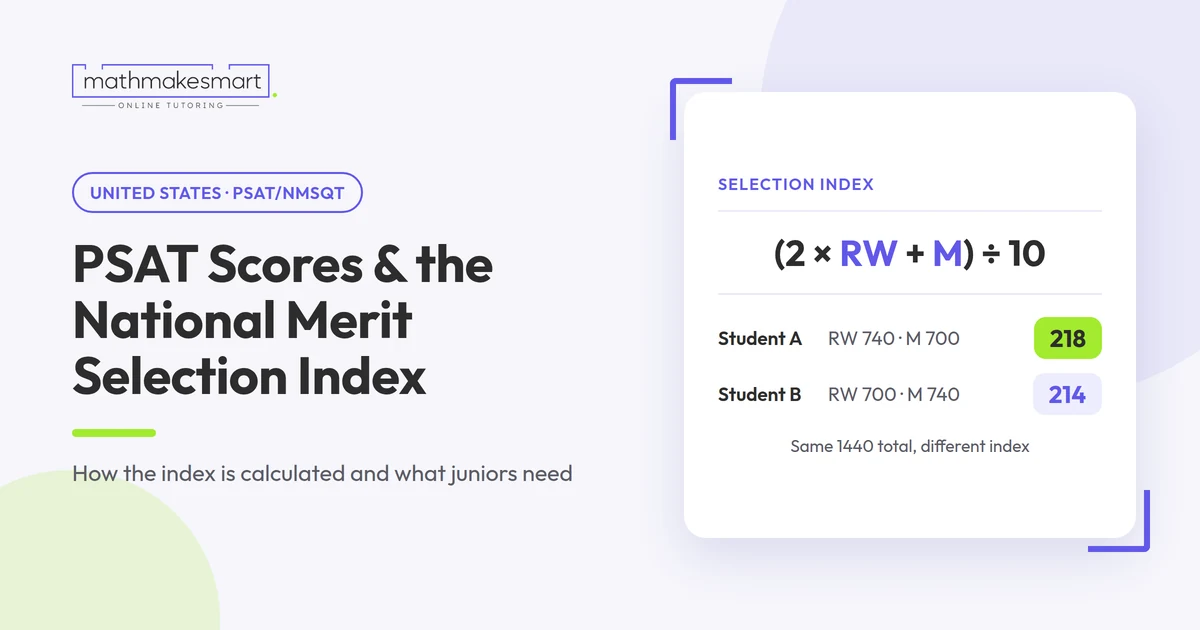
Selection Index = (2 × Reading and Writing + Math) ÷ 10
A student with 760 in both sections reaches the maximum of (1520 + 760) ÷ 10 = 228.
Why the same total can produce different indexes
Reading and Writing count twice, so two students with identical totals can land several points apart. This matters a lot near a state cutoff.
Student A: Reading & Writing: 740; Math: 700; Total: 1440; Selection Index: (1480 + 700) ÷ 10 = 218
Student B: Reading & Writing: 700; Math: 740; Total: 1440; Selection Index: (1400 + 740) ÷ 10 = 214
Both students scored 1440. In a state with a 216 cutoff, Student A becomes a Semifinalist, and Student B doesn't.
The practical lesson: a student who is already strong in math usually gets more Selection Index points per hour of study from Reading and Writing. Every 10 points on Reading and Writing adds 2 to the index. Every 10 points on Math adds 1.
Who is eligible for National Merit
Generally, a student enters the National Merit program by taking the PSAT/NMSQT in the fall of their third year of high school (junior year) and meeting the program's entry requirements. Students answer entrance questions on test day. If the score report shows an asterisk next to the Selection Index, those answers have made the student ineligible for that year's program (Compass Education Group).
That means a 9th or 10th grader's PSAT score, however good, isn't a National Merit result. It's a preview.
How the cutoffs work
NMSC doesn't use one national passing score. It sets two kinds of thresholds.
Commended Students use a single national cutoff. For the class of 2027, it was a Selection Index of 208, down from 210 for the class of 2026 (Compass Education Group). Commended Students are recognized, but they don't go on to compete for National Merit Scholarships.
Semifinalists are chosen state by state. Each state's cutoff reflects how many Semifinalists that state is allocated and how its students scored, so the line moves every year. NMSC describes Semifinalists as fewer than one percent of each state's high school seniors, with roughly 16,000 named nationally (NMSC program leaflet).
Here are recent Semifinalist cutoffs for a few states:
California: Class of 2026: 224; Class of 2027: 220
New York: Class of 2026: 223; Class of 2027: 220
Texas: Class of 2026: 222; Class of 2027: 219
Florida: Class of 2026: 219; Class of 2027: 216
Wyoming: Class of 2026: 210; Class of 2027: 208
Source: Compass Education Group, compiled from NMSC releases. The class of 2027 cutoffs were released in September 2026.
Two things stand out. First, a score that qualifies easily in one state can miss in another. Second, cutoffs moved down by three or four points between these two years in several large states. Nobody can tell you next year's cutoff in advance. Any figure you see for a future class is a projection, not a published number.
Semifinalist is not the finish line
Becoming a Semifinalist starts an application. Semifinalists then complete a scholarship application that typically includes academic records, an essay, a school recommendation, and an SAT or ACT score that confirms the PSAT performance. NMSC's materials describe about 15,000 Semifinalists advancing to Finalist, and a smaller number receiving Merit Scholarship awards. These include single-payment National Merit $2,500 Scholarships, corporate-sponsored awards, and college-sponsored awards (NMSC program leaflet). Exact award numbers change each year, so check the current figures on the NMSC website.
For many families, the biggest financial benefit isn't the $2,500. It's the merit aid that some colleges offer National Merit Finalists. That varies a great deal between colleges and changes from year to year, so check each college you're considering directly.
What counts as a "good" PSAT score?
It depends on what your child wants the score to do.
As SAT practice: A good score is one that shows clear, fixable patterns. A student scoring 1150 with most lost points in one or two question types is in a better position than the number suggests.
For National Merit: Only the junior-year Selection Index compared with your state's cutoff counts. Use the most recent cutoff for your state as a rough guide and treat it as a moving target.
For recognition only: Students who reach the national Commended cutoff often find it worth mentioning on applications even without Semifinalist status.
A grade-by-grade plan
9th and 10th grade: use the test as a diagnosis
Some schools give the PSAT/NMSQT or the PSAT 10 to younger students. Don't treat that score as a verdict. Look at which skills cost points. In math, early gaps often come from algebra fluency: rearranging equations, working with linear functions, and handling fractions without a calculator. In Reading and Writing, punctuation boundaries and evidence-based questions are common weak spots. These are curriculum skills, not test tricks, so improving them also helps in class.
The summer before junior year: the window that matters
If your child's Selection Index is within about 10 to 15 points of your state's recent cutoff, the summer before eleventh grade is the most useful time to prepare. Focused work over eight to ten weeks is more effective than cramming in September, when schoolwork, sports, and college visits are all competing for time.
A sensible summer structure looks like this:
Take one full practice test in the College Board's Bluebook app so the timing and on-screen tools feel familiar.
Sort missed questions by skill, not by section. "Lost 6 points on linear equations in context" tells you what to study. "Math was weak" doesn't.
Weight effort toward Reading and Writing if math is already strong, because of the 2× multiplier.
Retest every two to three weeks and track the Selection Index, not just the total.
Junior year: test day and after
After the junior-year PSAT, the result goes to NMSC automatically for eligible students. From then on, the PSAT itself becomes useful as a baseline for SAT preparation. The same skills carry over, and the SAT is often taken later in junior year.
Common mistakes families make
Reading the total instead of the index. A 1400 can be a 210 or a 214 depending on how it's split. Always calculate the index.
Relying on a projected cutoff. Cutoffs moved by several points between the last two classes. Plan to beat a range, not one number.
Treating 10th-grade results as final. A sophomore score is useful information about a student who still has a year of growth ahead.
Over-preparing a student who isn't near the line. If your child is 40 points of Selection Index below the cutoff, National Merit probably isn't a realistic target for this cycle. Preparing for the SAT and for coursework will do more good. That isn't a failure. It's a sensible use of time.
Ignoring the eligibility questions. Make sure your child answers the entrance questions on test day carefully. An asterisk on the score report is hard to fix after the fact.
When extra help is worth it
Outside support makes the most sense when a student is close to a cutoff and needs targeted practice in particular skills, or when PSAT results reveal gaps in algebra or grammar that are also hurting their grades. A tutor can help turn a score report into a study plan and keep weekly practice on track. No tutor can guarantee a Semifinalist result, because the cutoff isn't known until after the test.
If you'd like help reading your child's PSAT report or planning the months before junior year, Math Make Smart offers one-to-one online PSAT preparation with US tutors. Students can work on Reading and Writing, Math or both. You can book a free trial lesson to see whether the approach suits your child before committing.
Frequently asked questions
Does the PSAT score go to colleges?
No. PSAT/NMSQT scores aren't sent to colleges as part of an application. Their main uses are SAT practice and National Merit entry.
Can a sophomore qualify for National Merit?
Generally no. Entry is based on the PSAT/NMSQT taken in the third year of high school. Students on an unusual timeline, such as those graduating early, should check NMSC's entry requirements directly.
Is a 1400 on the PSAT good enough for National Merit?
It depends on how the score is split and which state you live in. A 1400 can give a Selection Index anywhere from 204 (640 Reading and Writing, 760 Math) to 216 (760 Reading and Writing, 640 Math). The middle of that range is around the Commended level, and most of it falls below recent Semifinalist cutoffs in large states.
Should my child take the PSAT if they don't care about National Merit?
Usually yes. It's realistic, timed practice for the SAT, and it shows which skills to work on.