B.C. Graduation Numeracy Assessment: Format, Scores and How to Prepare
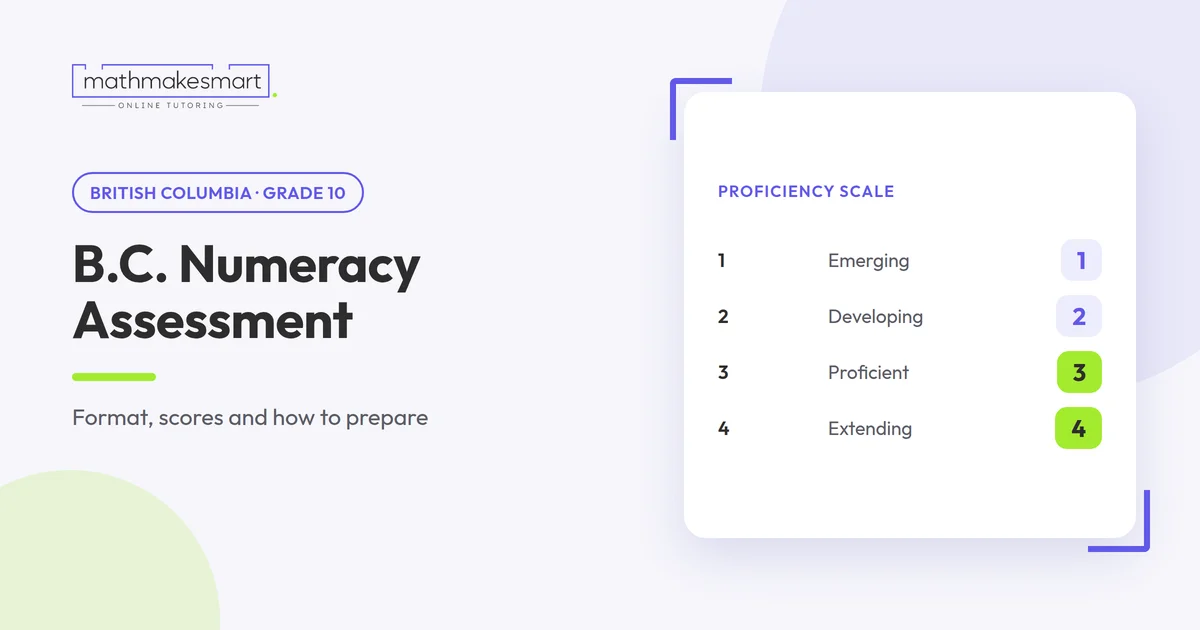
Quick answer: British Columbia's Graduation Numeracy Assessment, also called the Grade 10 Numeracy Assessment, is a graduation requirement that students usually take in Grade 10. It's delivered online in three parts: 24 computer-scored questions, two written-response questions chosen from four and done on paper, and an unscored self-reflection. Results are reported on a four-level scale: Emerging (1), Developing (2), Proficient (3) and Extending (4). Students can retake it to improve their result, and the best result counts.
What the assessment is (and isn't)
The assessment is set by the B.C. Ministry of Education and Child Care and is required for graduation (B.C. curriculum — Grade 10 Numeracy Assessment). It applies only in British Columbia; other provinces have their own requirements.
What surprises many families is that it isn't tied to a particular math course. It measures numeracy, meaning the ability to use math to make sense of real situations and make decisions. A student can be doing well in Foundations of Mathematics and Pre-calculus 10 and still find the assessment unfamiliar, because the questions are built around reading a scenario rather than practising a skill.
The three sections
The assessment is delivered online in three parts (B.C. curriculum; graduation numeracy brochure):
Common section: 24 questions based on four tasks (situations), done online and scored by computer.
Student-choice section: choose 2 of 4 questions and write the responses on paper; marked by B.C. educators using a rubric.
Self-reflection: short reflection questions online; not scored.
The brochure says the assessment typically takes two hours, and students may have an extra hour if they need it.
Why the written responses matter
The two written-response questions are where students most often under-perform. They're marked with a rubric, so a correct final number on its own isn't enough. Markers want to see how the student understood the situation, the method they chose, the calculations, and a clear conclusion.
The proficiency scale
Results are reported as a number from 1 to 4 (graduation numeracy brochure):
1: Emerging
2: Developing
3: Proficient
4: Extending
Students access their results and a personalized performance report through the StudentTranscripts Service.
Can students retake it?
Yes. Students can retake the assessment to improve their proficiency score, and their best result is the one that counts (brochure). Schools set the sessions, so ask the school when the next one runs.
A worked written-response example
Here's an original practice question in the style of a numeracy task. It isn't an official item.
Situation: Maya wants to buy a bike that costs $480, tax included. She has $95 saved and earns $35 a week from a part-time job. She also wants to keep $40 for a school trip. How many weeks will it take her to afford the bike?
A strong response:
Understand the goal. Maya needs $480 for the bike, and she wants $40 left over. So she needs $520 in total.
Work out what she still needs. $520 − $95 = $425.
Divide by her weekly earnings. $425 ÷ $35 ≈ 12.14 weeks.
Interpret the answer. She can't work a fraction of a week, so after 12 weeks she has $95 + (12 × $35) = $95 + $420 = $515, which isn't enough. After 13 weeks she has $95 + $455 = $550.
Conclude. Maya can afford the bike and keep $40 for the trip after 13 weeks.
Two things lift a response like this:
Rounding in context. 12.14 weeks has to become 13, not 12. Rounding down here gives the wrong decision.
Stating assumptions. For example, "assuming the price doesn't change and she spends nothing else."
How to prepare
The Ministry provides pre-assessment activities, including a sample assessment and videos showing how to work through questions (brochure). Start there; they show the real format.
A practical plan for the four weeks before the assessment:
Week 1: Do the official sample assessment. Note which kinds of situations caused trouble.
Week 2: Practise reading long scenarios: underline the question, list the information you need, and cross out what you don't.
Week 3: Practise written responses using the five-step approach above: goal, calculation, interpretation, assumptions, conclusion.
Week 4: A second timed run-through, then review only the errors.
Everyday skills that come up often in numeracy tasks include:
Percentages: discounts, tax and tips.
Rates and unit prices: which size is better value.
Reading graphs and tables.
Estimating to check an answer is reasonable.
Budgeting and planning over time, like the bike example.
Common mistakes
Skipping the reading. Numeracy questions hide the key detail in the scenario. Read twice before calculating.
Leaving answers as bare numbers. "13" scores less than "Maya needs 13 weeks."
Rounding the wrong way. Ask what the number means in real life before rounding.
Treating it as a math test. It's a thinking-and-explaining test that uses math.
When extra help makes sense
Support can help when a student is strong at procedures in class but struggles with word problems, when reading long scenarios is the barrier, or when a student wants to retake to improve a Developing (2) result.
A tutor can't guarantee a proficiency level, but can practise scenario-based questions and help a student explain their reasoning clearly. Math Make Smart offers online math tutoring for Canadian curricula, and you can book a free trial lesson to see if it's a good fit. For other provinces, see our guides to Alberta diploma exams and Ontario's Grade 9 math course.
Frequently asked questions
Is the numeracy assessment required to graduate in B.C.?
Yes. It's a graduation requirement.
When do students take it?
Usually in Grade 10.
Is there a pass mark?
There's no pass or fail. Students must write the assessment to meet B.C. graduation requirements, and results are reported as a proficiency level from 1 to 4 (Richmond School District (McNair Secondary)).
Can you retake it?
Yes. Students can retake it, and the best result counts.