SACE Stage 2 Mathematical Methods: How It's Assessed in South Australia
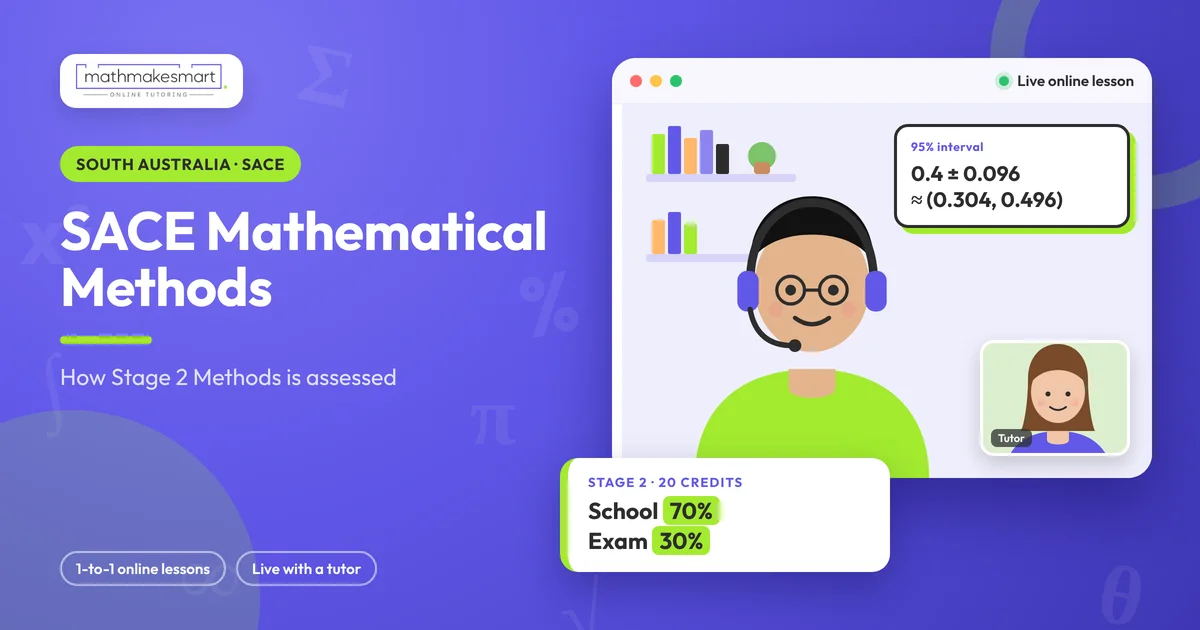
Quick answer: Stage 2 Mathematical Methods is a 20-credit Year 12 SACE subject. It's assessed 70% at school and 30% by an external exam. The school part is made up of skills and applications tasks (50%) and one mathematical investigation (20%). The exam is a 130-minute paper, and students can take in two unfolded A4 sheets of handwritten notes. A C- or better also meets the SACE numeracy requirement.
The assessment at a glance
From the SACE Board and school course pages (SACE — Mathematical Methods; Unley High School):
Skills and applications tasks: school-assessed · 50%
Mathematical investigation: school-assessed · 20%
Examination: external (SACE Board) · 30%
Schools set the exact number of skills and applications tasks. Published course pages show five or six, so check your school's learning and assessment plan.
Skills and applications tasks (50%)
These are tests and tasks done under supervised conditions across the year. They check routine skills and the ability to apply them to less familiar problems. Because they're worth half the subject, steady results all year matter more than one big finish.
The mathematical investigation (20%)
Students explore a mathematical problem, build and test a model, and write it up as a report. It rewards clear communication: stating assumptions, showing the maths, and explaining what the results mean and where the model breaks down.
Tip: treat it like a mini research project. Start early, keep notes on each decision, and leave time for a proper conclusion.
The external exam (30%)
The SACE Board says students sit one 130-minute examination, with a formula sheet provided, and may bring two unfolded A4 sheets (four sides) of handwritten notes (SACE — Stage 2 operational information). Calculator rules are set out in a separate SACE information sheet, so check the current version with your teacher.
What's in Stage 2 Methods
The topics are (Open Access College — Mathematical Methods):
Differential calculus
Further differential calculus
Discrete random variables
Integral calculus
Continuous random variables
Sampling and confidence intervals
Your school's subject outline is the definitive list of topics and subtopics.
A calculus example
Differentiate f(x) = e²ˣ.
Chain rule: f′(x) = 2e²ˣ.
A statistics example
In a sample of 100 students, 40 walk to school. Find an approximate 95% confidence interval for the proportion who walk.
p̂ = 0.4. Standard error = √(0.4 × 0.6 / 100) = √0.0024 ≈ 0.0490.
Margin = 1.96 × 0.0490 ≈ 0.0960.
Interval ≈ (0.304, 0.496), so roughly 30% to 50% of students walk.
Questions like this often ask what would happen to the interval with a larger sample. (It narrows, because the standard error shrinks.)
How to prepare
Bank marks in the skills and applications tasks. They're half the subject.
Plan the investigation early. It's 20%, and rushed write-ups lose easy marks.
Build your two A4 note sheets through the year.
Practise statistics as much as calculus. Half the topics involve random variables and sampling.
Use past SACE exams to get used to the 130-minute format.
Common mistakes
Leaving everything to the exam. It's only 30%.
A thin investigation conclusion. Explain limitations, not just results.
Weak interpretation in statistics. Always say what a confidence interval means in context.
Year 11 gaps. Stage 1 algebra and functions are the foundation for Stage 2.
When extra support might help
Support is worth considering when calculus or statistics isn't clicking, when a student wants help structuring the investigation, or when exam practice is needed.
A tutor can't guarantee a result or ATAR, but can build fluency and practise exam-style questions. Math Make Smart offers SACE, WACE and TCE support and online maths tutoring in Australia, and you can book a free trial lesson. For WA, see our WACE Methods guide; for how results become an ATAR, see our ATAR guide.
Frequently asked questions
How much is the SACE Methods exam worth?
30%. The other 70% is school-assessed.
How long is the exam?
The SACE Board lists one 130-minute exam.
Can I take notes into the exam?
Yes, two unfolded A4 sheets (four sides) of handwritten notes.
Does Methods meet the SACE numeracy requirement?
Yes, with a C- grade or better.