WACE Mathematics Methods ATAR: How It's Assessed in Western Australia
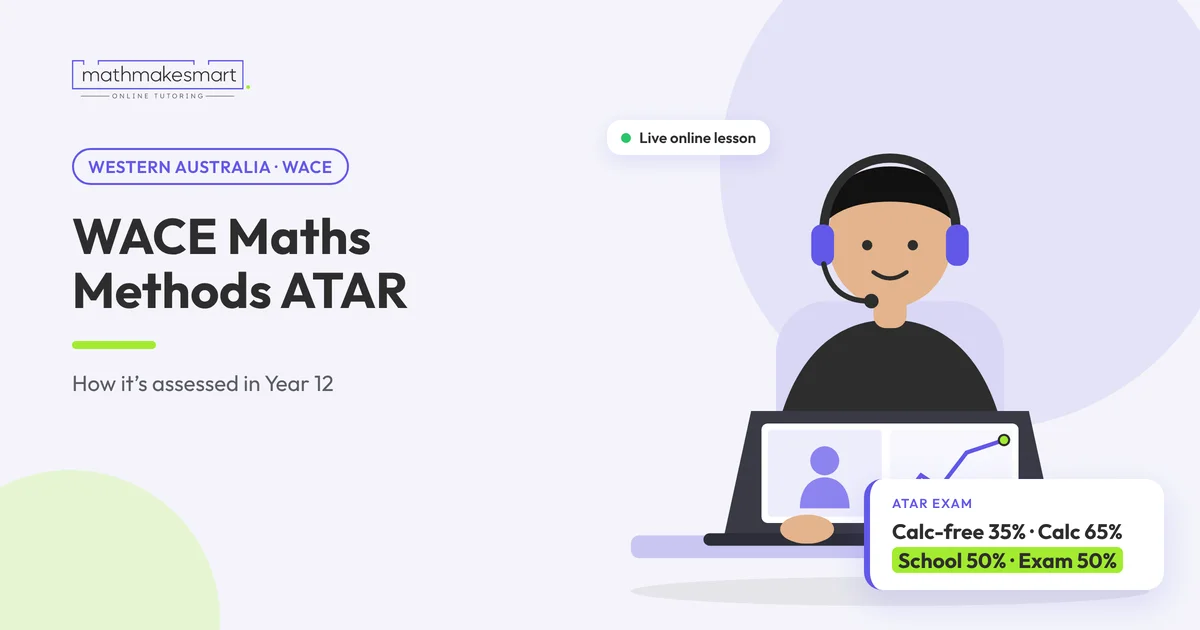
Quick answer: In Western Australia, Year 12 Mathematics Methods ATAR is assessed by the school and by an external ATAR exam. At school, response tasks are worth 40%, investigations 20% and school exams 40%. The external exam has a calculator-free section (35%, 50 minutes) and a calculator-assumed section (65%, 100 minutes), where a CAS calculator and two A4 sheets of notes are allowed. The final combined mark is the average of the exam mark and the moderated school mark.
How the combined mark works
For written ATAR courses, the School Curriculum and Standards Authority (SCSA) combines marks as the average of the ATAR course written exam mark and the moderated school mark (SCSA).
"Moderated" means the school marks are statistically adjusted to the scale of that school's exam results, so schools can be compared fairly. A student's rank order within the school doesn't change (SCSA).
Why that matters: school work counts for half, but how a school's group does in the exam affects how its school marks are scaled. Both halves deserve real effort.
School-based assessment in Year 12
The Year 12 Methods syllabus sets these weightings (SCSA — Methods Year 12 syllabus):
Response (40%): tests and tasks applying knowledge to routine and non-routine questions
Investigation (20%): planning, researching, conducting and communicating a mathematical investigation
Examination (40%): school exams, usually at the end of each semester or unit
The external ATAR exam
The exam has two sections (SCSA syllabus):
Section One, calculator-free (35%): 5–10 questions; 5 minutes reading and 50 minutes working time; no calculator or notes
Section Two, calculator-assumed (65%): 8–13 questions; 10 minutes reading and 100 minutes working time; CAS calculator assumed (up to three calculators); two unfolded A4 sheets of notes
Working or justification is required for any question or part worth more than two marks. Section Two includes questions on unfamiliar situations that ask students to choose and adapt a mathematical model.
A calculator-free example
Find the derivative of y = x²·sin(x).
Product rule: dy/dx = 2x·sin(x) + x²·cos(x).
A calculator-assumed example
The number of defective items in a batch follows a binomial distribution with n = 20 and p = 0.1. Find the probability of exactly 2 defective items.
P(X = 2) = ²⁰C₂ × 0.1² × 0.9¹⁸ = 190 × 0.01 × 0.1501 ≈ 0.285.
A CAS calculator gives this directly, but students still need to recognise the distribution and set up the problem.
What's in Year 12 Methods
The syllabus covers (SCSA syllabus):
Unit 3: further differentiation and applications; integrals; discrete random variables, including the binomial distribution.
Unit 4: logarithmic functions; continuous random variables and the normal distribution; interval estimates for proportions.
Year 11 content (Units 1 and 2) is assumed knowledge, and SCSA recommends completing it before Units 3 and 4.
How to prepare
Treat the calculator-free section seriously. It's 35% of the exam and needs fluent algebra and calculus by hand.
Build your two A4 sheets of notes over the year, not the week before.
Practise the investigation write-up. It's 20% of the school mark.
Show working on multi-mark questions. Anything over two marks needs justification.
Use SCSA past exams to get used to the two-section format.
Common mistakes
Relying on CAS for everything. Section One allows no calculator.
Ignoring the investigation. It's a fifth of the school mark.
Bare answers on long questions. Working is required above two marks.
Leaving Year 11 gaps. Units 1 and 2 are assumed knowledge.
When extra support might help
Support is worth considering when calculus or probability isn't sticking, when calculator-free accuracy is costing marks, or when a student wants help planning investigations and exam revision.
A tutor can't guarantee a result or ATAR, but can build by-hand fluency and practise past exam questions. Math Make Smart offers online maths tutoring in Australia, and you can book a free trial lesson. For other states, see our QCE Methods and VCE maths guides, and our ATAR guide.
Frequently asked questions
How are school and exam marks combined in WA?
For written ATAR courses, the combined mark is the average of the exam mark and the moderated school mark.
Is a calculator allowed in the Methods exam?
Not in Section One. Section Two assumes a CAS calculator.
Can I take notes into the exam?
In Section Two only: two unfolded A4 sheets.
How much is the investigation worth?
20% of the school-based assessment in Year 12.