What Is an Angle? Parts, Measurement and Types of Angles
Understanding Angles in Maths
Angles are everywhere: in the corner of a book, the blades of a pair of scissors and the hands of a clock. Many students find angles confusing at first, but once you know the basic parts and types, the topic becomes much easier. In this guide, we explain what an angle is, how to measure it, and the main types of angles you need to know.
What Is an Angle?
An angle is formed when two rays (or line segments) meet at a common end point. The two rays are called the arms of the angle, and the point where they meet is called the vertex. The size of an angle tells us how far one arm has turned away from the other.
We name an angle using three letters, with the vertex in the middle. For example, in the diagram below, the rays OA and OB meet at point O, so the angle is written as ∠AOB and O is the vertex.

Do Parallel Lines Make an Angle?
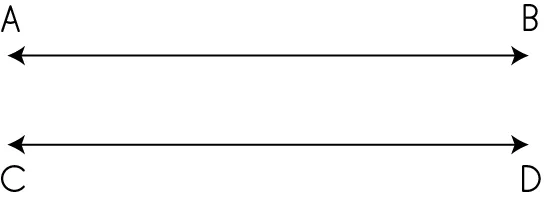
No. Parallel lines run side by side and never meet, however far they are extended, so they do not form an angle. We write that line AB is parallel to line CD as AB ∥ CD. An angle only exists where two lines or rays meet or cross.
How Do We Measure an Angle?
Angles are measured in degrees (°) using a protractor. Place the centre of the protractor on the vertex, line up the base line with one arm, then read the scale where the other arm crosses it. A full turn is 360°, a half turn is 180° and a quarter turn is 90°.
Types of Angles
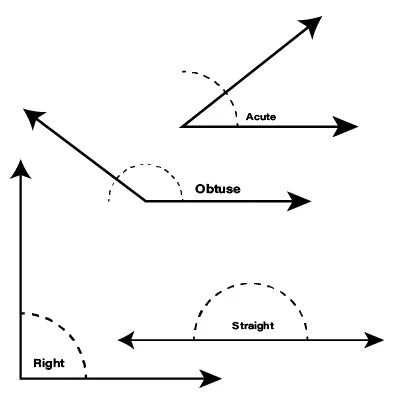
Zero angle: exactly 0°, where both arms lie on top of each other
Acute angle: greater than 0° and less than 90°
Right angle: exactly 90°, like the corner of a square
Obtuse angle: greater than 90° and less than 180°
Straight angle: exactly 180°, which looks like a straight line
Reflex angle: greater than 180° and less than 360°
Full angle: exactly 360°, one complete turn
Angles in Everyday Life
Once you start looking, you will find angles all around you:
The open blades of a pair of scissors
The bend in a hockey stick
The legs and back of a chair
Wooden stairs and ramps
The hands of a clock
Summing Up
An angle is made by two rays meeting at a vertex, it is measured in degrees with a protractor, and its size tells you its type: acute, right, obtuse, straight, reflex or full. Practise spotting and measuring angles around your home and the topic will soon feel natural. Related reading: Finding the Area of a Triangle (3 Methods).
If your child still finds angles or geometry tricky, a tutor can help. Math Make Smart offers one-to-one online math lessons for every grade. Book a free trial lesson today.
Frequently Asked Questions
What is an angle in maths?
An angle is formed when two rays (arms) meet at a common point called the vertex. It measures the amount of turn between the two arms.
What are the main types of angles?
Acute angles are less than 90°, right angles are exactly 90°, obtuse angles are between 90° and 180°, straight angles are exactly 180° and reflex angles are between 180° and 360°.
How do you measure an angle?
Use a protractor. Place its centre on the vertex, line up the zero line with one arm and read where the other arm crosses the scale.
What unit is used to measure angles?
Angles are usually measured in degrees (°). In more advanced maths, they are also measured in radians, where 360° equals 2π radians.
Do parallel lines make an angle?
No. Parallel lines never meet, so they don't form an angle with each other. Angles appear when another line, called a transversal, crosses them.