Primary School Standardised Tests: What Your Child's STen Score Means
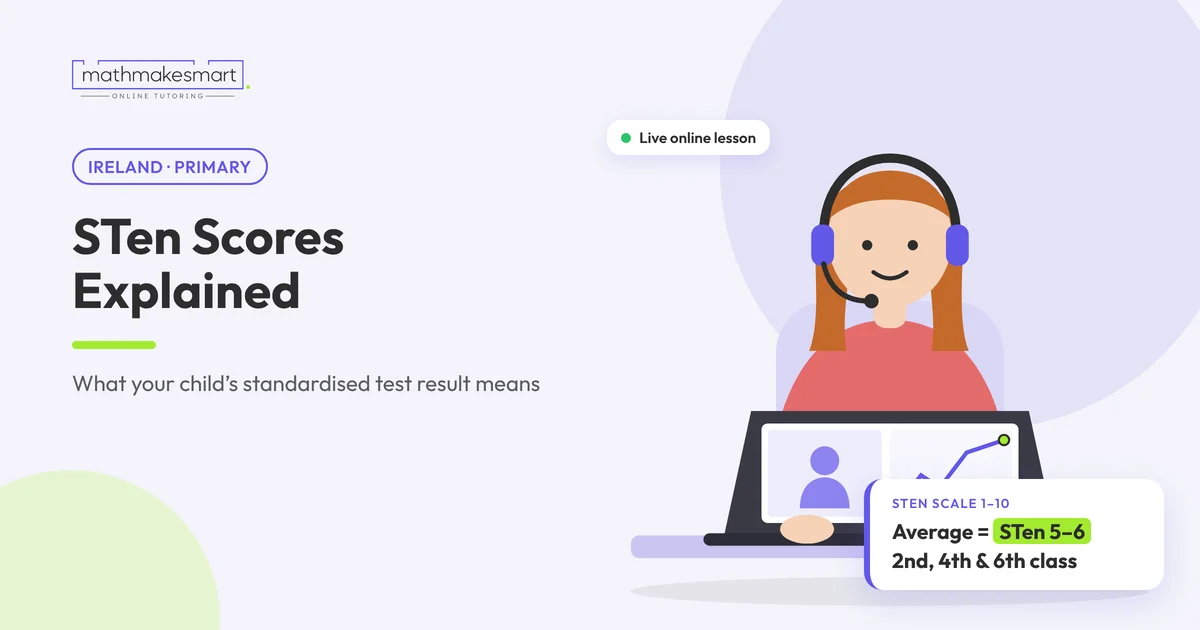
Quick answer: Irish primary schools must give standardised tests in English reading and maths (and Irish reading in Irish-medium schools) to pupils in 2nd, 4th and 6th class each May or June. Results are reported as STen scores from 1 to 10. STen 5–6 is average, 4 is low average, 7 is high average, 8–10 is well above average and 1–3 is well below average. A STen is a snapshot from one day, compared with children nationally. Teachers use it alongside their own assessment, not instead of it.
Who is tested, and when
A Department of Education circular requires schools to test all pupils in 2nd, 4th and 6th class every year in May or June. English-medium schools test English reading and mathematics; Irish-medium schools also test Irish reading (Circular 0018/2012). Some schools choose to test every class from 1st to 6th (Irish Times, May 2025).
Schools must include the results for 2nd, 4th and 6th class in the end-of-year report to parents, and report aggregate results to the Department (Circular 0018/2012).
Many schools use the Drumcondra Primary Mathematics Test, published by the Educational Research Centre. Pupils from 3rd class up record answers on answer sheets (ERC).
What the STen bands mean
A STen ("standard ten") puts your child's result on a scale from 1 to 10, compared with children of the same class or age nationally (Irish Times):
STen 8–10: well above average (about 17% of children)
STen 7: high average (about 17%)
STen 5–6: average (about 34%)
STen 4: low average (about 17%)
STen 1–3: well below average (about 17%)
Two things are easy to misread:
A 5 or 6 is the middle, where about a third of children land. It's not a "pass".
A STen of 4 isn't a fail. It's low average, shared by around one in six children.
What the tests don't tell you
Standardised tests are useful, but they have limits (Irish Times):
They're a snapshot of one day. A bad morning can pull a score down.
They don't measure creativity, effort, kindness or common sense.
They aren't designed to diagnose conditions such as dyslexia.
Teachers assess children continually, and those classroom observations often say more.
Reading a maths score in context
A maths STen tells you how your child did on that test compared with others. To make sense of it, look at three things together:
The teacher's comments on the same report.
The trend across 2nd, 4th and 6th class, rather than one result.
The gap between maths and reading, if there is one. A large gap can point to something specific worth talking about.
What to do after a low maths score
A STen of 1–3 in maths, or a drop of several points since the last test, is worth a conversation, not alarm.
Talk to the class teacher first. Ask how your child does day to day and whether the school plans any extra support.
Ask which areas were hardest. Number facts, problem solving and reading word problems need different help.
Build number confidence at home. Short, low-pressure practice works best.
Simple at-home practice
Everyday maths helps more than worksheets. For example, at the shop:
You buy 3 items at €2.40 each. How much change from €10?
3 × €2.40 = €7.20, so the change is €10 − €7.20 = €2.80.
Questions like this practise multiplication, money and subtraction together, in a real context.
What about a high score?
A STen of 8–10 is a good sign, but a single high score doesn't prove high achievement on its own, and teachers check it against other evidence (Irish Times). If your child is consistently strong and enjoys maths, look for ways to stretch them: puzzles, problem-solving challenges and, later, maths competitions.
Preparing for secondary school
Sixth class results often arrive just before the move to secondary school. For a look at what maths involves next, see our Junior Cycle maths guide.
When extra support might help
Support is worth considering when maths STens are consistently at 1–4, when a score has dropped noticeably, or when a child is anxious about maths.
A tutor can't change a test score directly, but can work on the specific skills a child finds hard in a calm, one-to-one setting. Math Make Smart offers online maths grinds, and you can book a free grind to see if it's a good fit.
Frequently asked questions
Which classes do standardised tests?
2nd, 4th and 6th class must be tested; some schools test every class from 1st to 6th.
What's an average STen score?
5 or 6.
Is a STen of 4 bad?
No. It's low average, and around one in six children score 4.
Where do I find my child's results?
In the end-of-year school report, or by asking the school.