What Is BMI? Body Mass Index Explained: Complete Guide
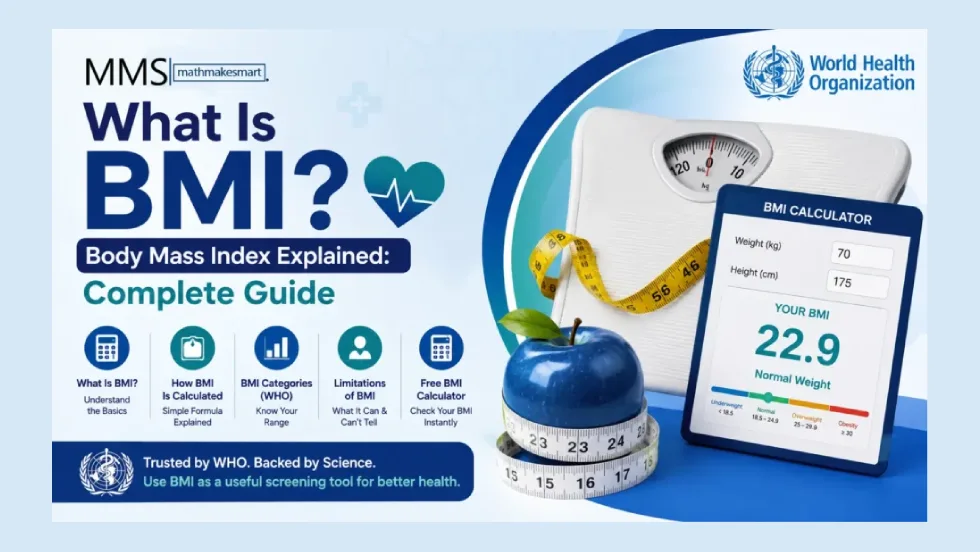
Understanding BMI: Why This Number Matters
Body Mass Index, universally known as BMI, is one of the most used and most misunderstood numbers in modern health. Doctors use it. Insurance companies reference it. Fitness trackers calculate it automatically. And yet most people who know their BMI number have no real understanding of what it measures, how it was derived, or why health professionals are increasingly cautious about using it in isolation. This guide cuts through the confusion. We explain exactly what BMI is, the formula behind it, what each category means for your health, the genuine limitations of the measurement, and how to calculate your own BMI. No jargon. No oversimplification. Just clear, honest information grounded in current medical guidance.
What Is BMI?
BMI stands for Body Mass Index. It is a simple numerical calculation that compares your body weight to your height, producing a single number used as a first-pass indicator of whether your weight falls within a range considered healthy for your height.
The World Health Organisation (WHO), the National Health Service (NHS), and the Centers for Disease Control and Prevention (CDC) all use BMI as a standard population-level screening tool. It helps health professionals identify people who may be at increased risk of weight-related conditions, including type 2 diabetes, cardiovascular disease, high blood pressure, and certain cancers.
Critically, BMI is a screening tool, not a diagnostic test. A high or low BMI does not confirm any medical condition. It is the starting point for a conversation, not the end of one.
A Brief History of BMI
The Body Mass Index was not invented by a physician. It was developed by Belgian mathematician and statistician Adolphe Quetelet in the 1830s and 1840s, originally called the “Quetelet Index.” Quetelet was not studying health; he was studying the statistical properties of the “average man” as part of his work on social science.
The formula sat largely unused in a medical context for over a century. In 1972, American physiologist Ancel Keys published a landmark study in the Journal of Chronic Diseases analysing multiple methods for estimating body fat. He coined the term “Body Mass Index” and concluded that Quetelet’s formula was the most effective simple measurement for population-level research.
The WHO and CDC adopted BMI as a standard classification tool in the 1990s, establishing the category thresholds that most health services still use today. It became the default largely because of its simplicity; it requires only two measurements, costs nothing to calculate, and can be applied to entire populations consistently.
The BMI Formula Explained
The formula itself is straightforward. In metric units:
BMI = weight (kg) ÷ height (m)²
Divide your weight in kilograms by the square of your height in metres.
Worked example (metric)
Suppose a person weighs 75 kg and is 1.78 m tall. Their BMI is calculated as:
BMI = 75 ÷ (1.78 × 1.78) = 75 ÷ 3.1684 = 23.7
A BMI of 23.7 falls within the healthy range (18.5–24.9).
Imperial calculation (lbs and inches)
If using pounds and inches, a conversion factor is applied:
BMI = (weight in lb × 703) ÷ height in inches²
Multiply your weight in pounds by 703, then divide by your height in inches squared. For example, 165 lb and 70 inches: 165 × 703 ÷ 4,900 ≈ 23.7.
BMI Categories, WHO and NHS Classifications
The WHO established the BMI thresholds that most global health services use. The NHS follows the WHO classification with an additional subdivision for severe obesity, giving six categories in total for adults aged 18 and over.
| BMI Range | Category | NHS / WHO Classification |
|---|---|---|
| Below 18.5 | Underweight | Below healthy weight — clinical assessment advised |
| 18.5 – 24.9 | Healthy weight | Weight in a healthy range for most adults |
| 25.0 – 29.9 | Overweight | Above healthy weight — lifestyle review recommended |
| 30.0 – 34.9 | Obese class I | Moderately obese — GP discussion recommended |
| 35.0 – 39.9 | Obese class II | Severely obese — clinical intervention recommended |
| 40.0 and above | Obese class III | Very severely obese — priority clinical management |
These thresholds are not arbitrary. Each one corresponds to statistically different risk profiles for metabolic and cardiovascular conditions, established through decades of population research. However, they represent averages across large populations; individual circumstances vary significantly.
What Each BMI Category Means for Your Health
Underweight (BMI below 18.5)
Being underweight carries its own health risks, which are often less widely discussed than obesity-related ones. These include increased vulnerability to illness due to reduced immune function, bone density loss and elevated osteoporosis risk, nutritional deficiencies affecting energy, cognition, and organ function, and fertility problems in both men and women. In some cases, a BMI below 18.5 may indicate an underlying health condition or an eating disorder that requires professional support.
If your BMI is below 18.5 and you have not had a recent medical assessment, a GP consultation is strongly recommended. If your BMI falls below 16, speaking to a healthcare professional urgently is advised.
Healthy weight (BMI 18.5–24.9)
For most adults, a BMI within this range is associated with the lowest statistical risk of weight-related health conditions. This does not mean someone with a BMI in this range is necessarily healthy in all respects; health is multifactorial. But it does suggest that weight is unlikely to be a primary contributing factor to health risk for most people in this category.
Maintaining a healthy BMI is associated with lower rates of type 2 diabetes, cardiovascular disease, high blood pressure, sleep apnoea, and certain cancers over a lifetime.
Overweight (BMI 25–29.9)
A BMI in the overweight range indicates that weight may be beginning to increase health risk, but the picture is nuanced. Someone with a BMI of 26 who is physically active, has a healthy diet, and normal blood pressure and cholesterol carries considerably less risk than the category number alone might suggest. Conversely, someone with a BMI of 27 who carries most of their weight around the abdomen (waist circumference is a better predictor here) may be at significantly higher risk than the category implies.
The NHS recommends that adults with a BMI of 25 or above take active steps to bring their weight into a healthier range where possible, starting with dietary changes and increased physical activity.
Obese class I (BMI 30–34.9)
At this level, the statistical association between BMI and health risk becomes more pronounced. Conditions more commonly associated with BMI in this range include type 2 diabetes, hypertension (high blood pressure), non-alcoholic fatty liver disease, sleep apnoea, and joint problems, particularly in the knees and hips. The NHS recommends discussing structured weight management options with a GP, which may include dietary referrals, physical activity programmes, or in some cases medication.
Obese class II and III (BMI 35 and above)
BMI in these ranges is associated with substantially elevated health risk. At class III obesity (BMI 40+), health conditions related to weight may be severe and complex. NHS clinical guidelines recommend specialist weight management services, which may include very low calorie diets, medication, or in some cases bariatric surgery, assessed and delivered by a multidisciplinary clinical team.
Ethnic Group Adjustments to BMI Thresholds
This is one of the most clinically important aspects of BMI that most general health resources overlook. The NHS applies lower thresholds for South Asian, Chinese, Black African, and Black Caribbean adults because research consistently shows that people from these ethnic backgrounds face increased health risks at lower BMI values than the standard thresholds suggest.
| Classification | Standard (White European) BMI | South Asian / East Asian / Black African BMI |
|---|---|---|
| Healthy weight | 18.5 – 24.9 | 18.5 – 22.9 |
| Overweight | 25.0 – 29.9 | 23.0 – 27.4 |
| Obese | 30.0 and above | 27.5 and above |
These adjusted thresholds apply to adults of South Asian, Chinese, other Asian, Middle Eastern, Black African, or African-Caribbean backgrounds. If you fall into one of these groups, your healthcare provider should be using these lower thresholds when interpreting your BMI, and so should you.
The Real Limitations of BMI, What It Cannot Tell You
BMI has faced growing scrutiny from researchers and clinicians in recent years, not because it is useless, but because it has been applied far beyond the purpose for which it was designed. Understanding its limitations is as important as understanding what it does measure.
It cannot distinguish muscle from fat
A professional athlete with very low body fat and high muscle mass may have a BMI in the overweight range. BMI sees total weight, not body composition.
It ignores fat distribution
Where fat is carried matters enormously for health risk. Abdominal fat (visceral fat) carries far higher metabolic risk than fat stored around the hips and thighs; BMI cannot detect this difference.
Standard ranges do not apply to all groups
Different thresholds apply to different ethnic groups, as described above. BMI also should not be used to assess children, pregnant women, or the elderly using adult standard ranges.
The “obesity paradox” in older adults
Some research suggests that for adults over 65, a BMI of 25–27 may be associated with lower mortality than the standard healthy range, a finding still being actively investigated.
It doesn’t account for sex differences
Women typically have higher body fat percentages than men at the same BMI. The same BMI number can represent meaningfully different body compositions in different sexes.
It was designed for populations, not individuals
Quetelet’s original formula was a statistical tool for describing populations. Applying it to assess an individual’s health involves assumptions that do not always hold at the individual level.
Better Measurements to Use Alongside BMI
Given the limitations described above, the NHS and clinical guidelines recommend using BMI in combination with other measurements for a more complete picture of weight-related health risk.
Waist circumference
Waist circumference is one of the most reliable single measurements of abdominal fat, the type most strongly associated with metabolic disease. NHS guidance suggests that health risk increases at a waist measurement of more than 94 cm (37 inches) for men and 80 cm (31.5 inches) for women, with substantially increased risk above 102 cm (40 inches) for men and 88 cm (34.5 inches) for women.
To measure correctly: find the midpoint between the bottom of your ribcage and the top of your hip bone, exhale normally, and measure without pulling the tape tight.
Waist-to-height ratio
Some researchers argue that waist-to-height ratio is a more sensitive predictor of cardiometabolic risk than BMI, particularly across different ethnic groups. A widely cited rule of thumb: your waist circumference should ideally be less than half your height.
Body fat percentage
Body fat percentage directly measures what BMI cannot — the actual proportion of your body weight made up of fat tissue. This can be estimated through DEXA scans (the gold standard), bioelectrical impedance scales, or skinfold caliper measurements. Healthy body fat ranges are approximately 10–20% for men and 18–28% for women, varying by age.
Metabolic health indicators
Blood pressure, fasting blood glucose, HbA1c, triglycerides, and HDL cholesterol together paint a picture of metabolic health that BMI alone cannot. Someone with a BMI in the overweight range but normal metabolic indicators carries a very different risk profile from someone with the same BMI and raised blood glucose and blood pressure.
BMI in Children and Teenagers
Standard adult BMI categories do not apply to anyone under 18. Children and adolescents are still growing; their height, weight, and body composition change rapidly, and a single set of numerical thresholds cannot account for this. Instead, the NHS uses BMI centile charts that compare a child’s BMI to others of the same age and sex.
Children are classified using four centile-based categories: underweight (below the 2nd centile), healthy weight (2nd–91st centile), overweight (91st–98th centile), and very overweight (obese) above the 98th centile. If you have concerns about a child’s weight, the appropriate first step is a conversation with their GP or health visitor, not an adult BMI calculator.
Frequently Asked Questions
1. What is a healthy BMI for an adult?
For most adults, a BMI between 18.5 and 24.9 is considered within the healthy range by the WHO, NHS and CDC. For South Asian, East Asian, Black African and some other ethnic groups, the NHS recommends lower thresholds, with overweight beginning at 23 and obesity at 27.5. A single number cannot fully define health, so always consider BMI alongside other clinical measures.
2. Can you be healthy with a high BMI?
Yes, in some cases. Athletes and very muscular people often have BMIs in the overweight range despite low body fat and excellent cardiovascular health. Some research also suggests older adults may do better at a slightly higher BMI. Always consider waist circumference, fitness, blood pressure and metabolic markers as part of the full picture.
3. What BMI is considered obese?
A BMI of 30 or above is classified as obese by WHO, NHS and CDC standards, divided into Class I (30–34.9), Class II (35–39.9) and Class III (40 and above). For adults of South Asian, East Asian and certain other ethnic backgrounds, the obesity threshold starts lower, at 27.5.
4. How accurate is BMI as a health measure?
BMI is a useful population-level screening indicator but an imperfect individual measure. It can misclassify muscular people, some older adults and people whose fat distribution differs from the average. Healthcare providers use it as a starting point, not a conclusion.
5. Does BMI apply to children?
Standard adult BMI categories do not apply to anyone under 18. For children and teenagers, the NHS uses age- and sex-specific BMI centile charts. If you are concerned about a child’s weight, speak with a GP, health visitor or school nurse.
6. Is BMI the same for men and women?
The formula and category thresholds are the same for both sexes, but women typically carry a higher proportion of body fat than men at the same BMI, so two people with identical BMIs can have different body compositions.
7. What should I do if my BMI is very high or very low?
If your BMI is below 16 or above 40, speak with your GP as a priority. For a BMI between 16 and 18.5 or between 30 and 40, a GP appointment is strongly recommended. Your GP will consider your full health picture, not just the number.
8. Why do South Asian adults have different BMI thresholds?
Research has found that adults of South Asian descent face higher metabolic risks at lower BMI values than white European adults, partly because they tend to carry more visceral (abdominal) fat at a given BMI. The NHS and WHO guidance reflects this with lower thresholds.
Is Your Child Struggling at School?
Understanding health and science starts with a great education. Math Make Smart provides 1-to-1 online tutoring services in Biology, Chemistry, Physics, Maths, and English for students across the UK, US, Canada, Australia, Ireland and New Zealand.
Conclusion
BMI is a useful tool when understood correctly, and a misleading one when applied carelessly. It gives a fast, free, universally comparable indicator of weight status that has genuine value for population health monitoring and as an initial clinical screening measure. It is not, and was never designed to be, a definitive verdict on individual health.
Used alongside waist circumference, metabolic blood markers, physical fitness measures, and individual medical history, BMI provides a piece of a larger, more meaningful picture. On its own, it can only tell you roughly where your weight sits relative to established statistical norms, not whether you are healthy, and not what you should do about it.
If your BMI calculation today raises a question, the right person to answer it is your GP or physician, armed with far more information than any single number can provide.
Sources and references: World Health Organisation (WHO) — BMI Classification; NHS — BMI healthy weight calculator and weight management guidance; CDC — Healthy Weight, Nutrition, and Physical Activity; NICE Clinical Guideline CG189 (Obesity: identification, assessment and management); Keys A. (1972) Journal of Chronic Diseases — Indices of relative weight and obesity.