
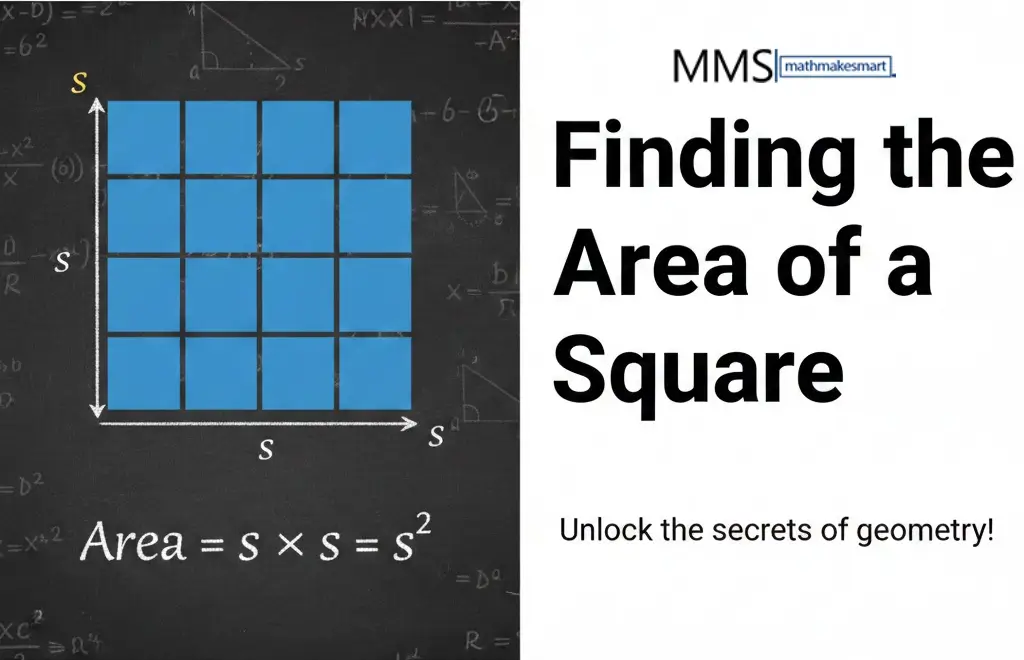
A square is a special quadrilateral with all four sides equal and all angles 90°. Finding the area of a square is one of the most fundamental concepts in mathematics, forming the foundation for understanding geometry in higher grades. The area of a square is calculated by multiplying the length of one side by itself, a simple yet powerful formula that helps students grasp spatial reasoning and problem-solving skills. Mastering this concept not only improves accuracy in exams but also builds confidence in tackling more complex mathematical topics.
At Math Make Smart, students around the world learn such core concepts through clear explanations, step-by-step guidance, and personalized support. As a globally trusted mathematics tutoring provider, Math Make Smart combines expert tutors, modern teaching methods, and one-to-one online learning to help students understand math deeply and succeed academically at every level. Here are all methods to find its area!
METHOD 1: Using Side Length (Most Common)
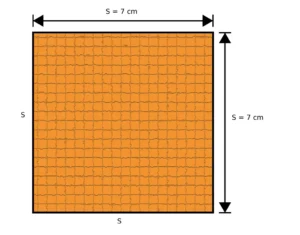
Formula: A = s² or A = side × side
Where s = length of one side
Example: Square with side = 7 cm
- A = 7²
- A = 49 cm²
METHOD 2: Using Diagonal
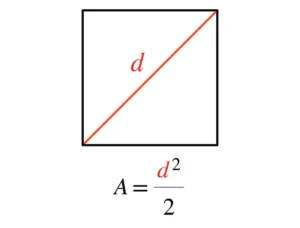
Formula: A = d²/2
Where d = length of the diagonal
How it works: In a square, diagonal = s√2, so s = d/√2, then A = (d/√2)² = d²/2
Example: Square with diagonal = 10 cm
- A = 10²/2
- A = 100/2
- A = 50 cm²
Verification: If d = 10, then s = 10/√2 = 7.07 cm, so A = 7.07² ≈ 50 cm²
METHOD 3: Using Perimeter
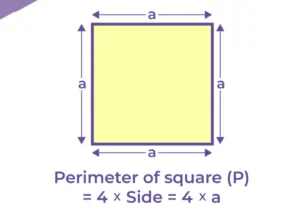
Formula: A = P²/16
Where P = perimeter (sum of all four sides)
How it works: Since P = 4s, then s = P/4, so A = (P/4)²
Example: Square with perimeter = 32 cm
- Method 1: A = 32²/16 = 1024/16 = 64 cm²
- Method 2: s = 32/4 = 8 cm, so A = 8² = 64 cm²
Do you want to hire an online Mathematics tutor for your child? Book free demo class now and choose the best mathematic teacher for your child.