
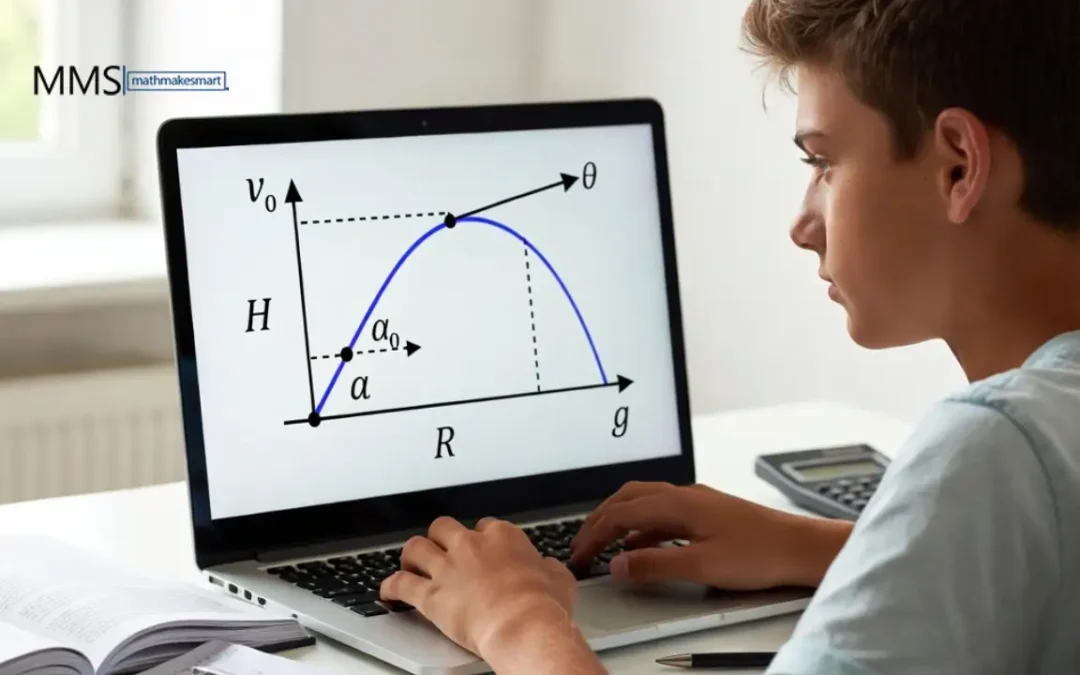
Projectile motion is one of the most important and frequently tested topics in high school Physics. Whether your child is preparing for AP Physics, A-Levels, IB, GCSE, or other board exams, mastering projectile motion is essential. In this clear and detailed guide, we explain how to solve projectile motion problems step-by-step with real examples.
What is Projectile Motion?
Projectile motion is the motion of an object thrown or projected near the Earth’s surface, moving under the influence of gravity only. Common examples include a kicked football, a thrown ball, or a projectile launched at an angle.
Key points:
- Horizontal velocity remains constant
- Vertical velocity changes due to gravity
- The path of the object is a parabola

Important Formulas (Plain Text)
- Horizontal component of velocity: Vx = V × cos(θ)
- Vertical component of velocity: Vy = V × sin(θ)
- Maximum Height: H = (Vy)² / (2 × g)
- Time of Flight: T = (2 × Vy) / g
- Horizontal Range: R = (V² × sin(2θ)) / g
Where:
- V = Initial velocity
- θ = Angle of projection
- g = Acceleration due to gravity (9.8 m/s²)
Step-by-Step Method to Solve Projectile Motion Problems
Example Problem: A ball is kicked with an initial velocity of 20 m/s at an angle of 30° above the horizontal. Calculate:
- Maximum height reached
- Total time of flight
- Horizontal range
1: Resolve initial velocity into components Vx = 20 × cos(30°) = 20 × 0.866 = 17.32 m/s Vy = 20 × sin(30°) = 20 × 0.5 = 10 m/s
2: Calculate Maximum Height H = (Vy)² / (2 × g) H = (10)² / (2 × 9.8) H = 100 / 19.6 = 5.1 meters
3: Calculate Time of Flight T = (2 × Vy) / g T = (2 × 10) / 9.8 T = 20 / 9.8 = 2.04 seconds
4: Calculate Horizontal Range R = Vx × T R = 17.32 × 2.04 = 35.33 meters
Final Answers:
- Maximum Height = 5.1 meters
- Time of Flight = 2.04 seconds
- Horizontal Range = 35.33 meters
Common Mistakes Students Make
- Forgetting to break velocity into horizontal and vertical components
- Using wrong sign for gravity (always take downward as negative)
- Confusing time to reach maximum height with total time of flight
- Rounding off values too early in calculations
Pro Tips from Expert Physics Tutors
- Always draw a quick diagram and label all known values
- Solve horizontal and vertical motions separately
- Keep units consistent throughout the solution
- Practice with different angles (especially 30°, 45°, and 60°)

Need Personalized Help with Projectile Motion or Physics?
At Math Make Smart, our expert online Physics tutors specialize in helping students understand difficult concepts like projectile motion through live 1-on-1 sessions.
We provide:
- Step-by-step concept clearing
- Exam-specific problem solving techniques
- Interactive virtual whiteboard sessions
- Lesson recordings for revision
- Flexible scheduling for all time zones
Whether your child needs help with homework, concept clarity, or full test/exam preparation, our subject specialist online tutors deliver real results.
Ready to improve your child’s Physics performance?
Book a completely free trial lesson today at MMS – Math make Smart. No credit card required. No long-term commitment.