
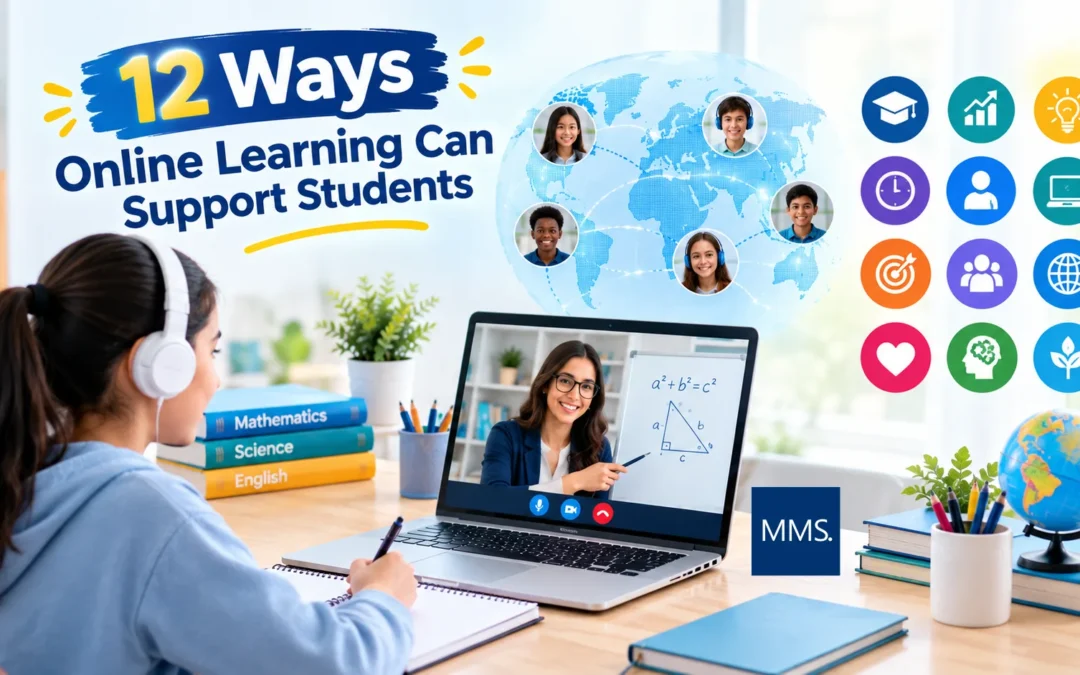
The Silent Shift Happening in Classrooms Around the World
Something remarkable is happening in education, and it is not confined to any single country. From secondary schools in the UK to universities in Australia, from home-study programmes in Canada to hybrid classrooms in New Zealand and Ireland, students are increasingly turning to online learning to supplement, strengthen, and in some cases transform their academic journeys. The numbers confirm what educators have observed on the ground: the global online education market is projected to surpass $200 billion in 2026, with a compound annual growth rate of over 22%.
At Math Make Smart, we have watched this shift unfold from the front row, supporting students across the UK, USA, Canada, Australia, Ireland, and New Zealand through personalised online tutoring services tailored to each country’s curriculum and examination requirements. But what exactly makes online learning so effective for students? And beyond the headlines and market projections, what does it actually change about how young people learn? This article explores twelve evidence-based ways online learning actively supports students, not just as a convenience, but as a genuine driver of academic progress and long-term confidence.
1. It Gives Students Control Over the Pace of Learning
Traditional classrooms operate on a single speed. A teacher must pitch their lesson to the average learner in the room, which means the student who needs more time is left behind, and the student ready to move forward is held back. Online learning eliminates this problem.
Research from the Research Institute of America found that e-learning helps students retain between 25% and 60% more information compared to traditional learning formats. A significant part of this is pacing. When students can pause, rewind, and revisit explanations at their own speed, comprehension deepens in a way that a single classroom delivery rarely achieves. For students in the USA preparing for the SAT, or students in the UK working through GCSE content, the ability to revisit difficult material until it genuinely makes sense is not a luxury; it is the difference between understanding and surface-level familiarity.
2. It Removes the Barrier of Geography
In 2026, a student in rural New Zealand has access to the same quality of online tutoring services as a student in central London or downtown Toronto. This matters enormously. Before digital education became widely accessible, the quality of academic support available to a student was almost entirely determined by their postcode. Students in major cities could access a large pool of qualified tutors and specialist teachers. Students in regional areas, rural communities, or smaller towns were limited to whatever local resources happened to be available.
Online learning dissolves this inequity. A student in regional Australia preparing for ATAR examinations can access the same subject-specialist tutor as a student in Sydney. A student in rural Ireland can receive targeted test preparation online without travelling hours to a city. Geography no longer defines educational opportunity, and that is one of the most meaningful changes online learning has delivered.
3. It Supports Homework Help in Real Time
One of the most consistent daily frustrations in student life is getting stuck on homework with no one to turn to. A student working through an algebra problem at 7 pm in Canada, a chemistry equation in the UK, or an English essay in Australia often has the same experience: the explanation from class has faded, the textbook is not helping, and the problem sits unresolved.
Online homework help services address this directly. Rather than leaving a student to struggle in isolation, or worse, submit work they do not understand, live one-to-one homework help connects students with subject specialists who can work through the problem with them in real time. Research consistently shows that immediate corrective feedback is one of the strongest drivers of learning. Getting a concept right the first time it is practised, rather than repeating an error until it becomes a habit, is exactly what well-delivered online homework help online achieves.
4. It Builds Academic Confidence Over Time
Confidence and academic performance are deeply linked. A student who feels unable to ask questions in a classroom of thirty peers will often stay silent, regardless of how confused they are. The social dynamics of a group learning environment, the fear of looking slow, and the anxiety of asking a basic question prevent many students from getting the help they need.
Online learning removes this pressure. In a one-to-one session, there are no peers to impress and no social risk in asking the same question multiple times. Students consistently report feeling more comfortable asking questions online than in a classroom. Over time, this willingness to clarify confusion, rather than paper over it, builds the kind of genuine understanding that grows into real confidence. Across the USA, UK, Canada, Australia, New Zealand, and Ireland, students who engage in regular online tutoring services demonstrate stronger long-term academic trajectories precisely because that confidence compounds.
5. It Adapts to Individual Learning Styles
No two students learn in the same way. Some are visual learners who need diagrams and spatial representations. Others are analytical and respond better to working through logic step by step. Some learn best through conversation; others through written exercises and independent practice. A classroom teacher delivering to thirty students has limited capacity to adapt to each individual’s preferred approach.
Online learning, particularly one-to-one tutoring, can adapt fully. A tutor working with a single student quickly identifies how that student processes information and adjusts their explanations accordingly. For Maths, this might mean using a shared whiteboard to draw out geometric problems visually. For English, it might mean reading a student’s draft aloud together before discussing structure. This level of adaptation is simply not possible in a group setting, and it is one of the clearest reasons why personalised online learning produces stronger outcomes for many students.
6. It Makes Test Preparation Online More Targeted and Effective
Examinations are high-stakes moments. The SAT and ACT in the USA, GCSEs and A-Levels in the UK, the ATAR in Australia, NCEA in New Zealand, Leaving Certificate examinations in Ireland, and provincial assessments in Canada, all carry significant consequences for a student’s academic and professional future. Generic revision is rarely enough.
Effective test preparation online goes beyond content review. It teaches students the format, timing, and question-type strategies specific to their examination. It uses past papers under timed conditions, analyses every mark scheme, and builds the exam technique that separates students who know the content from students who know how to perform under pressure. Studies show that 81% of students who engage in structured online preparation report grade improvements. That figure is not surprising; what is surprising is how many students still rely on passive revision when structured, specialist online test preparation is available and affordable.
7. It Offers Flexibility Around School and Family Life
Families in the UK, USA, Canada, Australia, New Zealand, and Ireland share a common challenge: school schedules, extracurricular commitments, part-time work, and family life do not always leave obvious windows for additional study. The inflexibility of traditional tutoring- fixed weekly times, travel requirements, and term-based availability- makes it difficult for many families to maintain consistent academic support.
Online learning eliminates scheduling friction. A session can be booked around a football training schedule in the UK, a basketball season in the USA, a school sports tournament in Australia, or family commitments anywhere. This flexibility is not just convenient; it is what allows online learning to be consistent. Consistency matters enormously in education. A student who has one reliable online session per week, every week, across a full term will make dramatically more progress than a student who has three sessions one week and none for the following three.
8. It Keeps Students Engaged Through Interactive Digital Tools
There is a persistent myth that online learning is passive, that students sit in front of a screen watching content without genuine engagement. This may have been partly true of early e-learning platforms. It is not true of modern, live online tutoring. Today’s online sessions use interactive shared whiteboards, real-time annotation, document collaboration, screen sharing, and two-way video to create genuinely dynamic learning environments.
Research published in 2026 found that students in active learning formats show approximately 62.7% engagement, compared to only 5% in passive lecture settings. When a student and tutor are simultaneously working on a problem on a shared whiteboard, the student writing their working, the tutor annotating corrections in real time, the engagement levels are far closer to those of active learning than passive watching. This is why students who experience well-designed online tutoring sessions often describe them as more focused and productive than classroom lessons.
9. It Provides Access to Subject Specialists Regardless of Local Availability
A student in rural Canada may not have a qualified A-Level Chemistry tutor within practical travelling distance. A student in New Zealand may need specialist SAT preparation that is simply not offered by local tutoring centres. A student in Ireland preparing for a specific STEM subject at Leaving Certificate level may find local specialist support limited.
Online learning provides access to subject specialists anywhere, tutors who not only know the subject deeply but also understand the specific examination format, mark scheme language, and curriculum requirements for each country. This level of curriculum-specific expertise makes a meaningful difference in examination results. A tutor who has personally studied AQA Chemistry mark schemes prepares a UK student very differently from a general science tutor, and the results reflect that difference.
10. It Supports Students With Different Needs and Learning Challenges
Students with dyslexia, ADHD, anxiety, auditory processing difficulties, or other learning differences often find traditional classroom environments genuinely difficult. The pace, the noise, the social dynamics, and the one-size-fits-all delivery of a classroom can make it harder, not easier, to absorb information.
Online learning can be genuinely transformative for these students. Tutors can work at a pace that suits the student’s processing speed, provide written summaries after each session, use visual and diagrammatic explanations, break concepts into smaller stages, and take breaks without social awkwardness. The removal of classroom-related anxiety often allows students with learning differences to engage with material more freely than they ever have in a formal school setting. For families in the UK, USA, Canada, Australia, New Zealand, and Ireland supporting children with additional learning needs, online tutoring services specifically adapted to those needs represent one of the most accessible and effective forms of support available.
11. It Strengthens Independent Study Skills
One of the most valuable long-term outcomes of good online tutoring is not the grade improvement on the next exam; it is the development of independent study habits. When a tutor teaches a student how to use past papers effectively, how to identify their own knowledge gaps, how to self-quiz, and how to manage revision time, they are building skills that will serve that student across every subject and every examination for the rest of their academic career.
Students who engage in regular online tutoring services report stronger time management, better self-assessment of their own understanding, and greater ability to approach unfamiliar problems independently. These metacognitive skills, knowing how to learn, not just what to learn, are increasingly recognised by universities and employers as among the most valuable outcomes of a good education. Online learning, at its best, builds these skills as a by-product of genuine academic engagement.
12. It Makes High-Quality Education Financially Accessible
Premium academic support has historically been available primarily to families who could afford in-person private tutoring at rates of $70–$100 or more per hour. Online learning has disrupted this entirely. The reduced overheads of online delivery, the ability to reach students across multiple geographies from a single location, and the scalability of digital platforms have collectively brought the cost of specialist one-to-one tutoring down significantly.
Students in the UK, USA, Canada, Australia, New Zealand, and Ireland can now access subject-specialist, curriculum-aligned, truly one-to-one tutoring, including test preparation online and homework help online, at rates that were previously associated only with generic or unqualified support. This democratisation of quality education is one of online learning’s most significant contributions to students’ lives worldwide.

online education
FAQs – Frequently Asked Questions
1. Is online learning as effective as in-person learning?
Research from the US Department of Education found that students in online learning conditions performed modestly better, on average, than those in face-to-face settings. Effectiveness depends primarily on the quality of instruction and the engagement of the learner, not the delivery mode.
2. How does online tutoring support test preparation?
Specialist online tutors work through past papers, mark scheme analysis, and exam technique alongside content knowledge. This dual focus on content and performance is what produces the grade improvements that distinguish online test preparation from general revision.
3. Can online learning help with homework help online?
Yes. One-to-one online tutoring is one of the most effective formats for homework support, precisely because the session can be directed entirely at the specific problem a student is facing on that day, not a pre-planned curriculum that may not address their immediate need.
4. Which subjects can be studied through online tutoring services?
Math Make Smart provides online tutoring services in Mathematics, English, Physics, Chemistry, and Biology, covering all major curricula and examinations in the UK, USA, Canada, Australia, New Zealand, and Ireland.
5. What age group benefits most from online learning?
Research shows benefits across all age groups, from primary school students building foundational skills to university applicants preparing for high-stakes entrance examinations. The format adapts well to learners of all ages when well-designed.
6. How long should an online learning session be?
For most secondary school students, 60-minute sessions strike the right balance between depth and focus. Younger students often benefit from shorter 40-45 minute sessions. University-level and advanced examination preparation may warrant 75-90 minute sessions.
Conclusion: How Math Make Smart Supports Your Online Learning Journey
The twelve benefits explored in this article are not theoretical; they represent real changes that thousands of students experience every year when they engage with structured, personalised online learning. Whether the challenge is understanding a difficult concept, preparing for a high-stakes examination, getting through tonight’s homework, or simply building the confidence to believe that academic success is achievable, online learning provides tools and support that classroom education alone rarely delivers.
If you or your child is navigating any of these challenges, in the UK, USA, Canada, Australia, New Zealand, or Ireland, Math Make Smart is here to help. We provide one-to-one online tutoring services in Mathematics, English, Physics, Chemistry, and Biology, with subject-specialist tutors trained in each country’s specific curriculum. Our test preparation online covers GCSE, A-Level, SAT, ACT, ELA, NAPLAN, ATAR, NCEA, and Leaving Certificate examinations, and our flexible homework help online is available whenever it is needed most. Every new student begins with a completely free trial lesson, no payment, no commitment. Contact the Math Make Smart team today and take the first step toward the academic results your child deserves. Book your free lesson for any subject from any country.