AP Statistics 2027: The Revised Course and Exam Explained
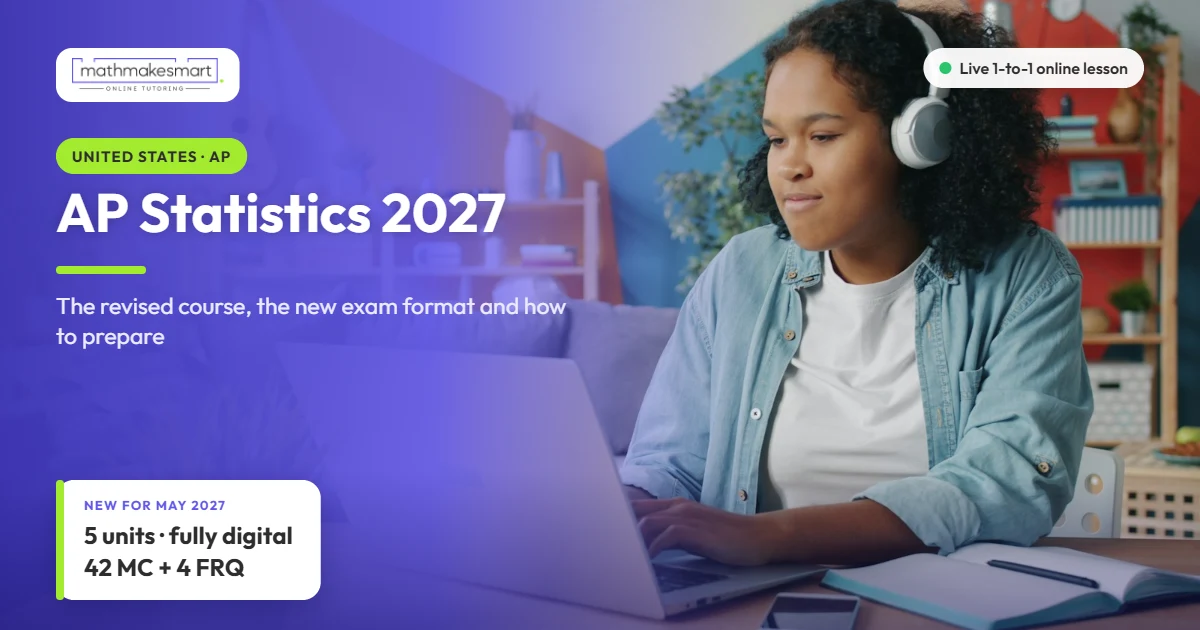
Quick answer: AP Statistics has been revised for the 2026-27 school year. The course is now organized into five units (down from nine), and the exam is fully digital in the Bluebook app. It has 42 multiple-choice questions in 1 hour 30 minutes and 4 free-response questions in 1 hour 30 minutes, each section worth 50%. Calculators are permitted. The 2027 exam is on Tuesday, May 11, 2027.
What changed for 2026-27
The College Board says AP Statistics "has been revised for the 2026-27 school year to align with current introductory college statistics courses" (College Board — AP Statistics exam).
The main changes:
Five units instead of nine. The content is regrouped into larger units (Math Medic summary).
42 multiple-choice questions, up from 40, with four answer choices instead of five (Math Medic).
Four free-response questions instead of six.
Fully digital. Both sections are taken in Bluebook, and answers are submitted automatically at the end.
If you're using older review books or practice tests, check that they match the 2027 format.
The five units
From the College Board's course-at-a-glance poster (College Board):
Unit 1: Exploring One-Variable Data and Collecting Data · Exam weighting: 20–30%
Unit 2: Probability, Random Variables, and Probability Distributions · Exam weighting: 15–25%
Unit 3: Inference for Categorical Data: Proportions · Exam weighting: 15–25%
Unit 4: Inference for Quantitative Data: Means · Exam weighting: 10–20%
Unit 5: Regression Analysis · Exam weighting: 10–20%
Inference (Units 3 and 4) together makes up roughly 25–45% of the exam, so confidence intervals and hypothesis tests deserve a big share of revision time.
The exam format
Section I, multiple choice: 42 questions · 1 hour 30 minutes · 50% of the score
Section II, free response: 4 questions · 1 hour 30 minutes · 50% of the score
Some multiple-choice questions come in sets based on a shared prompt. The four free-response questions follow a fixed pattern (College Board):
Q1: multi-focus on Practices 1 and 2
Q2: multi-focus on Practices 3 and 4
Q3: inference (a hypothesis test or a confidence interval)
Q4: multi-focus on Practices 2, 3 and 4
With only four questions, each free-response question carries more weight than under the old six-question format. Clear, complete communication matters on every one.
Worked examples
Standardizing a value (Unit 1)
Test scores have mean 70 and standard deviation 8. How unusual is a score of 86?
z = (86 − 70) / 8 = 2.0. The score is 2 standard deviations above the mean, which is unusually high for a roughly normal distribution.
Combining probabilities (Unit 2)
P(A) = 0.5, P(B) = 0.4 and P(A and B) = 0.2. Find P(A or B).
P(A or B) = 0.5 + 0.4 − 0.2 = 0.7.
Writing an inference conclusion (Units 3–4)
A test gives a p-value of 0.03 at α = 0.05.
Because 0.03 < 0.05, reject H₀. A strong answer then says, in context, what that means: "There is convincing evidence that the true proportion of students who … is greater than 0.40."
AP readers look for the conclusion in context, not just "reject H₀".
A 10-week revision plan
Weeks 1–2: Unit 1: describing distributions, sampling and experimental design
Weeks 3–4: Unit 2: probability rules, random variables, binomial and normal models
Weeks 5–6: Units 3–4: confidence intervals and significance tests, with full write-ups
Week 7: Unit 5: regression, residuals and interpreting slope
Weeks 8–9: Timed practice in the 2027 format (42 MC + 4 FRQ)
Week 10: Review errors; practice conclusions in context
This plan is MMS editorial guidance.
Common mistakes
Using outdated practice tests. The 2027 format has 42 MC and 4 FRQ.
Conclusions without context. Always link the result back to the situation.
Skipping conditions. Check randomness, independence and normality before inference.
Confusing p-value meaning. It's the probability of results this extreme if H₀ is true, not the probability H₀ is true.
When extra support might help
Support is worth considering when inference write-ups are losing marks, when probability isn't clicking, or when a student wants timed practice in the new format.
A tutor can't guarantee an AP score, but can practice free-response writing and fix weak topics. Math Make Smart offers AP test preparation and online math tutoring, and you can book a free trial lesson. Taking calculus too? See our AP Calculus AB vs BC guide, and for credit policies see AP scores explained.
Frequently asked questions
How many questions are on the 2027 AP Statistics exam?
42 multiple-choice and 4 free-response.
Is the AP Statistics exam digital?
Yes. It's fully digital in the Bluebook app.
When is the 2027 AP Statistics exam?
Tuesday, May 11, 2027.
Can I use a calculator?
Yes, calculators are permitted. Check the College Board calculator policy for approved models.