
If your child is approaching their GCSEs, or already in the thick of them, you have probably heard plenty about grade 9s, standard passes, grade boundaries, and foundation vs higher tier papers. But if you sat your own exams before 2017, the system looks nothing like what you remember. This GCSE Grades Explained guide explains everything clearly: how the current 9–1 grading system works, what each grade actually means for your child’s future, which subjects have two levels of paper, and exactly when extra support from an Online Tutoring Platform for a GCSE Maths tutor, GCSE English tutor, or GCSE Science tutor is worth considering.
What Are GCSEs and Who Takes Them?
GCSEs (General Certificates of Secondary Education) are the main qualifications taken by students in England, Wales, and Northern Ireland, typically at ages 15 and 16, in Years 10 and 11. Most students sit between eight and twelve subjects, which are chosen in Year 9. Some subjects are compulsory: English Language, English Literature, Maths, and Science, while others are chosen from a list of options including History, Geography, Languages, Computer Science, Art, and more.
The GCSEs are set and marked by exam boards. The main ones in England are AQA, Edexcel (Pearson), and OCR. Each board sets its own syllabus and exam papers, though the grade boundaries all follow the same 9–1 scale. Scotland uses a separate system (National Qualifications), while Wales still uses the traditional A*–G grading scale alongside some numerical grades. This guide focuses on the English 9–1 system used by the majority of UK secondary schools.

The 9–1 GCSE Grades Explained
England introduced the new 9–1 grading system in phases between 2017 and 2020, replacing the old A*–G letter-grade system used since the 1980s. The change was made for two main reasons: to reflect an increase in the difficulty and depth of GCSE content, and to better distinguish performance at the higher end of the scale, where previously a large number of students were all grouped together under a single A* grade.
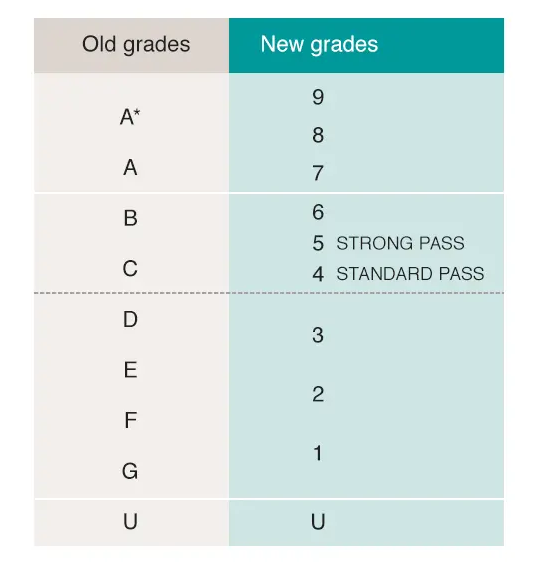
How the old grades compare to the new ones
| New Grade (9–1) | Old Grade (A*–G) | Broad Description |
|---|---|---|
| 9 | Above A* | Exceptional, top performers only |
| 8 | A*/A | Very strong performance |
| 7 | A | High level of achievement |
| 6 | B | Good performance |
| 5 | B/C boundary | Strong pass |
| 4 | C | Standard pass |
| 3 | D | Below standard pass |
| 2 | E/F | Well below standard pass |
| 1 | F/G | Minimum level of achievement |
| U | U | Unclassified, no grade awarded |
One important point: a grade 9 is not simply equivalent to an old A*. It sits above it, reserved for the very top performers nationally. In most subjects, fewer than 5% of all students achieve a grade 9 in any given year. This makes it a genuinely exceptional result rather than simply the top tier of a standard grading band.
What Each Grade Means, In Plain English
Parents sometimes ask whether a grade 6 is “good” or whether a grade 5 “really counts.” Here is what each grade genuinely represents, without the jargon.
Grade 9: Your child is among the very top achievers in the country for this subject. This grade is rare by design.
Grade 8: An outstanding result equivalent to the top of the old A grade. Opens all doors for A Level study.
Grade 7: A strong A-equivalent grade. A highly competitive result for selective sixth forms and university courses.
Grade 6: A solid B-equivalent. Meets the entry requirements for many A Level subjects at most sixth forms.
Grade 5: Described by the government as a “strong pass.” Often the benchmark for A Level courses in related subjects.
Grade 4: The “standard pass.” The minimum many colleges, sixth forms, and employers expect, particularly in English and Maths.
Grade 3: Below the standard pass. Your child may need to resit English or Maths at this level.
Grade 2: A low grade. Typically limits post-16 options significantly.
Grade 1: The minimum level of achievement. Not recognised as a pass by most further education providers.
U (Unclassified): The student did not meet the minimum standard required for a grade. No GCSE is awarded.
What Is a Pass at GCSE?
This is one of the most common questions parents ask, and the answer has two parts.
Standard Pass = Grade 4. A grade 4 is officially classified as a standard pass. It is the minimum grade accepted by most sixth forms, colleges, and employers in English and Maths. Students who do not achieve a grade 4 in English Language or Maths are required to continue studying and resitting those subjects as part of any 16–19 study programme.
Strong Pass = Grade 5. A grade 5 is classified as a strong pass. Some sixth forms and A Level courses require a grade 5 in relevant subjects. For competitive or oversubscribed courses, a grade 5 is increasingly the practical minimum.

The practical reality: for most pathways, A Levels at a competitive sixth form, apprenticeships at well-known companies, university courses, grade 5 is the working threshold. Grade 4 technically passes, but grade 5 keeps more options open.
How Grade Boundaries Work
Grade boundaries are not set in advance. They are published on Results Day by each exam board, after all exam papers have been marked.
Here is what that means practically:
Each year, after papers are marked, senior examiners review the distribution of marks across the country. They set the minimum number of marks needed for each grade, taking into account whether that year’s paper was harder or easier than in previous years. This process is called grade standardisation and is designed to keep results broadly consistent year to year.
What this means for your child
A student who scores 72 out of 100 might receive a grade 7 one year and a grade 6 the next, not because they performed differently, but because the national cohort performed differently. This is normal and intentional. Grade boundaries also vary between exam boards. An AQA grade 5 in Maths requires a different raw mark than an Edexcel grade 5 in Maths, because the papers are different.
When grade boundaries matter most: if your child is on the borderline between two grades, the published boundaries on Results Day tell you exactly how close they were. A student who missed a grade 5 by three marks is in a very different position from one who missed it by twenty marks, and that distinction is important if you are considering a remark or a resit.
Grade boundaries are published on each exam board’s website on Results Day and are freely available to download.

Foundation Tier vs Higher Tier, Which Paper Does Your Child Sit?
Several GCSE subjects, most importantly Maths, Sciences, and Modern Foreign Languages, offer two versions of the exam: Foundation and Higher.
This is called the tiered entry system.
What grades are available in each tier?
| Tier | Grades Available | Notes |
|---|---|---|
| Foundation | Grades 1 to 5 | Maximum grade achievable is a 5 |
| Higher | Grades 4 to 9 | Safety net of grade 3 if a 4 is narrowly missed |
Foundation tier is designed for students who are likely to achieve grades 1 to 5. The content is less advanced, and the questions are more accessible. However, a grade 5 is the ceiling — a student cannot achieve a 6, 7, 8, or 9 on a Foundation paper, no matter how well they perform. Higher tier covers the full range of content and questions, giving students access to grades 4 through 9. Students who sit Higher but do not quite achieve a grade 4 receive a safety net grade 3 rather than dropping to a U.
Who decides which tier your child sits?
The school makes this decision, based on your child’s progress, predicted grades, and performance in mock exams. The decision is usually confirmed several months before the exam sits. This decision matters enormously for students near the grade 5/6 boundary. A student predicted a grade 5 who sits Foundation can achieve that 5, but if they have any chance of a 6 or above, they need to be on Higher tier to access those grades. Parents who have concerns about tier entry should speak to the subject teacher directly.
Combined Science Grades Explained
If your child is studying Combined Science rather than individual Biology, Chemistry, and Physics, their grade will look slightly different from other GCSE results, and it often confuses parents. Combined Science counts as two GCSEs. Students study all three sciences (Biology, Chemistry, Physics) and receive a double grade reflecting their overall performance across all six exam papers (two per science).
How the double grades work
Combined Science grades are expressed as two adjacent numbers, such as:
- 7-7 (identical performance in both halves)
- 7-6 (slight difference between the two halves)
- 5-5
- 4-3 (still a pass, though narrow)
The two numbers are always either equal or one grade apart. Students cannot receive a 7-5 in Combined Science; for example, the maximum spread between the two grades is one point.
Foundation and Higher tier in Combined Science
Combined Science also operates on a tiered system:
| Tier | Grades Available |
|---|---|
| Foundation | 1-1 to 5-5 |
| Higher | 4-4 to 9-9 (with safety grade of 4-3) |
Students must sit all six papers at the same tier; they cannot mix Foundation and Higher papers within Combined Science. Combined Science vs Individual Sciences: Students who sit the three individual sciences separately (Triple Science) receive three separate GCSE grades, one each for Biology, Chemistry, and Physics. Individual sciences are generally considered more rigorous and are often required for A Level Sciences. Combined Science is the more common route and perfectly sufficient for most post-16 pathways.
Why GCSE Results Matter More Than You Might Think
GCSEs are not just a hoop to jump through. They have real consequences across three distinct areas of your child’s life.
Sixth form and college entry
Almost every sixth form and further education college uses GCSE results as entry criteria. The standard requirement is a grade 4 or 5 in English and Maths. Subject-specific requirements for A Levels can be higher; many schools require a grade 6 in a subject to study it at A Level, and selective sixth forms may require a 7 or above in core subjects. Students who do not meet the entry grade for their chosen sixth form may need to look at alternative providers, consider a resit strategy, or access foundation courses before progressing to A Levels.
University admissions
Universities scrutinise GCSE results much more carefully than many parents realise. Top universities, particularly for competitive courses like Medicine, Law, Economics, Engineering, and Dentistry, use GCSE grades as a first filter before even considering A Level predictions. A strong GCSE profile (multiple grades 7, 8, and 9) signals consistent academic ability across multiple subjects over several years. This carries real weight in competitive admissions.
Even for less competitive courses, GCSE grades in English and Maths are frequently required at grade 4 or above as a condition of offer.
Employment and apprenticeships
For students entering the workforce or pursuing higher and degree apprenticeships directly after school, GCSE grades, particularly in English and Maths, are the primary qualification employers assess. Degree apprenticeships at major employers often require GCSE grades of 5 or above in core subjects.

The Three Subjects That Carry the Most Weight: Maths, English, and Science
While all GCSEs matter, three subject areas carry disproportionate weight in almost every post-16 and post-18 pathway.
GCSE Maths
GCSE Maths is the single most consequential GCSE result. A grade 4 is the minimum required by virtually every sixth form, college, employer, and university. A grade 5 is increasingly the practical standard. Students who do not achieve grade 4 at 16 must continue studying Maths and resitting the exam until they do. Beyond just passing, strong performance in GCSE Maths (grades 6, 7, 8, 9) is required to study A Level Maths, which is itself a prerequisite for Engineering, Economics, Physics, Computer Science, and many other university programmes. Getting GCSE Maths right is foundational.
Topics where students most commonly underperform and where targeted support makes the biggest difference include: algebra, ratio and proportion, statistics, geometry, and problem-solving involving multiple steps. Working with a qualified GCSE Maths tutor gives students regular structured practice on these topics, immediate feedback on errors, and the confidence that comes from having the method clearly explained one-to-one, something a classroom of 30 students cannot replicate.
GCSE English
GCSE English actually consists of two separate GCSEs: English Language and English Literature. Both are compulsory in England, and students receive a separate grade for each.
English Language is the qualification most employers, colleges, and universities reference. It assesses reading comprehension, analysis, and written communication, skills that underpin virtually every subject and profession. A grade 4 in English Language is a basic requirement across almost all post-16 pathways. English Literature builds on analytical and essay-writing skills, studying a range of texts including a Shakespeare play, a 19th-century novel, and modern poetry. Many students find the written demands of GCSE English, particularly constructing a well-argued analytical essay under timed conditions, genuinely challenging. A GCSE English tutor helps students develop the specific writing techniques examiners reward: embedding quotations purposefully, building a structured argument, and using subject terminology accurately and naturally.
GCSE Science
Science is unique at GCSE because students have a fundamental choice: Combined Science (double award, worth two GCSEs) or Triple Science (three separate GCSEs in Biology, Chemistry, and Physics). Most students take Combined Science, but those planning to pursue science subjects at A Level are typically advised to consider Triple. Across both routes, GCSE Science demands strong skills in understanding concepts (not just memorising facts), interpreting data, applying knowledge to unfamiliar contexts, and performing accurately under timed conditions. Many students find one of the three sciences significantly harder than the others. A student who is strong in Biology might find the mathematical demands of Physics or the abstract concepts of Chemistry genuinely difficult. A specialist GCSE Science tutor, whether in Biology, Chemistry, or Physics, provides exactly the targeted help that a single general Science teacher cannot always deliver across three disciplines in a mixed-ability class.
When to Consider a GCSE Tutor
Most parents consider tutoring when something has clearly gone wrong, a disappointing mock result, a grade that fell further than expected, or obvious anxiety around a particular subject. But waiting for the crisis point is not the only or the best time to seek support.
Here are the situations where extra one-to-one support genuinely makes a difference:
- Your child is between two meaningful grade boundaries. A student sitting between a grade 4 and 5, or between a 5 and 6, is in a position where a small improvement in understanding and exam technique can meaningfully change their outcome. Targeted support in that gap is highly efficient.
- Your child has a specific topic they cannot get past. Algebra, organic chemistry, the unseen poem, quadratic equations, electromagnetism some topics block progress across an entire subject. A tutor can identify exactly where the understanding breaks down and fix it directly, rather than reteaching everything.
- Your child learns at a different pace than a classroom allows. GCSE classes move at the pace of the curriculum, not the pace of any individual student. Some students need more time on certain concepts; others need to be stretched beyond what the class is covering. One-to-one tutoring accommodates both.
- Mock results showed a significant gap between predicted and actual performance. Mocks are the most reliable early warning signal. If your child underperformed significantly in their mocks, acting on that feedback in Year 11 is far more effective than hoping things improve by themselves.
- Your child is anxious or lacking confidence. Exam anxiety is real and measurable in its impact on results. A consistent, calm, supportive tutoring relationship can rebuild confidence significantly, especially in Maths and English, where self-belief directly affects performance.
- Our online GCSE Maths tutors, GCSE English tutors, and GCSE Science tutors work with students across the UK in live one-to-one sessions, using interactive whiteboards and real past papers from the student’s own exam board. Sessions are flexible around your child’s school schedule, and every new student receives a free trial lesson with no commitment required.

How to Support Your Child During GCSEs? Practical Advice for Parents
You do not need to know the syllabus to make a significant difference to your child’s GCSE experience and results. Here is what the evidence consistently shows helps most.
- Create a structured revision environment. A quiet, consistent space, phone in another room, notifications off, is more valuable than the most sophisticated revision app. Research on learning consistently shows that distraction-free, spaced practice outperforms cramming in a stimulating environment.
- Talk about the plan, not just the panic. Many students feel overwhelmed by the scale of GCSEs as a whole. Breaking revision down subject by subject, topic by topic, week by week makes it manageable. Helping your child create a revision timetable and reviewing it together transforms an abstract anxiety into a concrete plan.
- Understand the tier decision for Maths and Science. If your child is currently in Year 10 or early Year 11, ask the school explicitly which tier they plan to enter your child for in Maths and Science. If your child is borderline, this decision directly affects which grades they can access. You have the right to ask about this, and it is worth asking early.
- Know the exam board. AQA, Edexcel, and OCR have different syllabuses, different question styles, and different mark schemes. Knowing your child’s exam board means they revise the right content and practise on the right style of questions. Past papers from the correct board are the single most effective revision resource available.
- Watch for warning signs without catastrophising. A difficult mock result, a subject they keep avoiding in revision, complaints that a teacher “explains it in a way I don’t understand”- these are signals worth acting on, not dismissing. Early intervention is almost always more effective than late-stage cramming.
- Look after the basics. Sleep, meals, and some genuine downtime are not distractions from exam preparation; they are prerequisites for the brain to consolidate learning. Students who are chronically sleep-deprived during revision retain significantly less than those who protect their sleep.
Frequently Asked Questions – FAQs
What grade is a pass at GCSE?
Grade 4 is the standard pass. Grade 5 is the strong pass. Most sixth forms and colleges require at least a grade 4 in English and Maths, and many require a 5 for subject-specific A Level entry.
Is a grade 7 a good GCSE result?
Yes, a grade 7 is an excellent result, broadly equivalent to the old grade A. It is well above the standard pass threshold and meets the entry requirements for virtually all A Level courses and competitive sixth forms.
Can my child resit their GCSEs?
Yes. Students who do not achieve a grade 4 in English Language or Maths must continue studying and resitting those subjects during any 16–19 study programme. Other subjects can be resat on a voluntary basis, though this is generally only worthwhile if there is a clear reason for underperformance and a concrete improvement plan in place.
What happens if my child sits Higher tier but does not achieve a grade 4?
Students who sit the Higher tier but do not reach grade 4 receive a safety net grade 3, rather than a U. This applies in Maths, individual Sciences, and Combined Science. Students who receive below the safety net threshold receive a U, meaning no grade is awarded for that subject.
How is Combined Science different from Triple Science?
Combined Science covers all three sciences (Biology, Chemistry, Physics) and awards two GCSEs. Triple Science (Individual Sciences) awards three separate GCSEs, one for each science. Triple Science covers more content, is generally considered more rigorous, and is usually required for A Level Sciences at selective sixth forms. Combined Science is perfectly sufficient for most post-16 pathways.
How do grade boundaries affect my child’s result?
Grade boundaries are the minimum marks required for each grade. They are set after exams are marked each year and published on Results Day. They vary by subject, exam board, and year. If your child narrowly missed a grade, checking the boundary can tell you exactly how close they were, which is useful if you are considering a remark.
When should I get a GCSE tutor?
Any time you notice a gap between your child’s current performance and where they need to be. The earlier in Year 10 or 11, the better, but meaningful improvement is possible even in the months leading up to exams if the tutoring is well-targeted. Our GCSE Maths tutors, GCSE English tutors, and GCSE Science tutors all work from your child’s specific exam board syllabus and past papers. Book a free trial lesson here.
Do universities look at GCSE grades?
Yes, more than many people realise. Competitive university courses use GCSE grades as a first screening tool before considering A Level predictions. Medicine, Law, Economics, Engineering, and Dentistry in particular look for a strong GCSE profile (typically multiple grades at 6, 7, 8, or 9). Even less competitive courses frequently require grade 4 or above in English and Maths as a condition of any offer.
What is the difference between AQA, Edexcel, and OCR?
These are the three main exam boards in England. They each set their own question papers, mark schemes, and syllabuses for GCSE subjects, though all use the 9–1 grading scale. The content is broadly similar, but the question styles and exact topics covered differ. Your child’s school will have chosen one board per subject; you can find out which by looking at your child’s timetable or asking their subject teacher.