NAPLAN Year 7 Maths Preparation: What’s Tested and How to Prepare
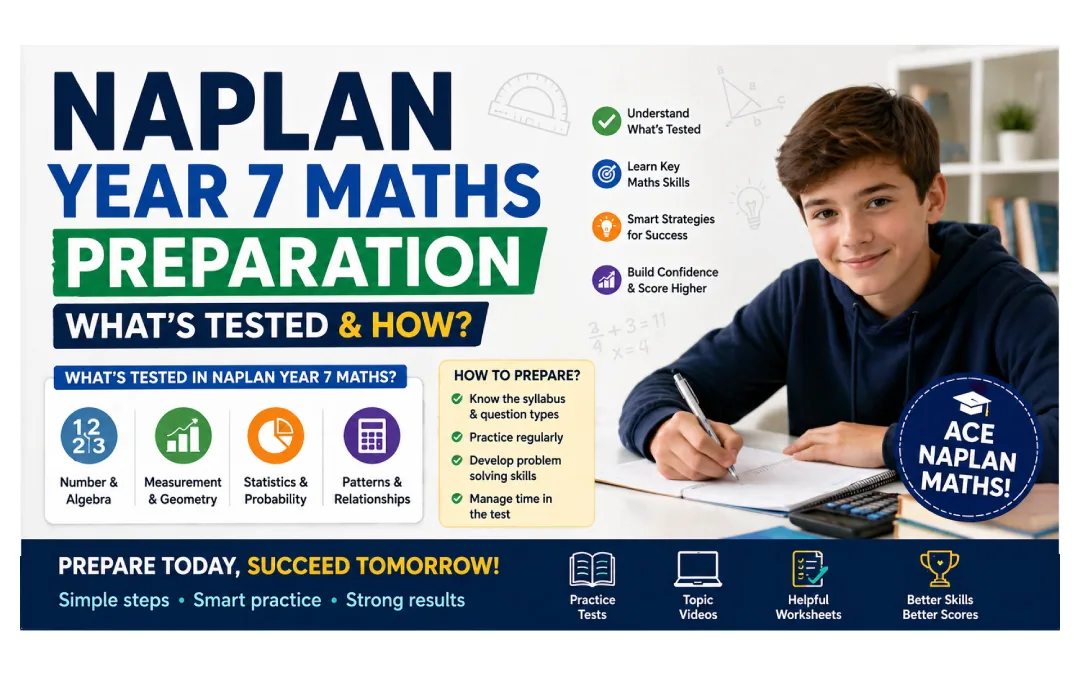
Getting Ready for NAPLAN Year 7 Maths
NAPLAN is one of the most discussed assessments in Australian education, and for many families, Year 7 is the first time their child sits it since primary school. If your child is heading into Year 7, understanding what the Numeracy test actually involves, what the scores mean, and how to help them prepare can make a significant difference. This guide to NAPLAN Year 7 maths preparation covers everything parents need to know. For one-to-one help, see our NAPLAN test preparation service.
What Is NAPLAN?
NAPLAN, the National Assessment Program: Literacy and Numeracy, is a standardised assessment taken by all Australian students in Years 3, 5, 7, and 9. It is administered by ACARA (Australian Curriculum, Assessment and Reporting Authority) and is held in March each year. You might also like Geometry Guide: Triangles, Circles and Pythagoras Explained.
The tests assess four domains:
- Reading
- Writing
- Language Conventions (spelling, grammar, punctuation)
- Numeracy (the focus of this guide)
Since 2023, results have been reported against four proficiency levels, replacing the old 10-band scale. NAPLAN is also now delivered as a fully online, adaptive test, which means the difficulty of questions adjusts in real time based on how a student is performing. This change significantly affected how students experience the test.
What Is Tested in NAPLAN Year 7 Numeracy?
The Year 7 Numeracy test covers content from the Australian Curriculum Mathematics strand, including material students should have covered from Year 4 through to Year 7. The test is divided into two components:
Non-Calculator Section
Students complete this section without any tools. Questions in this section typically assess:
- Mental arithmetic and number sense
- Fractions, decimals, and percentages
- Basic algebra (patterns and number sentences)
- Simple geometric reasoning
Calculator-Allowed Section
Students may use a calculator for this component. Questions typically assess:
- Multi-step problem solving
- Data interpretation (graphs, tables, charts)
- Measurement (area, perimeter, volume)
- Statistics and probability
- More complex number operations
Year 7 NAPLAN Numeracy: Key Topics Covered
Here is a more detailed breakdown of the content areas assessed in Year 7 Numeracy:
Number and Algebra
- Operations with whole numbers, fractions, decimals, and negative numbers
- Powers and square roots
- Order of operations (BODMAS/BIDMAS)
- Simple linear equations and substitution
- Ratios and proportional reasoning
- Percentages, finding percentages of quantities and percentage increase/decrease
Measurement and Geometry
- Perimeter, area, and volume of common 2D and 3D shapes
- Angles in triangles, quadrilaterals, and with parallel lines
- Coordinate geometry, plotting points and reading coordinates
- Transformations, reflections, rotations, translations
Statistics and Probability
- Reading and interpreting various graph types (bar, line, pie, column, dot plots)
- Mean, median, mode, and range
- Simple probability expressed as fractions, decimals, or percentages
- Understanding sample sizes and data variability
What Do NAPLAN Scores Mean?
Since 2023, NAPLAN results are reported against four proficiency levels:
| Proficiency Level | What It Means |
|---|---|
| Exceeding | Student is working well above the expected level for their year group |
| Strong | Student has demonstrated solid skills at the expected level |
| Developing | Student is approaching the expected level |
| Needs additional support | Student has not yet demonstrated the expected level |
It is important to understand that NAPLAN is not a pass/fail test, and results do not directly affect school grades or promotion to the next year group. However, they provide valuable diagnostic information about where a student’s numeracy skills sit relative to national expectations. Schools and parents receive detailed results showing not just the overall score, but performance in specific skill areas, making it possible to identify exactly where a student is strong and where support would be beneficial.
How the Adaptive Online Format Works
NAPLAN is delivered as an adaptive online test. This means:
- All students start with questions of moderate difficulty
- If a student answers correctly, subsequent questions become harder
- If a student answers incorrectly, subsequent questions become slightly easier
- The final score reflects both the difficulty of questions attempted and the accuracy of responses
The practical implication is that students should not panic if questions feel very difficult; it may mean they are being presented with higher-difficulty questions because they are performing well. Equally, if questions feel easier, it doesn’t necessarily mean the student is in trouble. One important preparation note: students who are not used to answering questions on a screen, using an online interface, or typing responses may be at a disadvantage. Familiarity with the test format matters as much as content knowledge.
When Should Year 7 NAPLAN Preparation Begin?
NAPLAN typically sits in March, in the first weeks of the school year. This means preparation should begin no later than January, ideally in November or December of the previous year. However, the most effective NAPLAN preparation is not cramming in January. It is building strong, well-rounded numeracy skills consistently throughout Years 5 and 6 so that by Year 7, students are simply applying skills they already have. If your child struggled with Year 5 NAPLAN Numeracy, Year 7 is the time to address those underlying gaps, not just the week before the test. You may also find our guide, How Much Does an Online Tutor Cost in Australia? 2026 Price Guide, useful.
Effective Preparation Strategies for Year 7 NAPLAN Numeracy
1. Do Genuine Diagnostic Work First
Before starting any practice papers, identify where your child is actually losing marks. Are they confident with fractions? Can they interpret graphs reliably? Do they struggle with multi-step word problems? The answers tell you exactly where to focus.
2. Use Official ACARA Practice Materials
ACARA publishes official sample questions and practice tests on the NAP website (nap.edu.au). These are the most accurate representation of what your child will encounter. Use them, not third-party workbooks that may not reflect the current format.
3. Practise the Online Format
Because NAPLAN is now fully online, children should practise answering questions on a device, such as a tablet or laptop, rather than on paper. ACARA’s website includes interactive practice tests in the real format.
4. Strengthen Mental Arithmetic
The non-calculator section rewards students who can compute quickly and accurately without tools. Daily mental maths practice, even 10 minutes of times tables, fraction conversions, and percentage calculations makes a measurable difference over 2–3 months.
5. Focus on Reading and Interpreting Questions Carefully
Many marks are lost in NAPLAN not because students don’t know the content, but because they misread the question, particularly multi-step word problems. Teach your child to underline key information, identify what is actually being asked, and estimate before calculating.
6. Work with a Tutor for Targeted Support
If your child has specific gaps, perhaps they’re consistently losing marks on data interpretation or struggle with fractions, a 1-to-1 tutor can target those areas directly. This is significantly more efficient than a child working through generic workbooks and hopefully covering the right content.
How Math Make Smart Supports NAPLAN Year 7 Preparation
Math Make Smart has online tutors specifically experienced in the Australian Curriculum and NAPLAN format. Tutoring sessions for Year 7 NAPLAN Numeracy are 1-to-1, online, and designed to:
- Identify specific areas of weakness using diagnostic questions
- Build fluency in the content areas most heavily tested
- Familiarise students with the online adaptive format
- Develop exam technique including time management and question interpretation
All new students receive a free trial lesson with no commitment required.
Book a free NAPLAN trial session →
Conclusion
NAPLAN Year 7 numeracy assesses the maths skills your child has built through primary school, from number and algebra to measurement, geometry, statistics and probability. Because the test is online and adaptive, steady understanding and calm problem-solving matter more than last-minute cramming.
Treat NAPLAN as a useful snapshot rather than a high-stakes exam. Regular practice, familiarity with the online format and support for any weak areas will help your child go in confident and show what they can really do.
Frequently Asked Questions
- Does NAPLAN affect my child’s school report or grades?
No. NAPLAN results are separate from school assessments and do not directly affect grades, promotion, or school reports. They are a national snapshot of literacy and numeracy skills. - What happens if my child is asked to sit NAPLAN support sessions at school?
Schools sometimes identify students for additional support based on NAPLAN results. This is a positive intervention; it means the school is taking the results seriously and providing targeted help. - Can parents opt their child out of NAPLAN?
Yes. Parents can withdraw their child from NAPLAN for any reason by submitting a written request to the school. However, the results provide genuinely useful diagnostic information, and most education professionals recommend participation. - Is Year 7 NAPLAN harder than Year 5 NAPLAN?
Yes, significantly. Year 7 NAPLAN draws on content up to early Year 7, while Year 5 NAPLAN drew on content up to early Year 5. Students who sat Year 5 NAPLAN two years ago will find the Year 7 content noticeably more demanding.