
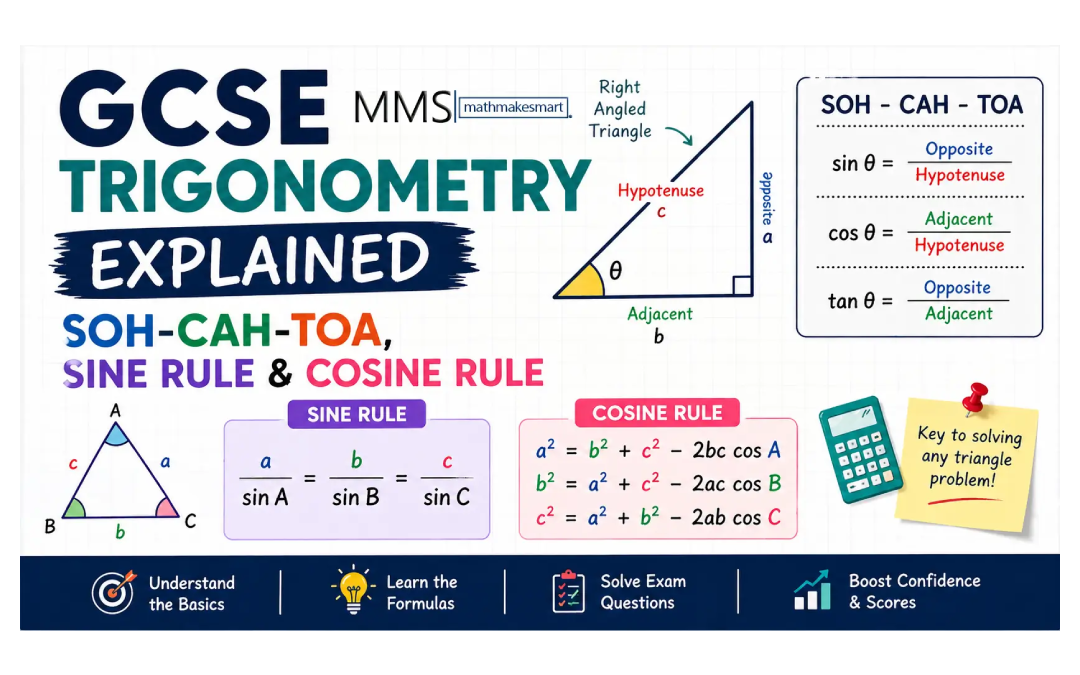
Trigonometry is consistently one of the most mark-rich topics on the GCSE Maths paper. It appears on both Foundation and Higher tier papers and can be worth up to 10 marks in a single exam, so understanding it properly is one of the highest-value things for GCSE Trigonometry Explained for students. The good news is that trigonometry is entirely learnable with the right approach. This guide walks through every core concept you need for GCSE, from basic SOH-CAH-TOA through to the Sine and Cosine rules for Higher tier.
Part 1: Right-Angled Triangles, SOH-CAH-TOA
SOH-CAH-TOA is the foundation of GCSE Trigonometry Explained. It applies to right-angled triangles only.
The Three Ratios
For a right-angled triangle, with reference to a chosen angle θ:
- Sine (sin): sin θ = Opposite ÷ Hypotenuse → SOH
- Cosine (cos): cos θ = Adjacent ÷ Hypotenuse → CAH
- Tangent (tan): tan θ = Opposite ÷ Adjacent → TOA
Labelling the Sides
Before you can use SOH-CAH-TOA, you must correctly label the three sides relative to the angle you’re working with:
- Hypotenuse: always the longest side, opposite the right angle (never changes)
- Opposite: the side directly opposite the angle θ
- Adjacent: the side next to angle θ that is not the hypotenuse
This is where most students go wrong. The opposite and adjacent sides change depending on which angle you’re working with.
Worked Example 1: Finding a Missing Side
A right-angled triangle has an angle of 35° and a hypotenuse of 12 cm. Find the length of the side opposite the 35° angle.
Step 1: Identify which sides are involved.
- We know: hypotenuse = 12 cm, angle = 35°
- We want: opposite side
Step 2: Which ratio uses the opposite and hypotenuse? → SIN
Step 3: Write the equation:
sin(35°) = Opposite / 12Step 4: Solve:
Opposite = 12 × sin(35°)
Opposite = 12 × 0.5736...
Opposite ≈ 6.88 cm (to 3 significant figures)
Worked Example 2: Finding a Missing Angle
A right-angled triangle has an opposite side of 7 cm and an adjacent side of 10 cm. Find the angle θ.
Step 1: Identify which sides are involved.
- We know: opposite = 7, adjacent = 10
Step 2: Which ratio uses opposite and adjacent? → TAN
Step 3: Write the equation:
tan(θ) = 7 / 10 = 0.7Step 4: Use inverse tan to find the angle:
θ = tan⁻¹(0.7)
θ ≈ 34.99° ≈ 35.0°
Note: On your calculator, inverse tan is usually written as tan⁻¹ or arctan, accessed via the SHIFT or 2nd button.
Which Ratio Do I Use?
| I know… | I want… | Use |
|---|---|---|
| Hypotenuse, angle | Opposite | SIN |
| Hypotenuse, angle | Adjacent | COS |
| Opposite, angle | Hypotenuse | SIN (rearranged) |
| Adjacent, angle | Hypotenuse | COS (rearranged) |
| Opposite, adjacent | Angle | TAN |
| Adjacent, hypotenuse | Angle | COS (inverse) |
| Opposite, hypotenuse | Angle | SIN (inverse) |
Part 2: Exact Values, No Calculator Required
For Paper 1 (non-calculator), you need to know these exact trigonometric values:
| Angle | sin | cos | tan |
|---|---|---|---|
| 0° | 0 | 1 | 0 |
| 30° | 1/2 | √3/2 | 1/√3 |
| 45° | √2/2 | √2/2 | 1 |
| 60° | √3/2 | 1/2 | √3 |
| 90° | 1 | 0 | undefined |
How to Remember Them
For sin values (0° to 90°): √0/2, √1/2, √2/2, √3/2, √4/2 , this gives 0, 1/2, √2/2, √3/2, 1
Cos is sin in reverse. Tan is sin ÷ cos.
Part 3: Pythagoras’ Theorem (Foundation and Higher)
Pythagoras is often tested alongside trigonometry and applies to right-angled triangles:
a² + b² = c², where c is the hypotenuse.
When to Use Pythagoras vs Trigonometry
- Pythagoras: Use when you know two sides and want the third; no angle needed.
- Trigonometry: Use when an angle is involved, either given or asked for.
Part 4: Sine Rule (Higher Tier)
The Sine Rule applies to any triangle, not just right-angled ones.
Formula:
a / sin(A) = b / sin(B) = c / sin(C)Where a, b, c are side lengths and A, B, C are the angles opposite those sides.
When to Use the Sine Rule
Use the Sine Rule when you know:
- Two angles and one side (AAS or ASA) to find another side
- Two sides and a non-included angle (SSA) to find another angle
Worked Example 3: Sine Rule to Find a Side
Triangle ABC has angle A = 40°, angle B = 75°, and side b = 9 cm. Find side a.
Step 1: Identify: A = 40°, B = 75°, b = 9, find a.
Step 2: Apply Sine Rule:
a / sin(40°) = 9 / sin(75°)Step 3: Solve for a:
a = 9 × sin(40°) / sin(75°)
a = 9 × 0.6428 / 0.9659
a ≈ 5.99 cm ≈ 6.00 cm
Part 5: Cosine Rule (Higher Tier)
The Cosine Rule also applies to any triangle and is used in different situations from the Sine Rule.
Formula (finding a side):
a² = b² + c² − 2bc cos(A)Formula (finding an angle):
cos(A) = (b² + c² − a²) / (2bc)When to Use the Cosine Rule
Use the Cosine Rule when you know:
- Two sides and the included angle (SAS) to find the third side
- All three sides (SSS) to find any angle
Worked Example 4: Cosine Rule to Find a Side
Triangle has sides b = 8 cm, c = 5 cm, and included angle A = 60°. Find side a.
Step 1: Apply Cosine Rule:
a² = 8² + 5² − 2(8)(5) cos(60°)
a² = 64 + 25 − 80 × 0.5
a² = 89 − 40
a² = 49
a = 7 cm
Worked Example 5: Cosine Rule to Find an Angle
A triangle has sides a = 7 cm, b = 8 cm, c = 5 cm. Find angle A.
Step 1: Use the angle-finding version:
cos(A) = (b² + c² − a²) / (2bc)
cos(A) = (64 + 25 − 49) / (2 × 8 × 5)
cos(A) = 40 / 80
cos(A) = 0.5
A = cos⁻¹(0.5) = 60°
Part 6: Area of a Triangle Using Trigonometry (Higher)
For non-right-angled triangles, when you know two sides and the included angle:
Area = (1/2) × a × b × sin(C)Worked Example 6
Find the area of a triangle with sides a = 6 cm, b = 9 cm, and included angle C = 50°.
Area = (1/2) × 6 × 9 × sin(50°)
Area = (1/2) × 54 × 0.7660
Area ≈ 20.7 cm²
Choosing the Right Method, Exam Summary
| Scenario | Triangle Type | Use |
|---|---|---|
| Find side/angle, right-angled triangle | Right-angled | SOH-CAH-TOA |
| Find side (2 angles + 1 side) | Any | Sine Rule |
| Find angle (2 sides + opposite angle) | Any | Sine Rule |
| Find side (2 sides + included angle) | Any | Cosine Rule |
| Find angle (3 sides known) | Any | Cosine Rule |
| Find area (2 sides + included angle) | Any | Area = ½ab sin C |
| Find third side (2 sides, right-angled) | Right-angled | Pythagoras |
Practice Questions
Foundation (SOH-CAH-TOA):
- A right-angled triangle has a hypotenuse of 15 cm and an angle of 42°. Find the opposite side.
- A right-angled triangle has opposite = 5 cm and hypotenuse = 13 cm. Find the angle.
Higher (Sine/Cosine Rule): 3. Triangle PQR: P = 50°, Q = 65°, r = 10 cm. Find side p. 4. Triangle with sides 6, 8, 10 cm. Is it right-angled? (Hint: check with Pythagoras first, then find the largest angle using the Cosine Rule.)
Struggling With Trigonometry or Other GCSE Maths Topics?
Math Make Smart provides 1-to-1 online GCSE Maths tutoring with subject specialist online tutors experienced in AQA, Edexcel, and OCR. Sessions are personalised to your child’s specific topic gaps and include worked examples, past paper practice, and exam technique coaching.