
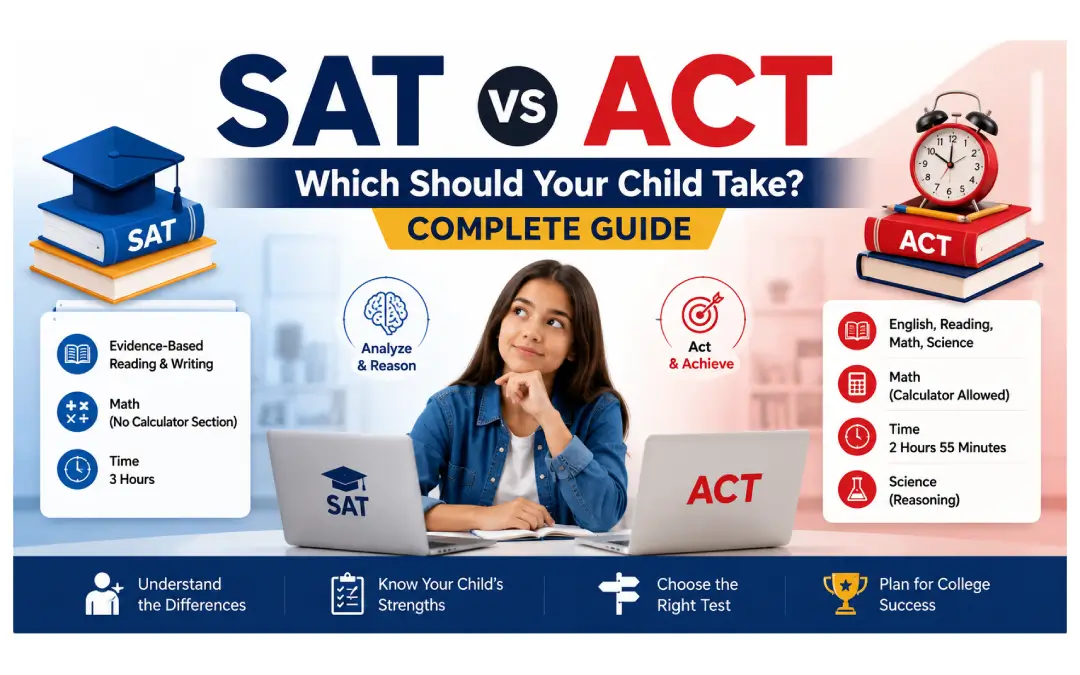
For students applying to US colleges and universities, the SAT and ACT are among the most consequential exams they will sit. A strong score opens doors to scholarship opportunities, more competitive universities, and stronger application packages. A weak score in a subject a student is otherwise capable of can close them just as quickly. This SAT vs ACT guide gives students and parents a complete picture of both exams. What’s on each test, how they differ, which one suits which type of student, and how to do online test preparation effectively.
The Big Picture: SAT vs ACT at a Glance
| Feature | SAT | ACT |
|---|---|---|
| Administrator | College Board | ACT, Inc. |
| Total time | ~2 hrs 14 min (digital) | 2 hrs 55 min (paper) / ~2 hrs 20 min (digital) |
| Sections | Reading & Writing, Math | English, Math, Reading, Science |
| Score range | 400–1600 | 1–36 (composite) |
| Science section | No | Yes |
| Calculator use | Yes (digital tools built in) | Permitted throughout |
| Accepted by | All US colleges and universities | All US colleges and universities |
| Format | Digital (2024 onwards) | Digital and paper available |
Both tests are accepted equally by all US universities. There is no advantage to submitting one over the other; admissions officers treat them as equivalent. The question is simply which test plays more to your child’s strengths.
The Digital SAT
The SAT moved to a fully digital, adaptive format in 2024. This is a significant change from the paper-based SAT that many parents remember, and it affects preparation strategies considerably.
Key features of the digital SAT:
- Delivered on a laptop or tablet using the College Board’s Bluebook app
- Adaptive: the difficulty of the second module in each section adjusts based on performance in the first module
- Shorter than the previous paper SAT (approximately 2 hours 14 minutes)
- Built-in calculator available throughout the entire Math section
- Desmos graphing calculator available within the app
The adaptive format means that students who perform well in the first module will face harder questions in the second, and these harder questions are worth more. Students need to both understand the content and manage the pressure of knowing that early performance shapes the rest of the test.

SAT: What’s Tested?
Reading and Writing (800 points)
The Reading and Writing section presents short passages followed by questions testing:
- Craft and Structure: vocabulary in context, text structure, purpose, cross-text connections
- Information and Ideas: comprehension, supporting claims with evidence, data analysis
- Standard English Conventions: punctuation, sentence structure, grammar
- Expression of Ideas: rhetorical synthesis, transitions
The shift to shorter passages means more questions per passage and a faster pace. Students who struggle with reading speed under time pressure often find the digital SAT format more manageable than the old paper version.
Math (800 points)
The SAT Math section covers four content areas:
- Algebra: linear equations, systems of equations, linear functions
- Advanced Math: quadratic and exponential functions, polynomials, complex equations
- Problem-Solving and Data Analysis: ratios, rates, percentages, data interpretation, probability
- Geometry and Trigonometry: area, volume, right triangles, circles, trigonometric functions
The majority of marks (around 70%) come from Algebra and Advanced Math. Students with strong algebraic skills tend to do well on SAT Math even with weaker geometry knowledge.
ACT: What’s Tested?
English (36 points)
75 questions in 45 minutes covering:
- Grammar, punctuation, and usage
- Sentence structure and organisation
- Rhetorical skills improving clarity, style, and organisation of passages
For English learning and concepts, you can hire an online English tutor.
Math (36 points)
60 questions in 60 minutes covering pre-algebra through to trigonometry and basic statistics. Unlike the SAT, the ACT Math section also includes:
- Matrices and vectors
- Logarithms
- Complex number operations
Students who have taken Pre-Calculus or higher often find ACT Math more straightforward than SAT Math. Get learned by an expert online Math tutor.
Reading (36 points)
40 questions in 35 minutes, four passages across literary narrative, social science, humanities, and natural science. The pace is demanding. Students read roughly 3,500 words and answer 40 questions in 35 minutes, leaving less than a minute per question.
Science (36 points)
This is the section that surprises many students; ACT Science does not actually require much science knowledge. It tests data interpretation, graph reading, and scientific reasoning through passages that present experiments, conflicting viewpoints, and data sets. Strong critical reading skills matter more than specific knowledge of science content here. Clear your concepts with our expert science tutor.
Optional Writing
Both SAT and ACT offer an optional essay. Very few US colleges now require it. Check your target schools’ requirements before deciding whether to sit it.

Which Test Is Right for Your Child?
This is the most important question, and the best way to answer it is to sit a full-length practice test for each and compare scores.
Students who tend to prefer the SAT:
- Strong algebra and advanced maths skills
- Comfortable reading carefully and precisely
- Prefer shorter, more focused passages
- Work better in a slightly shorter, adaptive format
Students who tend to prefer the ACT:
- Strong across all subjects including science reasoning
- Comfortable working at a faster pace
- Have covered Pre-Calculus or trigonometry
- Prefer a more predictable, non-adaptive format
The practical recommendation: Sit one official SAT practice test and one official ACT practice test. Convert both scores to a comparable scale (concordance tables are available from College Board and ACT). Whichever produces a higher equivalent score is the stronger starting point.
Target Scores by University Tier
| University Tier | SAT Target | ACT Target |
|---|---|---|
| Ivy League / MIT / Stanford | 1500–1580+ | 34–36 |
| Top 30 universities (e.g., UCLA, Michigan) | 1350–1500 | 30–34 |
| Top 100 universities | 1200–1380 | 26–31 |
| Good four-year colleges | 1050–1200 | 22–26 |
| Minimum for most four-year colleges | 900–1050 | 18–22 |
These are approximate medians for enrolled students. Many universities are test-optional, but submitting a strong score still strengthens applications at test-optional schools.
Effective SAT and ACT Preparation Strategies
Start with a Diagnostic Test
Don’t begin content revision without first sitting a full-length practice test under timed conditions. This tells you exactly where your child is starting from and which sections need the most attention.
Use Official Materials
- SAT: College Board publishes free official practice tests on Khan Academy and through the Bluebook app. These are the most accurate representation of the real test.
- ACT: ACT publishes official practice tests at act.org. Third-party materials vary in quality.
Set a Target Score Early
Knowing which universities your child is aiming for and what scores those universities expect lets you set a clear, measurable target. This focuses preparation and avoids the trap of over-preparing for sections where scores are already competitive.
Understand the Test Format Not Just the Content
Both the SAT and ACT have specific question types that appear repeatedly. Learning to recognise common question patterns and the most efficient way to answer each type is as important as content knowledge.
Time Management Is Critical
Both tests require strict time management. Students should practise pacing from the very beginning not just in the final weeks. Completing each section within the time limit, while maintaining accuracy, is a skill that requires deliberate practice.
How Math Make Smart Supports SAT and ACT Students
Math Make Smart provides 1-to-1 online tutoring for SAT and ACT preparation. Our specialist tutors work with students on all sections: Reading, Writing, Math, and ACT Science. With sessions tailored to each student’s diagnostic results and target scores. We support students across the UK, US, Australia, Canada, and New Zealand preparing for SAT and ACT for US college applications. All sessions are online and flexible around school timetables. Every new student receives a free trial lesson with no commitment required.
Book Your Free SAT/ACT Trial Session →
Frequently Asked Questions
- How many times can a student sit the SAT or ACT? Both tests can be sat multiple times. Most students sit 2–3 times to achieve their best score. Colleges generally see the highest score (SAT) or the best composite (ACT), and many use superscoring, taking the highest section scores from multiple sittings.
- When should my child start SAT or ACT preparation? Most students begin in Year 11 (US Grade 10–11), aiming to have a strong score by the end of Year 12 so there is time to resit if needed. Starting preparation 4–6 months before the first sitting is typical.
- Is the SAT or ACT harder? Neither is objectively harder; they test different skills. The ACT is faster-paced; the SAT requires deeper analytical reading. The best test is the one that plays to your child’s strengths.
- Do UK students need the SAT or ACT? UK students applying to US universities typically need either the SAT or ACT. Requirements vary by institution; always check each university’s admissions requirements, as some accept A-Level results in place of standardised tests.