
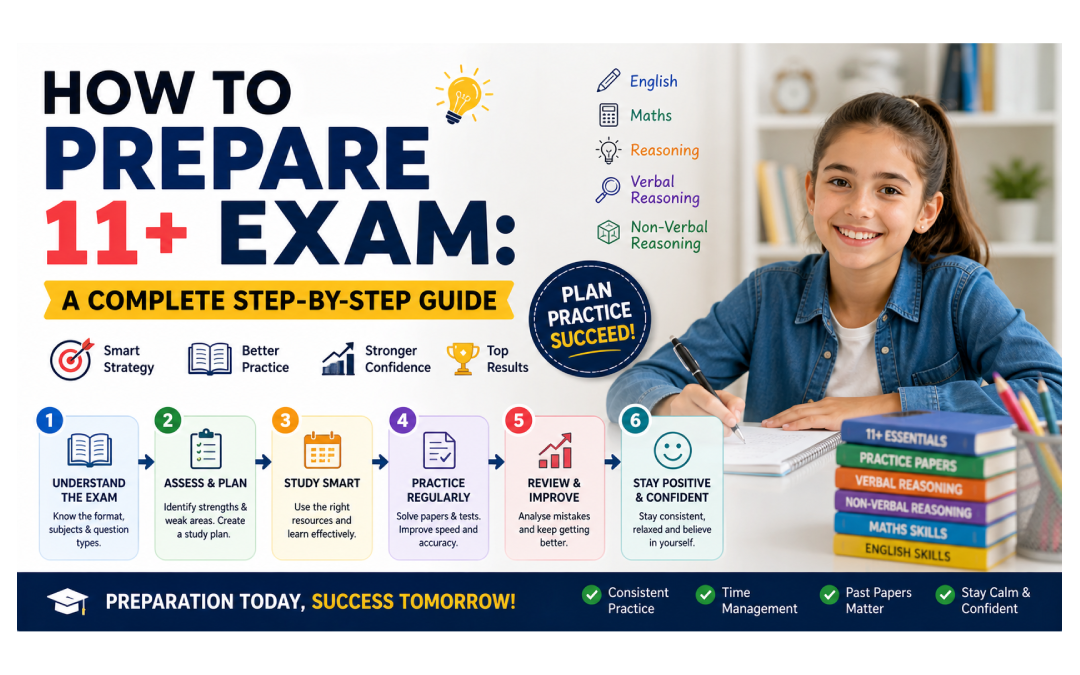
The 11+ exam is one of the most competitive assessments in the UK education system. Each year, thousands of children want to know how to prepare the 11+ Exam to secure a place at a grammar school or independent school, often against hundreds of other well-prepared candidates. Getting the preparation right matters enormously. This guide gives parents a clear, step-by-step plan, from understanding what’s actually tested to what effective preparation looks like month by month.
What Is the 11+ Exam?
The 11+ is an entrance examination taken by children in Year 6 (aged 10 & 11), used by grammar schools and many independent schools to assess suitability for selective secondary education. The name comes from the fact that it was traditionally taken at age 11, before the transition to secondary school. There is no single national 11+ exam. Different schools and local authorities use different exam providers, with the most common being:
- GL Assessment (Granada Learning) used by most grammar schools in England
- CEM (Centre for Evaluation and Monitoring) used in areas including Durham, Birmingham, and parts of the south-east
- Independent school papers used by individual independent schools, often more demanding
Parents need to find out online tutors for test preparation which follow the curriculum their target school uses, as the style and content of the test varies significantly.
What is tested in the 11+ test?
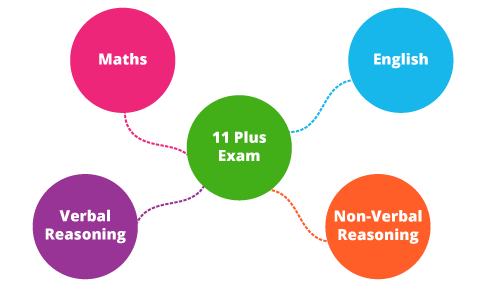
Most 11+ test preparation requires some combination of these four areas:
English / Verbal Reasoning
- Reading comprehension
- Vocabulary and word meanings
- Synonyms and antonyms
- Spelling, punctuation, and grammar
- Verbal analogies and word relationships (particularly in GL Assessment)
Maths / Numerical Reasoning
- Arithmetic (all four operations, fractions, decimals, percentages)
- Problem-solving and word problems
- Data handling and number patterns
- Shape, space, and measures
Verbal Reasoning
- Word codes and letter patterns
- Analogies and word classifications
- Sequences and logic puzzles
- Found primarily in GL Assessment papers
Non-Verbal Reasoning
- Pattern recognition
- Shape sequences and spatial awareness
- Figure matrices and rotations
- Found in both GL and CEM papers
CEM papers tend to test English, Maths, and a combination of verbal and non-verbal reasoning in a more integrated format. They are widely considered harder to specifically prepare for because the style of questions is less predictable.
When Should 11+ Preparation Begin?
This is the question parents ask most frequently, and the honest answer depends on the child. Minimum preparation: Most children need at least 6 months of structured preparation. For children sitting the exam in September of Year 6, this means starting in March of Year 5 at the latest.
Recommended preparation: 9 to 12 months of consistent, moderate-intensity work produces the strongest results without burning children out. Starting in Year 5 and building gradually through to the exam gives the most time for skills to develop naturally.
Early preparation: Some parents begin exploring 11+ style questions in Year 4, focusing on developing reading habits, mental maths, and puzzle-solving. This is reasonable if approached gently; the goal is building strong foundations, not drilling Year 4 children with exam papers.
The most common mistake is starting too late, often in September of Year 6, giving a child just weeks before the exam. By this point, there is simply not enough time to close genuine gaps.
Step-by-Step 11+ Preparation Plan
Step 1: Find Out Which Exam Your Child Will Sit
Contact your target schools and ask which 11+ provider they use (GL Assessment, CEM, or their own paper) and what subjects are included. This shapes everything else.
Step 2: Assess Your Child’s Current Level
Before buying books or hiring a tutor, spend a week doing a baseline assessment. Sit your child down with a few practice questions in each subject area and note:
- Which types of questions they find straightforward
- Which types they find challenging
- How they respond to pressure and time constraints
This tells you where to focus your preparation time.
Step 3: Build the Foundations (6 to 12 Months Before)
Before tackling practice papers, ensure the underlying skills are strong:
- Maths: Times tables to 12×12 should be automatic. Fraction, decimal, and percentage conversions should be fluent. Division and multiplication of larger numbers should be reliable.
- English: Daily reading is non-negotiable. Children who read widely have larger vocabularies, better comprehension, and stronger writing skills than those who don’t. Aim for 20 to 30 minutes of reading per day.
- Verbal reasoning: Introduce verbal reasoning puzzle books early. These are available from major publishers and help children get familiar with question types.
Step 4: Introduce Structured Practice (4 to 6 Months Before)
Once foundations are in place, begin working through past papers and practice papers systematically:
- Start with untimed practice to build familiarity without pressure
- Move to timed practice once the child is comfortable with question formats
- Review every incorrect answer carefully; understanding why an answer was wrong is more valuable than getting a high score
Aim for 3 – 4 practice sessions per week of 30 – 45 minutes each, not marathon sessions. Shorter, focused practice is more effective at this age.
Step 5: Target Weak Areas (2 to 4 Months Before)
By now, you should have a clear picture of where your child is losing marks. Focus preparation time on these areas:
- If non-verbal reasoning is weak, use puzzle books and visual pattern exercises
- If maths word problems are the issue, practise translating wordy questions into calculations
- If vocabulary is limiting comprehension, use vocabulary-building apps and targeted reading
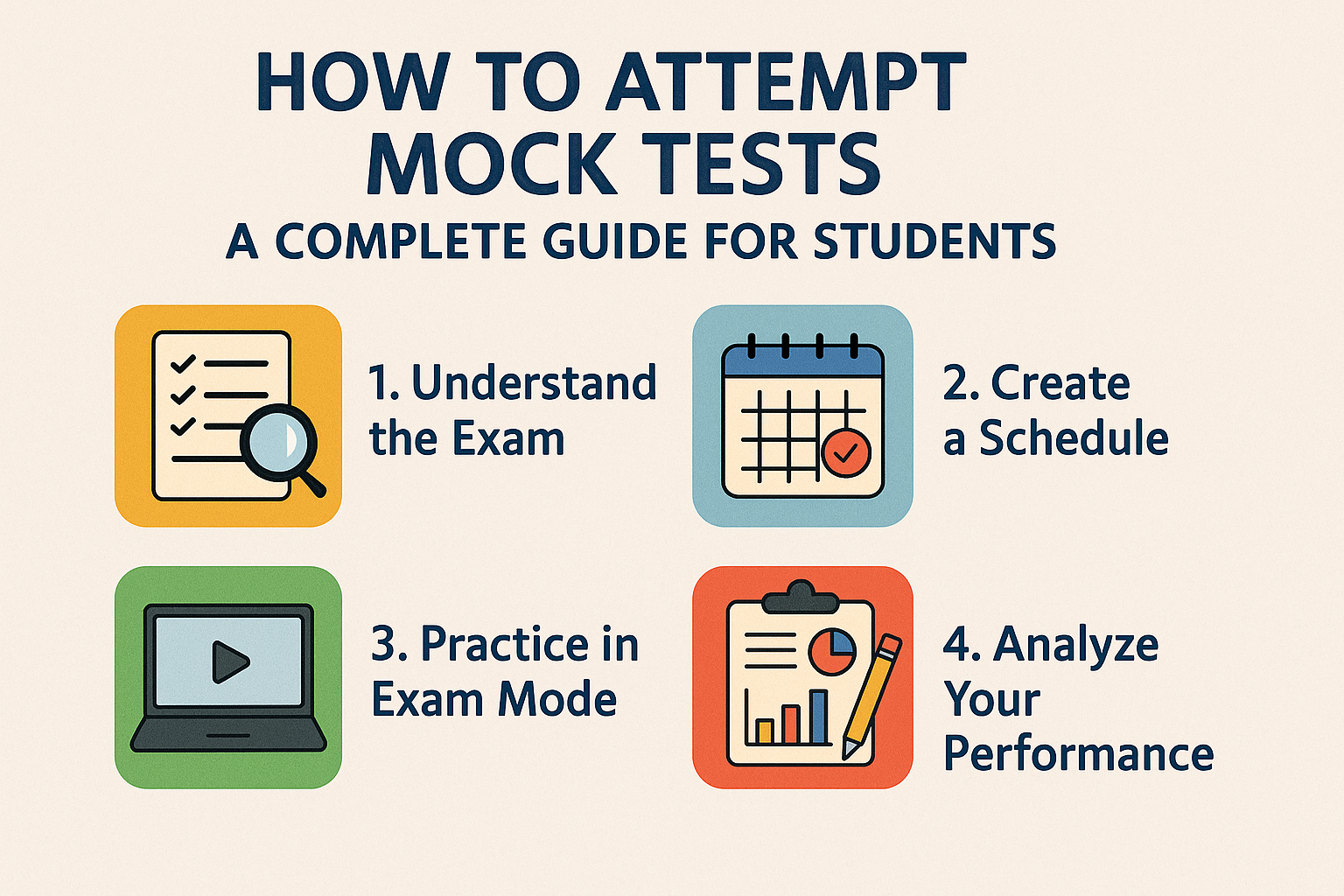
Step 6: Full Mock Papers Under Exam Conditions (4 to 8 Weeks Before)
In the final weeks, simulate exam conditions as closely as possible:
- Use a proper desk with minimal distractions
- Time each paper strictly
- Use only what would be permitted in the real exam
- Review results with your child calmly and constructively
This phase is about building exam confidence and stamina, not introducing new content.
Step 7: The Week Before the Exam
Do very little structured preparation in the final week. Light review, plenty of sleep, good food, and a calm household matter more than one more practice paper. Anxiety in children is often a reflection of parental anxiety; staying positive and reassuring makes a genuine difference.
How a Tutor Can Help: How to Prepare 11+ Exam
Many children benefit significantly from working with an experienced 11+ tutor, particularly in these situations:
- When parents aren’t confident assessing their child’s gaps themselves
- When a child needs external accountability to maintain regular practice
- When non-verbal reasoning or verbal reasoning is genuinely weak; these are skills that benefit from structured teaching
- When a child responds better to instruction from someone other than a parent (very common)
A good 11+ tutor will diagnose weaknesses, provide targeted practice materials, and give honest feedback on whether a child is realistically on track for their target school. Math Make Smart offers online tutoring with specialist tutors experienced in both GL Assessment and CEM formats. Sessions are 1-to-1, and include a free trial lesson.
Book a Free 11+ Trial Lesson →
Frequently Asked Questions
Is the 11+ very difficult?
It is competitive, but “difficult” depends on the child. Children who are naturally strong in maths and English and who prepare consistently can approach the exam with confidence. The challenge is as much about exam technique and time management as raw intelligence.
What score is needed to pass the 11+?
There is no universal pass mark. Each school sets its own threshold, and this changes year to year depending on the performance of that year’s cohort. In highly competitive areas, children may need to score in the top 5–10% of all candidates.
Should I tell my child they’re preparing for the 11+?
Yes, children generally perform better when they understand the purpose of their preparation. Frame it positively: they are working hard to give themselves the best possible chance at a school they’d enjoy. Avoid placing so much pressure on the outcome that failure feels catastrophic.
What if my child doesn’t pass?
Many excellent secondary schools are non-selective. A child who doesn’t secure a grammar school place is not at a disadvantage for life; they can still achieve outstanding GCSE and A-Level results at a non-selective school, particularly with the right support.