
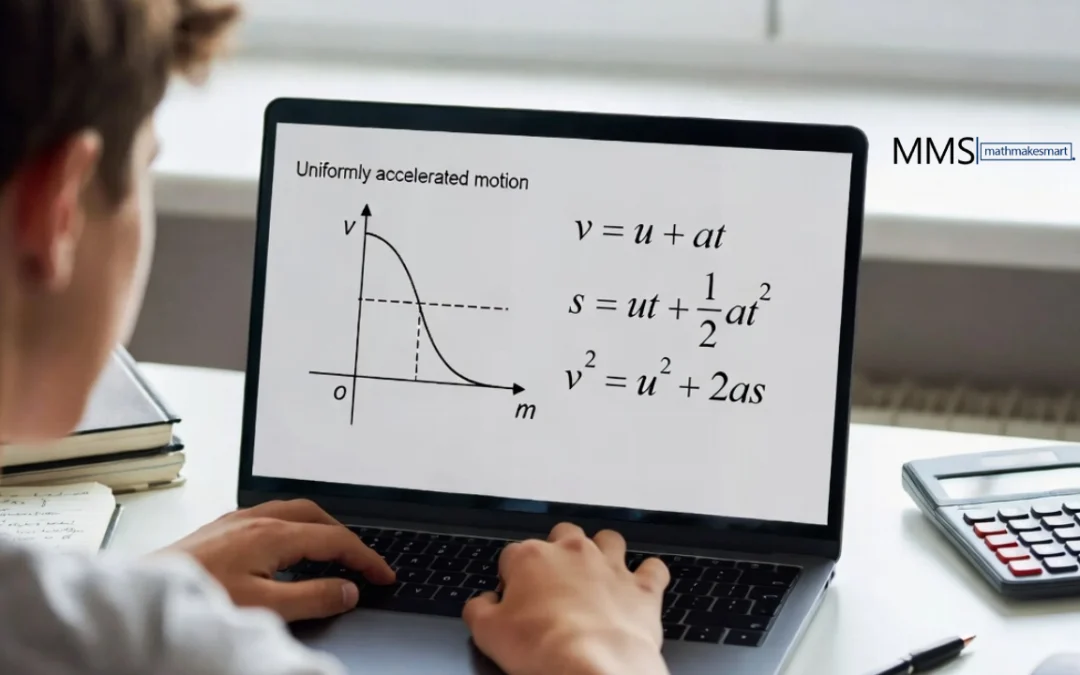
Uniformly Accelerated Motion (UAM) is one of the most important topics in high school Physics. It forms the foundation for understanding motion under constant acceleration, such as free fall, cars accelerating on highways, or objects sliding down inclined planes. In this clear and detailed guide from the best online tutoring website, Math Make Smart, we’ll walk you through how to solve uniformly accelerated motion problems step-by-step with real examples.
What is Uniformly Accelerated Motion?
Uniformly Accelerated Motion occurs when an object moves with a constant acceleration. This means its velocity changes at a steady rate.
Common real-life examples:
- A car accelerating from rest
- An object falling freely under gravity
- A ball rolling down a ramp

Key Equations for Uniformly Accelerated Motion
Here are the four main equations you need to remember:
- v=u+at v = u + at
- s=ut+12at2 s = ut + \frac{1}{2}at^2
- v2=u2+2as v^2 = u^2 + 2as
- s=(u+v)2×t s = \frac{(u + v)}{2} \times t
Where:
- u u = initial velocity
- v v = final velocity
- a a = acceleration
- t t = time
- s s = displacement
Step-by-Step Method to Solve UAM Problems
Example Problem: A car starts from rest (initial velocity = 0 m/s) and accelerates uniformly at 3 m/s² for 8 seconds. Calculate:
- Final velocity
- Distance traveled
Step 1: Identify known values u = 0 m/s (starts from rest) a = 3 m/s² t = 8 s
Step 2: Find Final Velocity Use equation 1: v = u + at v = 0 + (3 × 8) v = 24 m/s
Step 3: Find Distance Traveled Use equation 2: s = ut + ½ at² s = (0 × 8) + ½ × 3 × (8)² s = 0 + ½ × 3 × 64 s = 1.5 × 64 = 96 meters
Final Answers:
- Final velocity = 24 m/s
- Distance traveled = 96 meters
Another Example (More Challenging)
Problem: A train moving at 30 m/s begins to decelerate uniformly at 2 m/s² until it stops. How long does it take to stop, and how far does it travel during deceleration?
Solution:
Known: u = 30 m/s, v = 0 m/s (stops), a = -2 m/s²
Time to stop: v = u + at 0 = 30 + (-2) × t 2t = 30 t = 15 seconds
Distance traveled: v² = u² + 2as 0 = (30)² + 2(-2)s 0 = 900 – 4s 4s = 900 s = 225 meters
Answers:
- Time to stop = 15 seconds
- Distance traveled = 225 meters
Common Mistakes Students Make
- Forgetting the negative sign when deceleration occurs
- Mixing up the equations (using the wrong formula for the given variables)
- Not converting units properly (km/h to m/s, etc.)
- Rounding too early in multi-step calculations
Pro Tips from Our Physics Tutors
- Always list known and unknown values first
- Draw a quick motion diagram if possible
- Choose the equation that contains the three known variables and the one unknown
- Check your answer with common sense (does the number make sense?)
Need Help Mastering Uniformly Accelerated Motion or Any Physics Topic?
At Math Make Smart, our expert online Physics tutors specialize in helping students understand difficult concepts like uniformly accelerated motion through live 1-on-1 sessions.
We provide:
- Clear concept explanation with real-life examples
- Step-by-step problem-solving practice
- Exam-specific techniques and past paper practice
- Interactive virtual whiteboard sessions
- Lesson recordings for revision
Whether you need help with homework, clearing concepts, or preparing for important Physics exams (AP Physics, A-Levels, IB, GCSE, etc.), our specialist tutors can help.