
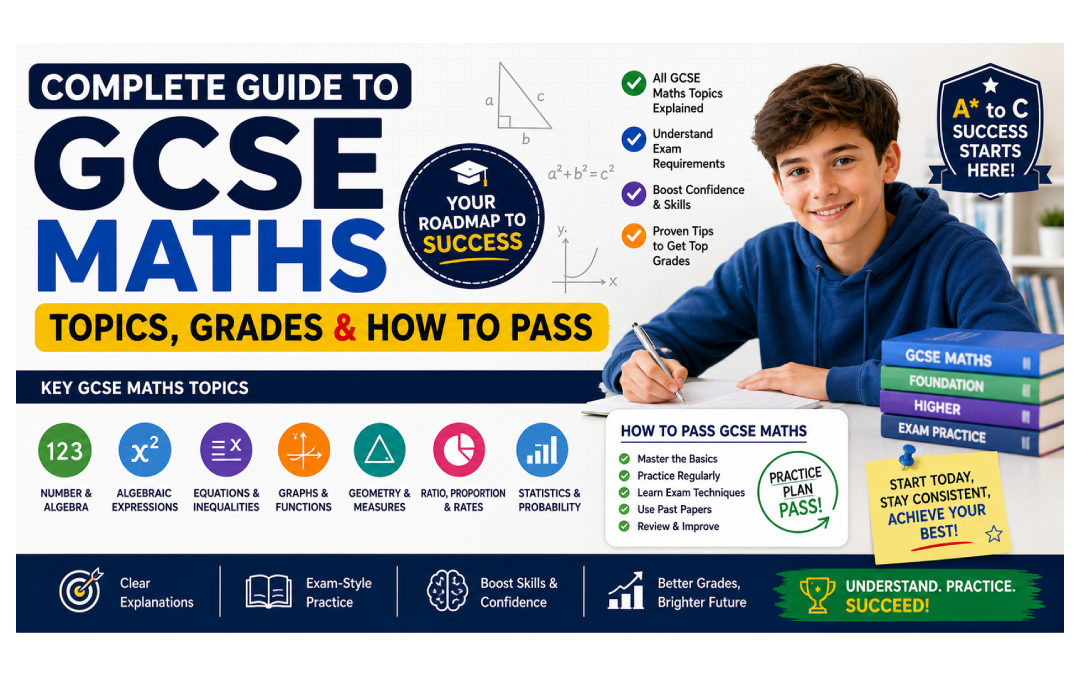
GCSE Maths is one of the most important qualifications your child will ever sit. A grade 4 or above is required for most college courses, apprenticeships, and university programmes. A grade 5 or above opens significantly more doors. And yet, it’s also the subject where many students feel the most anxiety and the least confident. This guide covers everything you need to know about GCSE Maths. MMS is the best online private tutoring website guide from what’s actually on the exam to how students can maximise their grade.
What Is GCSE Maths?
In the UK, GCSE Maths is a nationally assessed qualification taken by students in England, Wales, and Northern Ireland, typically at the end of Year 11 (age 15–16). In Wales it is called GCSE Mathematics; in Scotland, students sit National 5 instead. The qualification is graded on a 9–1 scale (9 being the highest), which replaced the old A*–G system. A grade 4 is broadly equivalent to the old grade C and is widely considered a “standard pass.” A grade 5 is considered a “strong pass.”
Which Exam Boards Offer GCSE Maths?
Three main exam boards in England offer GCSE Maths:
- AQA, the most widely used exam board in England
- Edexcel (Pearson) popular in London and many academy schools
- OCR common in grammar and independent schools
Each board covers the same national curriculum content but structures its papers slightly differently. Your child’s school will have chosen one board, and their tutor should be familiar with that board’s specific format and past papers.
How Is GCSE Maths Assessed?
All three major exam boards assess GCSE Maths through three papers sat in May/June of Year 11:
| Paper | Duration | Calculator? | Weighting |
|---|---|---|---|
| Paper 1 | 1 hr 30 min | No | 33.3% |
| Paper 2 | 1 hr 30 min | Yes | 33.3% |
| Paper 3 | 1 hr 30 min | Yes | 33.3% |
There are two tiers:
- Foundation tier grades 1–5, covering content up to Higher Foundation level
- Higher tier grades 4–9, covering more demanding content including some A-Level preparation topics
Schools decide which tier to enter students for, though students can request to be moved if they’re consistently performing above or below their predicted tier.

Key GCSE Maths Topics
General Certificate of Secondary Education – GCSE Maths is divided into six main content areas:
1. Number
- Fractions, decimals, and percentages
- Powers, roots, and standard form
- Ratio and proportion
- Bounds and estimation
2. Algebra
- Solving linear and quadratic equations
- Simultaneous equations
- Inequalities and sequences
- Graphs of functions (linear, quadratic, cubic, reciprocal)
- Factorisation and expanding brackets
3. Ratio, Proportion, and Rates of Change
- Direct and inverse proportion
- Speed, distance, time
- Compound measures (density, pressure)
- Percentage change and reverse percentages
4. Geometry and Measures
- Angles in polygons and parallel lines
- Circle theorems
- Pythagoras’ theorem and trigonometry (SOH-CAH-TOA)
- Area, volume, and surface area of 2D and 3D shapes
- Transformations (reflection, rotation, translation, enlargement)
- Vectors (Higher tier)
5. Probability
- Theoretical and experimental probability
- Combined events and tree diagrams
- Conditional probability (Higher tier)
6. Statistics
- Mean, median, mode, and range
- Frequency tables and cumulative frequency
- Histograms and box plots
- Scatter diagrams and correlation
What Are the Grade Boundaries?
Grade boundaries vary each year and by exam board, but as a general guide:
| Grade | Approximate % Score (Foundation) | Approximate % Score (Higher) |
|---|---|---|
| 9 | ….. | 85–90%+ |
| 8 | ….. | 70–80% |
| 7 | ….. | 55–65% |
| 6 | ….. | 45–55% |
| 5 | 85–90% | 35–45% |
| 4 | 60–70% | 22–30% |
| 3 | 40–50% | — |
These are approximations; check the specific exam board’s grade boundary documents after results are published each August.
The Most Common Reasons Students Underperform in GCSE Maths
Understanding why students struggle is as important as knowing the content. The most frequent issues are:
Accumulated gaps. Maths is cumulative. A student who didn’t fully understand fractions in Year 7 will struggle with algebra in Year 9 and then with simultaneous equations in Year 10. Gaps left unaddressed compound into bigger problems.
Algebraic fluency. The majority of marks lost on GCSE Higher papers come from algebraic errors, expanding brackets incorrectly, not rearranging equations carefully, or confusing negative numbers. Consistent practice is the only fix.
Exam technique. Many students know the content but lose marks through poor exam technique: not showing working, misreading questions, spending too long on one question, or not checking answers. This is teachable.
Calculator dependence. Paper 1 is non-calculator. Students who rely heavily on calculators for even basic arithmetic are at a significant disadvantage on this paper.

How to Effectively Prepare for GCSE Maths
Start Early
Year 10 is the time to begin structured preparation. Students who start reinforcing weaker topics in Year 10 arrive at their Year 11 exams with confidence and fluency. Students who start revision in April of Year 11 are fighting against time.
Use Past Papers
Past papers are the single most effective revision tool for GCSE Maths. They teach students the specific wording of questions, the typical difficulty level, and where their weaknesses lie. All major exam boards publish past papers and mark schemes freely online.
Work on Weak Topics, Not Comfortable Ones
Students naturally gravitate toward practising topics they already understand. Effective revision means identifying the specific topics where marks are being lost — and spending disproportionate time on those.
Get Targeted 1-to-1 Support
Classroom teachers cannot give every student individual attention on their specific gaps. A 1-to-1 tutor who can identify exactly where a student is losing marks and deliver targeted practice is one of the most effective interventions available.
How Math Make Smart Supports GCSE Maths Students
Math Make Smart provides 1-to-1 online Maths tutors aligned to all major UK exam boards, AQA, Edexcel, and OCR. Tutors are subject specialists with experience teaching at GCSE and A-Level, and sessions are designed around each student’s individual weaknesses rather than generic content delivery.
Every session includes:
- Diagnostic assessment to identify specific topic gaps
- Targeted teaching using worked examples and past paper questions
- Shared whiteboard for visual problem-solving
- Session notes and practice materials
Students can book a completely free trial lesson with no commitment required.
Start with a Free Trial Lesson →
Frequently Asked Questions
When should my child start GCSE Maths revision?
Structured revision should start in Year 10. Topic-specific tutoring can begin even earlier if there are gaps from KS3.
What is a good GCSE Maths grade?
A grade 5 or above is considered a strong pass and is required by many sixth forms and colleges. A grade 6 or above is required for A-Level Maths. A grade 4 is the minimum standard pass required by most employers and institutions.
Can a student move from Foundation to Higher tier?
Yes, though the school will make the decision based on predicted performance. Students consistently scoring above grade 5 on Foundation papers should discuss moving to Higher tier with their teacher.
How many hours of revision does GCSE Maths need?
Most educators recommend 1–2 hours of maths revision per week from the start of Year 10, increasing to 3–5 hours per week in the term before exams.