Geometry Guide: Triangles, Circles and Pythagoras Explained
Why Geometry Matters at Every Age
Geometry is the branch of mathematics that studies shapes, sizes, distances, and the relationships between them. It is not an abstract exercise; it describes the world around us with precision. Architects calculate roof angles using triangle properties. Pilots use circle geometry when calculating flight arcs. Even a carpenter checking whether a door frame is square is applying Pythagoras’ Theorem without naming it. For students, geometry builds a type of mathematical thinking that is genuinely different from algebra or arithmetic. It trains visual reasoning, the ability to look at a diagram and extract numerical information. That skill transfers directly to physics, engineering, design, and data science.
Across curricula worldwide, whether the Australian Curriculum, England’s National Curriculum, the US Common Core, or the IB, geometry is a consistent and heavily tested strand. Understanding it thoroughly, rather than memorising formulas in isolation, makes a meaningful difference at every examination level. This geometry guide covers the core ideas, and our tutoring services support students on every major curriculum.
Key Triangle Types and Their Properties
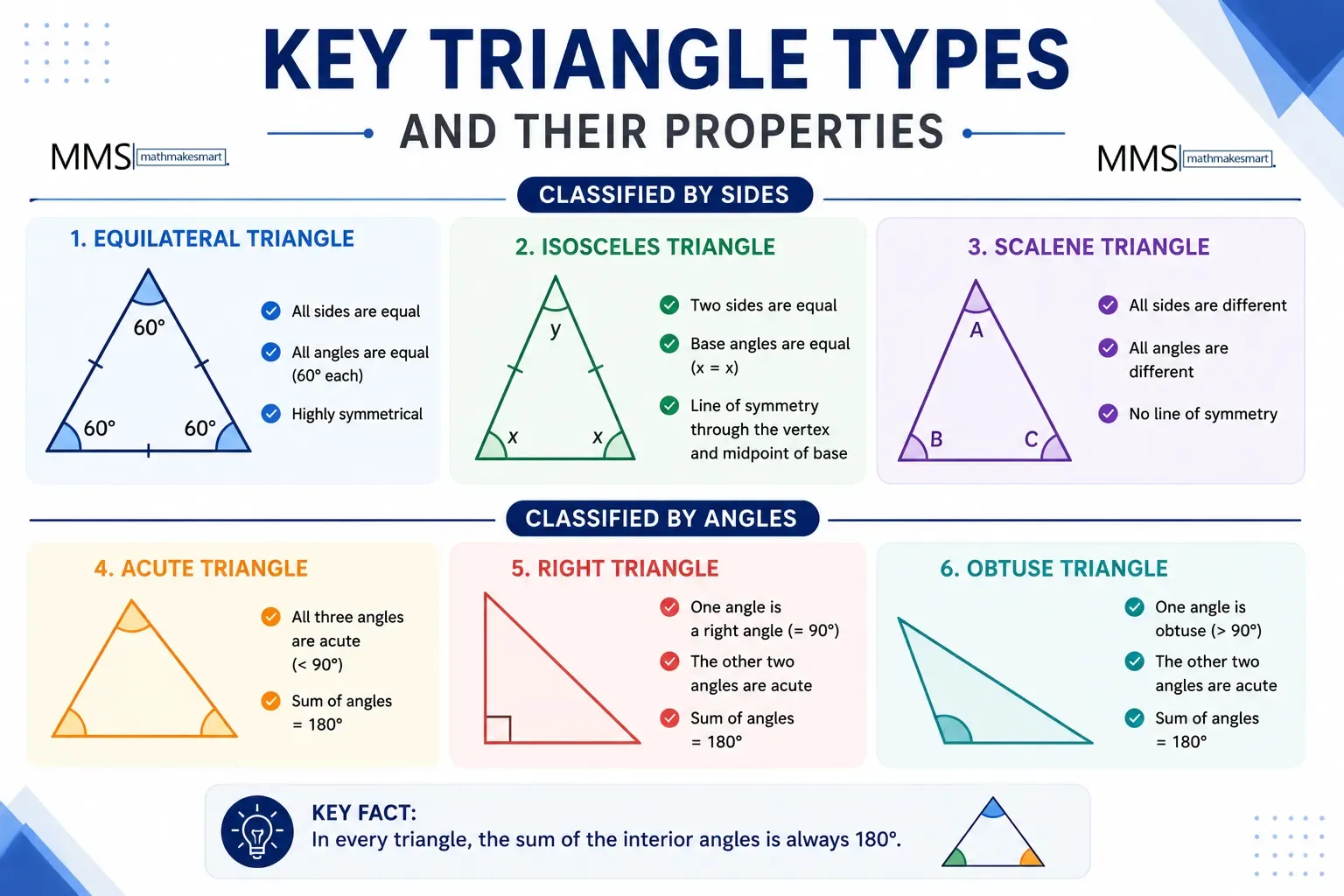
Before applying any formula, students need to recognise the type of triangle they are working with. Each type carries specific properties that determine which tools are available.
| Triangle Type | Defining Feature | Key Properties |
|---|---|---|
| Equilateral | All three sides equal | All angles = 60°; three lines of symmetry |
| Isosceles | Two sides equal | Base angles are equal; one line of symmetry |
| Scalene | No sides equal | No equal angles; no lines of symmetry |
| Right-angled | One angle = 90° | Hypotenuse is the longest side; Pythagoras applies |
| Obtuse | One angle > 90° | Longest side is opposite the obtuse angle |
| Acute | All angles < 90° | All sides relatively balanced in length |
The Angle Sum Rule
Every triangle, regardless of type, has interior angles that sum to exactly 180°. This rule is foundational; if you know two angles in a triangle, you can always find the third.
Example: A triangle has angles of 47° and 68°. The third angle = 180° − 47° − 68° = 65°.
Exterior Angles
An exterior angle of a triangle equals the sum of the two non-adjacent interior angles. So if a triangle has interior angles of 40° and 75°, the exterior angle at the third vertex is 40° + 75° = 115°. This is a frequently tested shortcut that saves time in multi-step problems.
Area and Perimeter of Triangles
Perimeter is simply the total distance around the outside; add all three sides.
If a triangle has sides of 5 cm, 7 cm, and 9 cm: Perimeter = 5 + 7 + 9 = 21 cm
Area requires the base and the perpendicular height (the height measured at 90° to the base):
Area = 1/2 × base×height
Example: A triangle has a base of 10 cm and a perpendicular height of 6 cm. Area = ½ × 10 × 6 = 30 cm²
⚠️ Common mistake: Students sometimes use a slanted side instead of the perpendicular height. Always confirm the height forms a right angle with the base before substituting.
For an equilateral triangle with side length s, the height can be derived using Pythagoras (covered shortly), giving the formula:
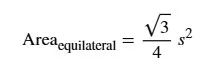
This version becomes useful at GCSE and A-Level when diagrams do not provide a height directly.
Pythagoras’ Theorem: Full Explanation
Pythagoras’ Theorem is one of the oldest and most useful results in all of mathematics. It describes a relationship between the three sides of any right-angled triangle.
The Formula
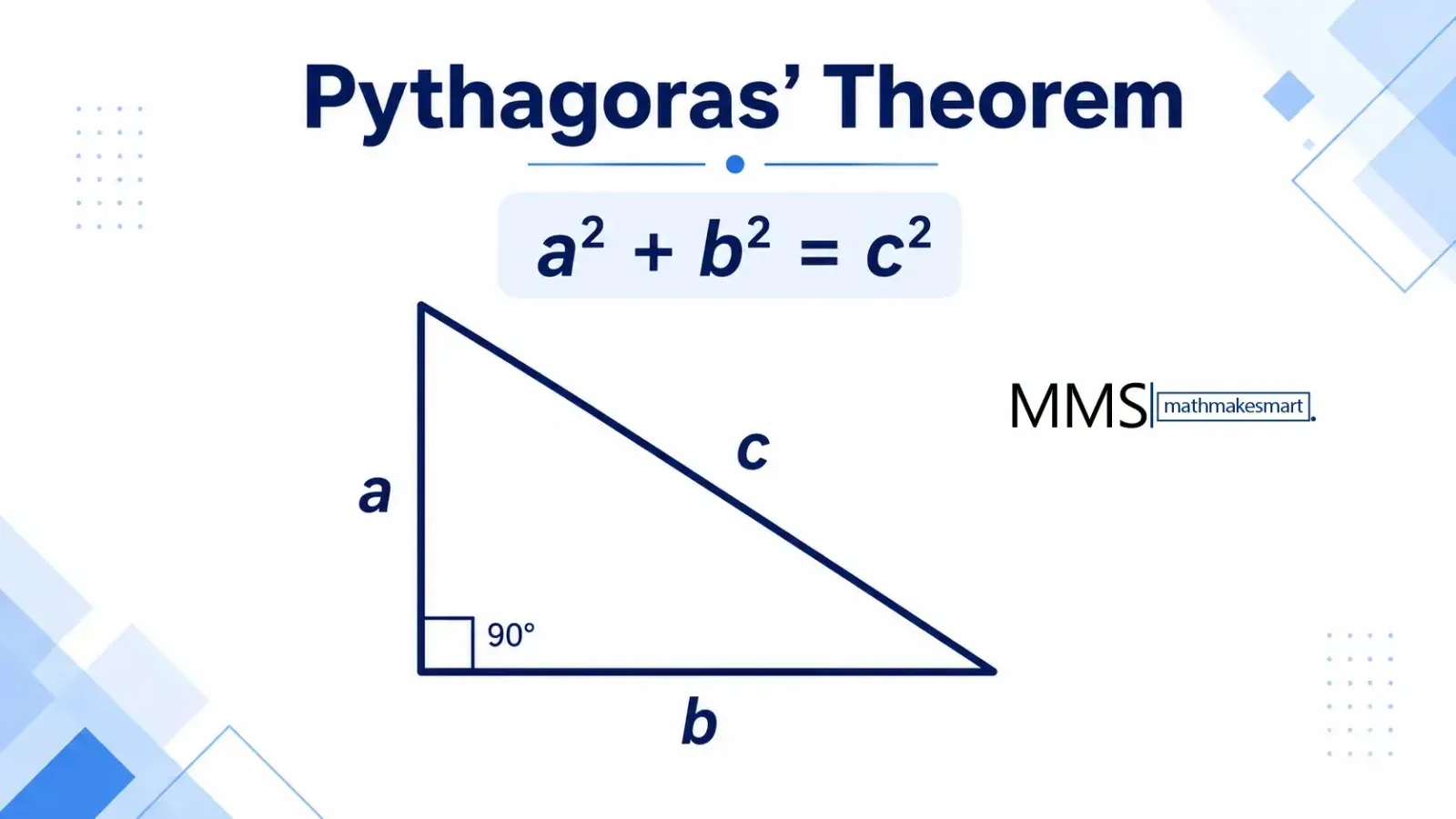
a² + b² = c²
Where:
- c is the hypotenuse: the side directly opposite the right angle, always the longest side
- a and b are the two shorter sides (sometimes called the legs of the triangle)
Why It Works: A Visual Proof
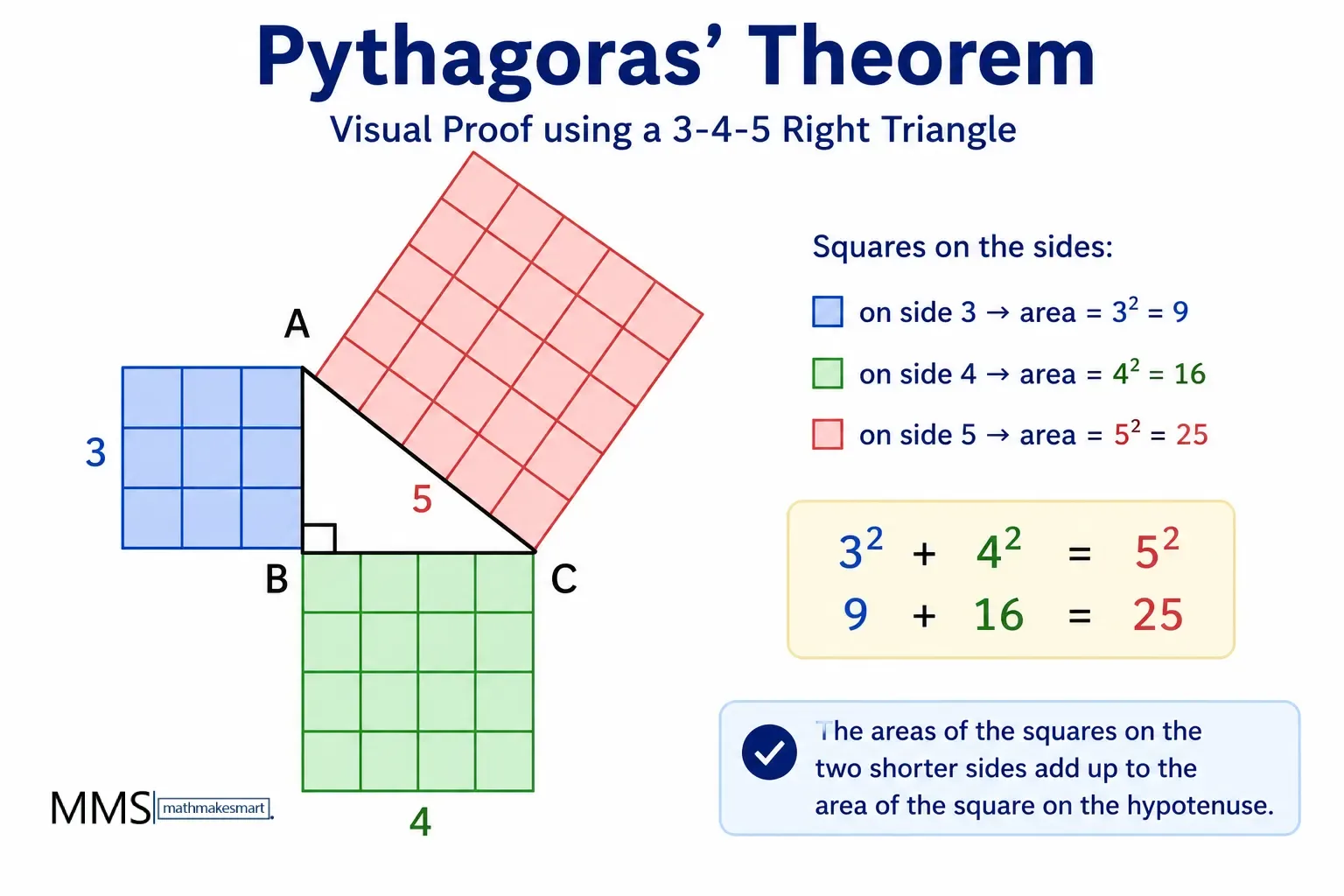
Draw a right-angled triangle with legs of 3 cm and 4 cm. Now draw a square on each side of the triangle:
- The square on the 3 cm side has area 3² = 9 cm²
- The square on the 4 cm side has area 4² = 16 cm²
- The square on the hypotenuse has area 9 + 16 = 25 cm² → so the hypotenuse = √25 = 5 cm
This geometric interpretation, that the area of the square on the hypotenuse equals the combined areas of the squares on the other two sides, is what the theorem is literally saying. Understanding it this way makes the formula genuinely memorable rather than arbitrary.
Important Restriction
Pythagoras’ Theorem only applies to right-angled triangles. Using it on a non-right-angled triangle is one of the most common errors students make. Always check for the right angle symbol (□) in the diagram before applying the formula.
Worked Examples: Pythagoras Step by Step
Example 1: Finding the Hypotenuse (Primary/Middle School Level)
A right-angled triangle has legs of 6 cm and 8 cm. Find the hypotenuse.
Step 1: Identify the hypotenuse; it is the side we are finding, call it c.
Step 2: Write the formula: a² + b² = c²
Step 3: Substitute: 6² + 8² = c²
Step 4: Calculate: 36 + 64 = c²
Step 5: Simplify: 100 = c²
Step 6: Square root both sides: c = √100 = 10 cm
Check: Does 6² + 8² = 10²? → 36 + 64 = 100 ✓
Example 2: Finding a Shorter Side (Middle/High School Level)
A right-angled triangle has a hypotenuse of 13 cm and one leg of 5 cm. Find the other leg.
Step 1: The hypotenuse is c = 13. One leg is a = 5. Find b.
Step 2: a² + b² = c²
Step 3: 5² + b² = 13²
Step 4: 25 + b² = 169
Step 5: b² = 169 − 25 = 144
Step 6: b = √144 = 12 cm
🔑 Key point: When finding a shorter side, you always subtract on the way to isolating b². Students who mistakenly add here will get a number larger than the hypotenuse, which is geometrically impossible. If your answer is bigger than c, go back and check.
Example 3: Real-World Application (High School Level)
A ladder 7.5 m long leans against a vertical wall. The base of the ladder sits 2.1 m from the base of the wall. How far up the wall does the ladder reach? Give your answer to 2 decimal places.
Diagram description: The wall is vertical, the ground is horizontal, and the ladder forms the hypotenuse. The triangle has legs = height up wall (unknown) and 2.1 m (ground distance), with hypotenuse = 7.5 m.
Step 1: c = 7.5 m, a = 2.1 m, find b.
Step 2: a² + b² = c²
Step 3: 2.1² + b² = 7.5²
Step 4: 4.41 + b² = 56.25
Step 5: b² = 56.25 − 4.41 = 51.84
Step 6: b = √51.84 = 7.20 m (to 2 d.p.)
✏️ Exam tip: In problems like this, always draw and label the triangle even if the question does not provide a diagram. Drawing it yourself removes ambiguity about which side is the hypotenuse.
The Converse of Pythagoras’ Theorem
The converse works in reverse: if you know all three sides of a triangle, you can test whether it contains a right angle.
- If a² + b² = c² → the triangle is right-angled
- If a² + b² > c² → the triangle is acute (all angles less than 90°)
- If a² + b² < c² → the triangle is obtuse (one angle greater than 90°)
Example: A triangle has sides 7 cm, 10 cm, and 12 cm. Is it right-angled?
Test: 7² + 10² vs 12²: 49 + 100 = 149, but 12² = 144.
Since 149 > 144, the triangle is acute, not right-angled.
Pythagorean Triples: The Shortcuts Worth Memorising
A Pythagorean triple is a set of three whole numbers that satisfy a² + b² = c². Recognising these saves calculation time in exams.
| Triple | Scaled Versions (×2, ×3, etc.) |
|---|---|
| 3, 4, 5 | 6-8-10 · 9-12-15 · 15-20-25 |
| 5, 12, 13 | 10-24-26 |
| 8, 15, 17 | 16-30-34 |
| 7, 24, 25 | 14-48-50 |
If you spot two sides from a known triple, the third is immediately obvious. For instance, if you see a right-angled triangle with legs 9 and 12, you instantly know the hypotenuse is 15 (the 3-4-5 triple scaled by 3), no calculation required.
Circles: Parts, Formulas, and Key Relationships
A circle is defined as all the points on a plane that are exactly the same distance from a central point. That distance is the radius. Every other measurement of a circle derives from it.
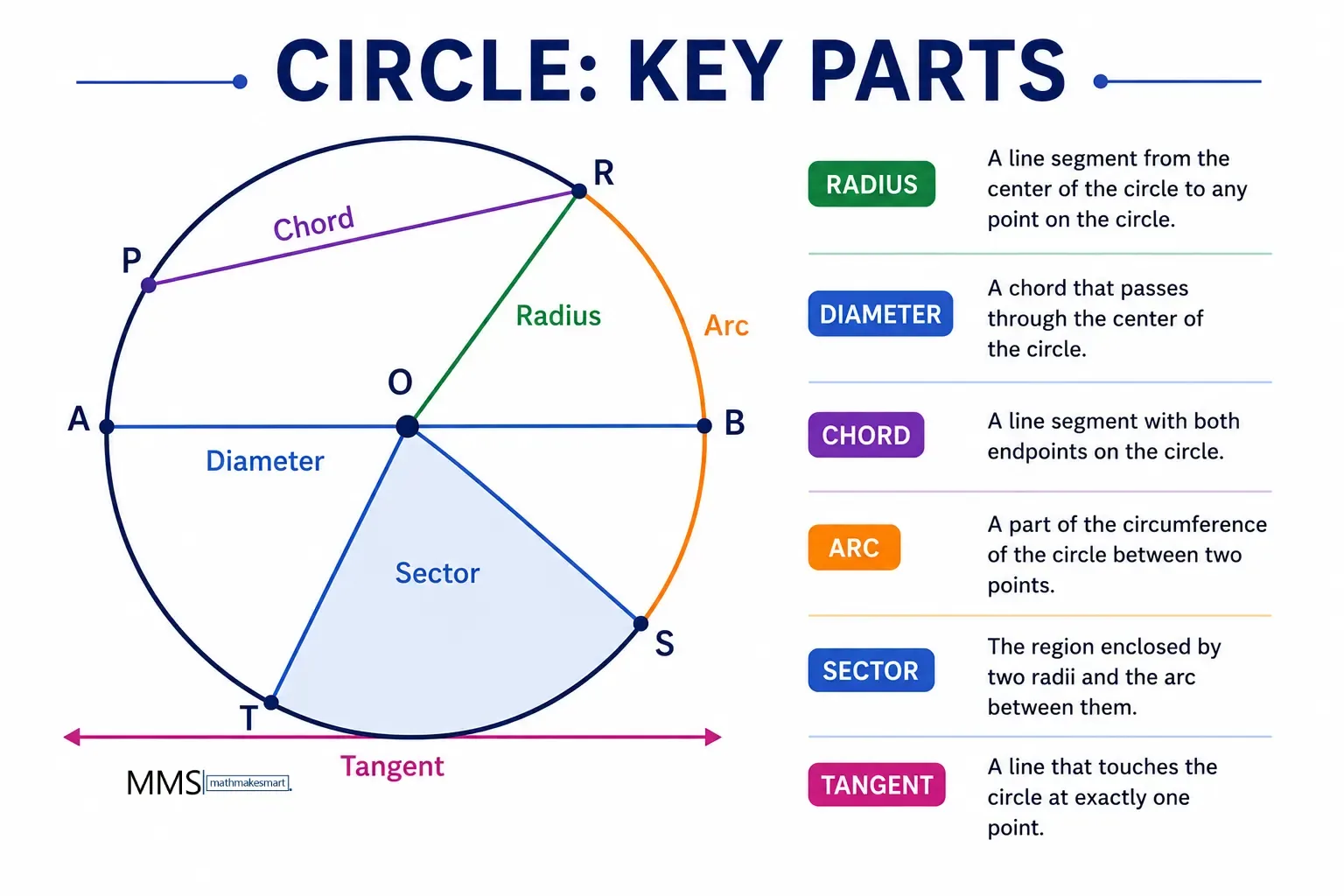
Key Parts of a Circle
| Term | Definition |
|---|---|
| Radius (r) | Distance from centre to any point on the circumference |
| Diameter (d) | Straight line through the centre; d = 2r |
| Circumference | The perimeter (outer boundary) of the circle |
| Chord | A line segment connecting two points on the circumference |
| Arc | A portion of the circumference |
| Tangent | A straight line that touches the circle at exactly one point |
| Sector | A “slice” of the circle bounded by two radii and an arc |
| Segment | The region between a chord and the arc it cuts off |
Essential Circle Formulas
Circumference = 2πr = πd
Area = πr²
Example: A circle has a radius of 5 cm.
- Circumference = 2π × 5 = 10π ≈ 31.42 cm
- Area = π × 5² = 25π ≈ 78.54 cm²
💡 Exam tip: When a question says “give your answer in terms of π”, leave it as 10π or 25π without converting to a decimal. This is an exact answer and will always earn full marks.
Arc Length and Sector Area
For a sector with angle θ (in degrees) and radius r:
Arc length = θ / 360 × 2πr
Sector area = θ / 360 × πr²
Example: Find the arc length of a sector with radius 9 cm and angle 80°.
Arc length = (80/360) × 2π × 9 = (2/9) × 18π = 4π ≈ 12.57 cm
Circle Theorems (High School Level)
Circle theorems describe relationships between angles and lengths inside and around circles. They appear frequently in GCSE, IGCSE, and equivalent examinations worldwide. Each theorem must be stated by name in exam answers to earn reasoning marks.
The Eight Core Circle Theorems
Theorem 1: Angle at the Centre The angle at the centre of a circle is twice the angle at the circumference when both are subtended by the same arc.
If the centre angle is 110°, the circumference angle is 55°.
Theorem 2: Angle in a Semicircle: An angle inscribed in a semicircle is always 90°. If a triangle is drawn with its base as the diameter, the apex angle is always a right angle.
This is one of the most tested theorems, and one of the most useful, because it creates a right-angled triangle where Pythagoras then applies.
Theorem 3: Angles in the Same Segment: Angles subtended by the same chord, on the same side of the chord, are equal.
Theorem 4: Cyclic Quadrilateral: In a quadrilateral whose four vertices all lie on a circle (a cyclic quadrilateral), opposite angles add up to 180°.
Theorem 5: Tangent–Radius: A tangent to a circle meets the radius at exactly 90° at the point of contact.
Theorem 6: Two Tangents from an External Point Tangent lines drawn from an external point to a circle are equal in length.
Theorem 7: Perpendicular from Centre to Chord: A perpendicular line drawn from the centre of a circle to a chord bisects (cuts in half) that chord.
Theorem 8: Alternate Segment Theorem: The angle between a tangent and a chord equals the angle in the alternate segment.
Circle Theorem Quick-Reference Table
| Theorem | Key Relationship |
|---|---|
| Angle at centre | Centre angle = 2 × circumference angle |
| Angle in semicircle | Angle = 90° |
| Same segment | Equal angles |
| Cyclic quadrilateral | Opposite angles sum to 180° |
| Tangent–radius | Always 90° |
| Two tangents | Equal lengths from external point |
| Perpendicular to chord | Bisects the chord |
| Alternate segment | Tangent–chord angle = angle in alternate segment |
Connecting Pythagoras and Circles
Pythagoras’ Theorem and circle geometry combine frequently in higher-level problems. The connection point is usually Theorem 2 (angle in a semicircle) or Theorem 5 (tangent–radius), both of which create right angles and therefore right-angled triangles.
Worked Example: Chord Length Using Pythagoras
Problem: A circle has centre O and radius 10 cm. A chord PQ is drawn so that the perpendicular distance from the centre O to the chord is 6 cm. Find the length of chord PQ.
Step 1: The perpendicular from the centre bisects the chord (Theorem 7). Let M be the midpoint of PQ, so OM = 6 cm and OM ⊥ PQ.
Step 2: Triangle OMP is right-angled at M, with hypotenuse OP = 10 cm (radius) and OM = 6 cm.
Step 3: Apply Pythagoras:
OM² + MP² = OP²
6² + MP² = 10²
36 + MP² = 100
MP² = 64
MP = 8 cm
Step 4: Since M is the midpoint, PQ = 2 × MP = 16 cm
Common Mistakes and How to Avoid Them
These errors appear in student work across every level. Recognising them before an exam is worth marks.
Mistake 1: Applying Pythagoras to non-right-angled triangles. Always confirm the right angle before using a² + b² = c². If the triangle is not right-angled, you need the Cosine Rule instead.
Mistake 2: Misidentifying the hypotenuse. The hypotenuse is always opposite the right angle, not necessarily the longest-looking side in a diagram. Label it first, before writing the formula.
Mistake 3: Adding instead of subtracting when finding a shorter side. If you know the hypotenuse and one leg, rearrange to b² = c² − a². The minus sign is essential. Adding here gives a value larger than the hypotenuse, which is geometrically impossible.
Mistake 4: Premature rounding. Never round intermediate values. Keep full decimal precision throughout the calculation and only round the final answer to the required accuracy. Rounding at intermediate stages cascades errors and can cost accuracy marks.
Mistake 5: Using diameter instead of radius in circle formulas. Area = πr², not πd². If you are given the diameter, halve it first. This mistake is easy to make under time pressure.
Mistake 6: Forgetting to state the circle theorem. In GCSE, IGCSE, and equivalent exams, angles found using circle theorems must be accompanied by the theorem’s name or description. Writing “90° because tangent meets radius” earns the reasoning mark; writing “90°” alone may not.
Mistake 7: Confusing arc length with sector area. Both involve (θ/360), but arc length multiplies by 2πr while sector area multiplies by πr². Keep the formulas distinct by remembering: arc is a length (one dimension), and area is two-dimensional.
Practice Questions with Full Solutions
Section A: Pythagoras (Mixed Levels)
Q1 (Primary): A right-angled triangle has legs of 9 cm and 12 cm. Find the hypotenuse.
Solution: a² + b² = c² 9² + 12² = c² 81 + 144 = c² c² = 225 c = √225 = 15 cm
(Note: this is the 3-4-5 triple scaled by 3.)
Q2 (Middle School): A right-angled triangle has a hypotenuse of 17 cm and one leg of 8 cm. Find the missing leg.
Solution: 8² + b² = 17² 64 + b² = 289 b² = 225 b = √225 = 15 cm
Q3 (High School): A rectangular field is 48 m long and 20 m wide. A path is built diagonally from one corner to the opposite corner. How long is the path? Give your answer to 1 decimal place.
Solution: The diagonal is the hypotenuse of a right-angled triangle with legs 48 m and 20 m. 48² + 20² = c² 2304 + 400 = c² c² = 2704 c = √2704 = 52.0 m
Section B: Circles
Q4 (Middle School): A circle has a diameter of 14 cm. Find its area and circumference. Give answers to 2 decimal places.
Solution: Radius = 14 ÷ 2 = 7 cm Area = π × 7² = 49π ≈ 153.94 cm² Circumference = 2π × 7 = 14π ≈ 43.98 cm
Q5 (High School): A sector has radius 12 cm and central angle 135°. Find the exact area of the sector.
Solution: Sector area = (135/360) × π × 12² = (3/8) × 144π = 54π cm²
Q6 (High School): Points A, B, and C lie on a circle with centre O. Angle BAC = 38°. Find angle BOC.
Solution: By the Angle at the Centre theorem: angle at centre = 2 × angle at circumference. Angle BOC = 2 × 38° = 76°
Exam Tips for Geometry
- Label everything before calculating. On a triangle, label sides a, b, and c (or opposite, adjacent, hypotenuse) before choosing a formula. On a circle diagram, label the radius, centre, and any chord or tangent before applying a theorem.
- Write formulas before substituting. Examiners want to see your method. Writing a² + b² = c² before substituting numbers demonstrates understanding, and earns method marks even if a calculation error follows.
- Give exact answers unless told otherwise. If the question says “give in terms of π”, do not convert. Leaving an answer as 18π is exact and correct; 56.548… is an approximation that may not match the mark scheme.
- Check the reasonableness of your answer. The hypotenuse must always be the longest side. The area of a circle must always be greater than the area of the largest square that fits inside it. A quick reasonableness check catches most errors before you write the final answer.
- Draw your own diagram when none is provided. A clearly labelled sketch takes 30 seconds and prevents misidentification of sides, angles, or positions of points.
- Know your theorems by name. Across GCSE, IGCSE, VCE, and equivalent syllabuses, stating the geometric reasoning earns separate marks. “Angles in the same segment are equal” is a complete justification; “they are both the same” is not.
FAQs
What is Pythagoras’ Theorem in simple terms?
In any right-angled triangle, the longest side squared equals the sum of the squares of the other two sides. Written as a formula: a² + b² = c², where c is the longest side (hypotenuse).
Does Pythagoras’ Theorem work on all triangles?
No, it only applies to right-angled triangles. For other triangles, you need the Cosine Rule (c² = a² + b² − 2ab·cosC), which is covered at GCSE and equivalent level.
How do I remember which side is the hypotenuse?
The hypotenuse is always directly opposite the right angle (the 90° corner). It is always the longest side. Once you identify the right angle, the side directly across from it is the hypotenuse.
What are Pythagorean triples and why should I memorise them?
Pythagorean triples are sets of whole numbers that satisfy a² + b² = c², such as 3-4-5 and 5-12-13. Recognising them in exam questions means you can state the missing side instantly without any calculation, a genuine time-saver.
How many circle theorems do I need to know for GCSE?
Most GCSE syllabuses (AQA, Edexcel, OCR in England; equivalent boards in Australia, Ireland, and elsewhere) expect students to know 7–8 circle theorems, including the angle at the centre, angle in a semicircle, cyclic quadrilateral, tangent-radius, and alternate segment theorem. Check your specific specification, as coverage can vary slightly.
How is Pythagoras’ Theorem used with circles?
When a radius meets a tangent at 90°, or when the diameter forms the base of a triangle inscribed in a circle (creating a 90° angle at the apex), a right-angled triangle exists. Pythagoras can then be applied to find missing lengths such as chord lengths, tangent lengths, or distances from the centre.
What is the difference between arc length and circumference?
Circumference is the complete perimeter of the circle (the full 360° arc). Arc length is just a portion of the circumference, calculated using (θ/360) × 2πr, where θ is the angle of the sector in degrees.
How do I find the area of a triangle if I am not given the height?
If you know all three sides, you can use Heron’s Formula. If you know two sides and the included angle, the formula ½·a·b·sinC applies. Both of these are covered at GCSE Higher and A-Level.
What is a cyclic quadrilateral?
A cyclic quadrilateral is a four-sided shape where all four vertices lie on the circumference of a circle. The defining property is that opposite angles sum to 180°, a fact that is routinely tested in geometry exams at GCSE and equivalent level.
How do I improve at geometry if I keep making mistakes?
Slow down the labelling step. Most geometry errors occur before the calculation, through misidentifying the hypotenuse, mislabelling a radius as a diameter, or applying a theorem to the wrong angle. Developing the habit of labelling every element of the diagram before writing a single formula eliminates the majority of careless mistakes.
Conclusion
Geometry rewards clear thinking and careful labelling more than raw calculation speed. Pythagoras’ Theorem is not complicated; it says that one square equals the sum of two others, but students who understand why it works will apply it correctly in unfamiliar contexts, while those who have only memorised the formula will hesitate whenever a problem looks slightly different from their practice examples.
The same applies to circle theorems. There are only eight to learn, each describing a precise, logical relationship. Stating them explicitly in exam answers is not a technicality; it is evidence of mathematical reasoning, which is exactly what examiners are looking for.
Take the practice questions in this guide seriously. Work through them with a pencil and paper, label every diagram before you write a formula, and check your final answer against the reasonableness criteria discussed. Geometry becomes significantly easier once the foundational habits are in place, and significantly more satisfying once problems that once seemed opaque start to resolve themselves logically, step by step.
If any section of this guide left you wanting a clearer explanation, more practice, or personalised support with your specific curriculum, Math Make Smart offers expert 1-on-1 online mathematics tutoring in Geometry and all other areas, from primary level through to VCE, HSC, GCSE, A-Levels, and beyond. Book a free trial lesson today.