Finding the Area of the Shaded Region Step by Step (With Examples)
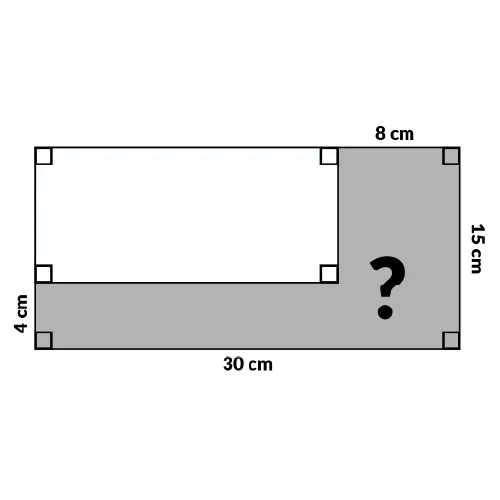
What Is the Area of a Shaded Region?
The shaded region in a geometry problem is the part of a shape or diagram that is coloured or marked differently from the rest. Finding its area usually means one of two things: either you calculate the area of a large shape and subtract the area of the smaller shape cut out of it, or you break the shaded region itself into simpler shapes and add their areas together. Both methods give the same answer; choosing which to use depends on which set of dimensions you are given.
There are two approaches:
Method 1: Subtraction (most common):
Area of shaded region = Area of outer shape − Area of inner (unshaded) shape
Use this when the shaded region surrounds a clear unshaded hole or inner shape.
Method 2: Addition:
Area of shaded region = Area of piece A + Area of piece B + Area of piece C
Use this when you can break the shaded region itself into recognisable smaller shapes and add them together.
Both methods give the same answer. Which one you choose depends on which measurements you are given in the question.
Quick Reference: Area Formulas You Need
Before the examples, here are the area formulas used in every shaded region problem. Keep these handy.
| Shape | Area Formula | Notes |
|---|---|---|
| Rectangle | Length × Width | — |
| Square | Side² | — |
| Triangle | ½ × Base × Height | Height must be perpendicular |
| Circle | π × r² | r = radius |
| Semicircle | ½ × π × r² | Half a full circle |
| Quarter circle | ¼ × π × r² | One quarter of a full circle |
| Parallelogram | Base × Height | Height is perpendicular |
| Trapezoid (trapezium) | ½ × (a + b) × Height | a and b are the parallel sides |
Use π = 3.14 for approximate answers, or leave answers in terms of π when the question asks for an exact answer.
Example 1: Rectangle with a Rectangular Cutout
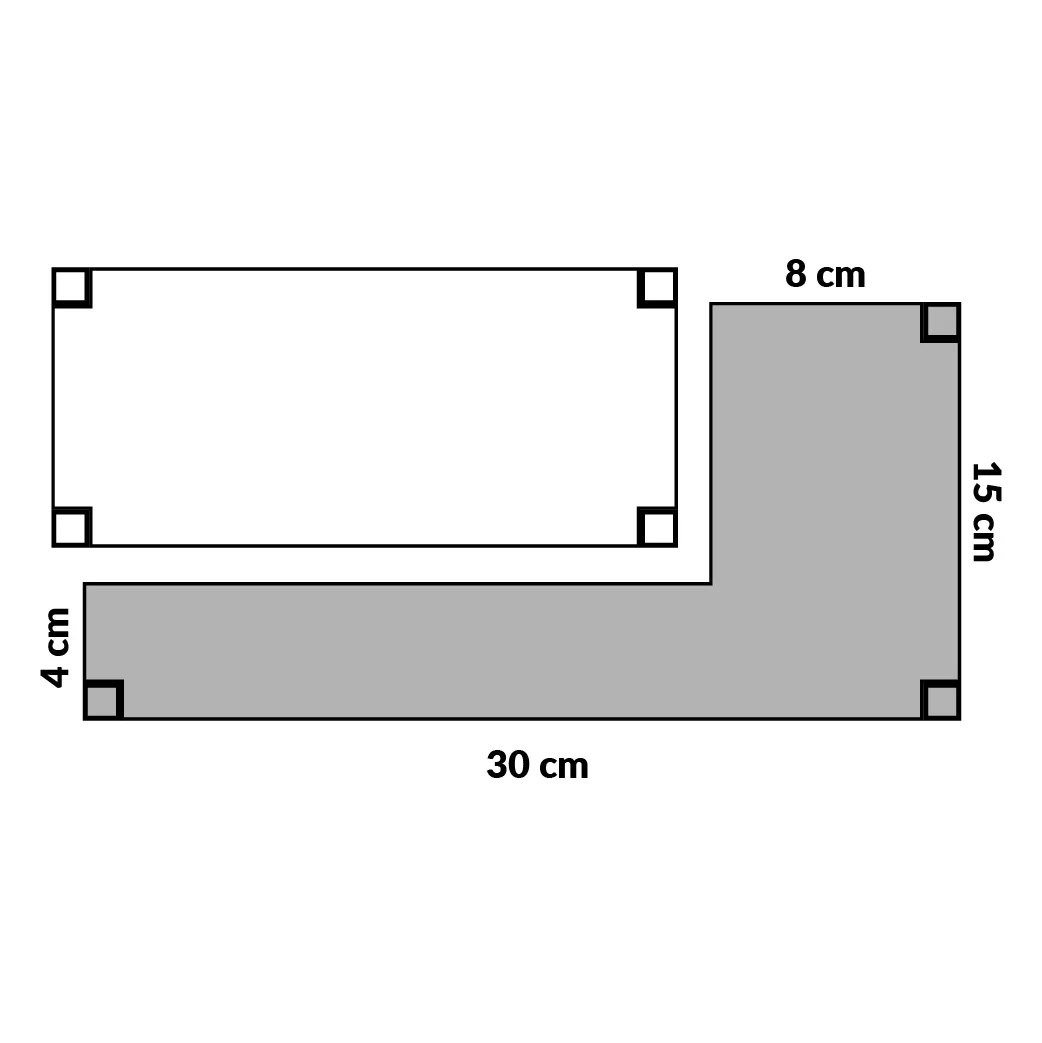
The problem: A large rectangle measures 30 cm × 15 cm. A smaller rectangular piece is cut from one corner. The cut measures 22 cm wide by 11 cm tall (the white unshaded section). Find the area of the shaded region.
Method 1: Subtraction
Step 1: Find the area of the whole (outer) rectangle.
Area of outer rectangle = 30 cm × 15 cm = 450 cm²
Step 2: Find the area of the inner (unshaded) white rectangle.
Width of white rectangle = 30 − 8 = 22 cm
Height of white rectangle = 15 − 4 = 11 cm
Area of white rectangle = 22 cm × 11 cm = 242 cm²
Step 3: Subtract.
Area of shaded region = 450 cm² − 242 cm² = 208 cm²
Method 2: Addition (splitting the shaded region into three rectangles)
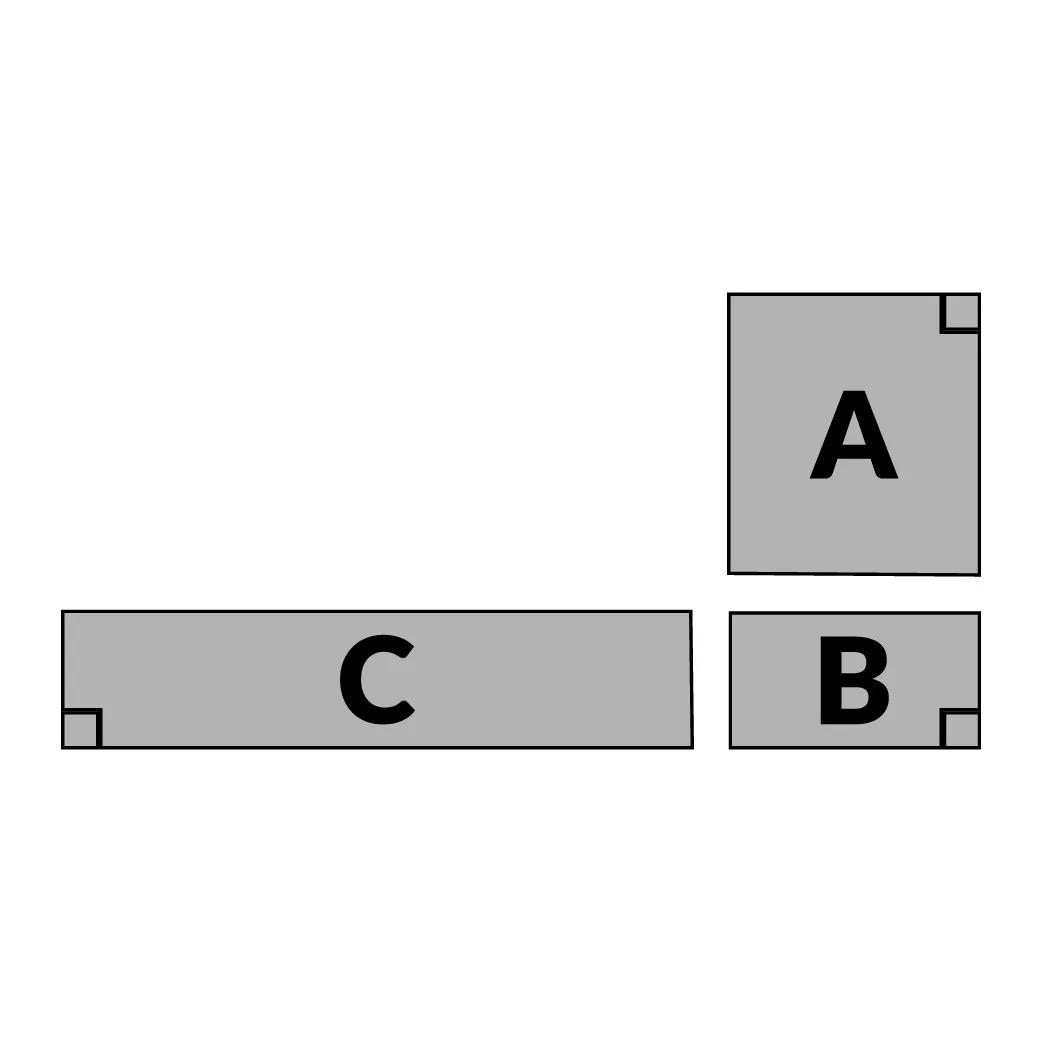
Label the three visible shaded sections A, B, and C.
Rectangle A (left strip, full height minus white section): Area = 8 cm × 11 cm = 88 cm²
Rectangle B (small corner rectangle): Area = 8 cm × 4 cm = 32 cm²
Rectangle C (bottom strip, full width minus left strip): Area = 22 cm × 4 cm = 88 cm²
Step 4: Add all three.
Area of shaded region = 88 + 32 + 88 = 208 cm² ✓
Both methods give the same answer. Method 1 was faster here because the unshaded region was one clean rectangle.
Example 2: Square with a Circle Inside
The problem: A circle is drawn inside a square. The side of the square is 14 cm. The circle touches all four sides (its diameter equals the side length). Find the area of the shaded region — the four corner sections not covered by the circle.
This is one of the most common shaded region problems at GCSE, NAPLAN, and Ontario Grade 10 level.
Method: Subtraction
Step 1: Find the radius of the circle.
The circle's diameter = 14 cm, so radius r = 7 cm.
Step 2: Find the area of the square.
Area of square = 14² = 196 cm²
Step 3: Find the area of the circle.
Area of circle = π × 7² = 3.14 × 49 = 153.86 cm² (using π = 3.14)
Step 4: Subtract.
Area of shaded region = 196 − 153.86 = 42.14 cm²
Exact answer (leaving in terms of π):
Area of shaded region = 196 − 49π cm²
Key mistake to avoid: Many students use the side length (14 cm) as the radius. Here the side length is the diameter, so always halve it to get the radius before using the circle formula.
Example 3: Rectangle with a Semicircle Removed
The problem: A rectangle is 20 cm long and 10 cm wide. A semicircle is cut from one of the shorter ends. The diameter of the semicircle equals the width of the rectangle. Find the area of the remaining shaded region.
Method: Subtraction
Step 1: Find the area of the full rectangle.
Area = 20 × 10 = 200 cm²
Step 2: Find the radius of the semicircle.
The diameter = 10 cm (same as the rectangle's width), so r = 5 cm.
Step 3: Find the area of the semicircle.
Area of semicircle = ½ × π × 5² = ½ × 3.14 × 25 = 39.25 cm²
Step 4: Subtract.
Area of shaded region = 200 − 39.25 = 160.75 cm²
Exact answer:
Area = 200 − 12.5π cm²
Note: If the semicircle were added on top of the rectangle rather than removed, you would add the areas instead of subtracting.
Example 4: Triangle Inside a Rectangle
The problem: A rectangle is 12 cm wide and 8 cm tall. A triangle is drawn inside it, with its base along the bottom of the rectangle (12 cm) and its apex touching the top edge. Find the shaded area outside the triangle but inside the rectangle.
Method: Subtraction
Step 1: Find the area of the rectangle.
Area = 12 × 8 = 96 cm²
Step 2: Find the area of the triangle.
The triangle shares the same base (12 cm) and height (8 cm) as the rectangle.
Area of triangle = ½ × 12 × 8 = 48 cm²
Step 3: Subtract.
Area of shaded region = 96 − 48 = 48 cm²
In this case, the shaded region is exactly half the rectangle; that always happens when a triangle fills a rectangle base to apex. A useful check.
Example 5: Composite Shape, Two Rectangles
The problem: An L-shaped shaded region is made up of two rectangles joined together.
- Top rectangle: 6 cm wide × 4 cm tall
- Bottom rectangle: 10 cm wide × 3 cm tall
Find the total shaded area.
Method: Addition
Step 1: Find the area of the top rectangle.
Area = 6 × 4 = 24 cm²
Step 2: Find the area of the bottom rectangle.
Area = 10 × 3 = 30 cm²
Step 3: Add both areas.
Total shaded area = 24 + 30 = 54 cm²
This is the same shape type as Example 1 Method 2 — once you can spot that a shaded region is really just several rectangles joined together, you always use the Addition method.
Common Mistakes to Avoid
These are the errors that cost students marks most often in shaded region problems.
1. Forgetting to write cm² (squared units). Area is always measured in square units. Writing 208 cm instead of 208 cm² will lose a mark in most exams. Get into the habit of writing the ² automatically.
2. Using diameter instead of radius in circle calculations. The formula is π × r² — radius, not diameter. If a problem gives you the diameter, divide it by 2 first. This is the single most common circle mistake in exam conditions.
3. Subtracting the wrong region. Make sure you are subtracting the unshaded region from the total, not the shaded region from itself. Draw the diagram, label which part is shaded and which is not, before writing any numbers.
4. Not identifying all the component shapes first. Before calculating anything, spend 30 seconds identifying every shape in the diagram. Composite shapes often have three or four components. Missing one means your answer will be wrong.
5. Rounding π too early. If you round π = 3.14 at the beginning of a multi-step problem, rounding errors build up. Keep π as a symbol through all steps and only round at the very last line, or use your calculator's π button.
6. Forgetting to square the radius. π × r² means you square the radius first, then multiply by π. A common error is writing π × r (missing the square), which gives a completely different answer.
Still Struggling with Geometry Problems?
Shaded region questions appear in:
- UK: GCSE Maths (Edexcel, AQA, OCR)
- Australia: NAPLAN Numeracy, Years 7–10 Australian Curriculum Maths
- New Zealand: NZC Mathematics, NCEA Level 1 and 2
- Canada: Ontario MPM1D/MPM2D, Alberta Mathematics 10C and 20-1
- USA: Common Core Geometry, SAT Math
If you or your child is working through these topics and needs one-to-one support, our qualified online maths tutors work through geometry problems step by step in live sessions, pausing, re-explaining, and working through new examples until the method clicks.
Book a free trial lesson today, no credit card required →
Conclusion
Finding the area of a shaded region always comes back to one idea: work out the area of the larger shape and subtract the area of the unshaded part. For composite shapes, split them into simpler pieces, find each area and then add or subtract as needed.
Write down the formulas you need, label every measurement, and check that all lengths are in the same units before calculating. With practice, even complicated diagrams become a series of simple steps.
Frequently Asked Questions
How do you find the area of a shaded region?
Find the area of the whole shape, then subtract the area of the unshaded part. Shaded area = total area − unshaded area.
How do you find the shaded area between a square and a circle?
Calculate the area of the square (side²) and the area of the circle (πr²), then subtract the circle's area from the square's area.
What if the shaded region is made of several shapes?
Split it into simple shapes such as rectangles, triangles and circles. Find the area of each, then add the shaded parts together or subtract the unshaded parts.
Which formulas do I need for shaded area problems?
The most common are rectangle (length × width), triangle (½ × base × height), circle (πr²), semicircle (½πr²) and square (side²).
What are common mistakes with shaded area questions?
Using the diameter instead of the radius, mixing units, forgetting to subtract the unshaded part and leaving off square units in the final answer.