
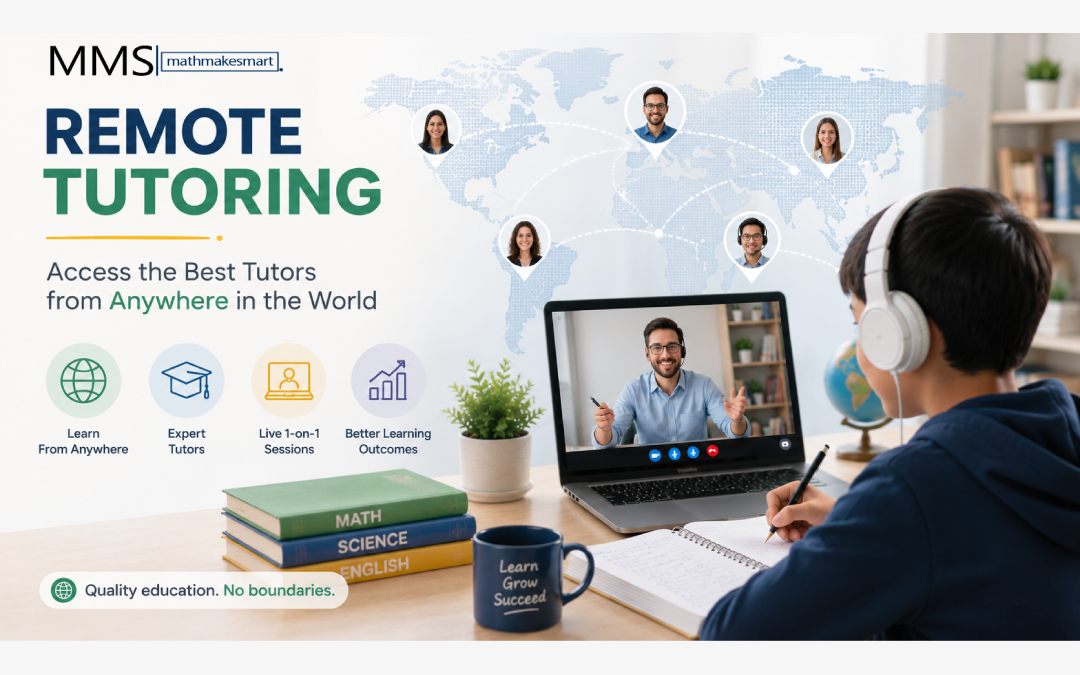
Before remote tutoring became widely available, the quality of private tutoring a child could access was almost entirely determined by where they lived. Families in major cities had a large pool of qualified tutors to choose from. Families in smaller towns, rural areas, or abroad had very limited options, and often had to accept lower quality or pay premium rates for tutors willing to travel. Remote tutoring eliminated that disparity. Today, any student with a reliable internet connection and a laptop or tablet has access to the same pool of highly qualified subject-specialist online tutors, regardless of whether they live in central London, rural Queensland, a small town in Canada, or anywhere else in the world.
What Is Remote Tutoring?
Remote tutoring is academic support delivered at a distance, with tutor and student in different locations, connected through video call and shared digital tools. The session experience is identical to virtual or online tutoring: live video, interactive shared whiteboard, real-time collaboration. The distinguishing characteristic is simply that neither party needs to be in a particular location for the session to happen.
This matters more than it might initially seem. It means a student in a rural area without qualified local maths tutors can access a specialist in A-Level Further Maths. A student in regional Australia can receive NAPLAN preparation from a tutor who specialises specifically in that test. A family relocating internationally mid-school-year can maintain tutoring continuity with the same tutor throughout the move.

Why Remote Tutoring Has Transformed Private Education
The democratisation of access is the most significant thing remote tutoring has achieved. High-quality private tutoring was previously concentrated in urban areas and available primarily to families with the resources to pay for it and the geographic proximity to access it. Remote tutoring has changed both constraints simultaneously.
Cost fell because remote tutors do not charge for travel time and can serve students across multiple time zones efficiently. Access expanded because the relevant pool of tutors for any student is now global rather than local.
A family in New Zealand whose child needs specialist support for A-Level Chemistry is no longer limited to the tutors within driving distance. They can access the same quality of specialist tutoring as a family in central London, and often at a lower price per hour.
The Practical Advantages of Remote Tutoring
Beyond expanded access, remote tutoring offers practical advantages for all families regardless of location:
- No travel time. Each session saves 30 to 60 minutes of travel time for the student and often for a parent. Over a full academic year of weekly sessions, this adds up to 25 to 50 hours, time that can be spent on rest, exercise, or revision.
- Flexible scheduling. Remote sessions are not constrained by the tutor’s location or the need to travel between appointments. This makes scheduling more flexible and rescheduling easier when the unexpected happens.
- Access to specialists for niche subjects. A Level Chemistry, SAT Math, 11+ verbal reasoning, NAPLAN Year 9 numeracy, AP Biology- these subjects require tutors with specific expertise. Remote tutoring means a student is never limited to whatever generalist happens to be available locally.
- Continuity during disruption. Illness, family travel, relocation, and school timetable changes can all disrupt in-person tutoring arrangements. Remote tutoring continues without interruption through all of these; the student logs on from wherever they are.
- Lower cost than in-person equivalents. Without travel costs built in, remote tutors can offer more competitive hourly rates than in-person tutors who factor in travel time and transport costs.
Subjects Available for Remote Tutoring
Remote tutoring is available for all mainstream academic subjects. The most commonly requested are:
- Mathematics: the most-requested subject globally, across all year groups. Remote maths tutoring via shared whiteboard is particularly effective because problems can be worked through step by step with both parties writing simultaneously.
- English and ELA: reading comprehension, essay writing, grammar, vocabulary, and test preparation. Particularly valuable for students whose written work needs detailed, personalised feedback.
- Physics, Chemistry, Biology: secondary school through to A-Level, AP, and NAPLAN. Subject-specialist science tutors who understand the specific examination requirements of the student’s curriculum.
- Test preparation: SAT, ACT, 11+, 13+, NAPLAN, A-Level, ELA, and placement tests. Specialist exam tutors focus on content knowledge, past paper practice, and the exam techniques that turn understanding into marks.
Remote Tutoring Across Six Countries
Math Make Smart provides remote tutoring to students across the US, UK, Australia, Canada, Ireland, and New Zealand. Our online tutors are trained in each country’s specific curriculum and examination requirements, an important distinction, since the content and format of examinations vary significantly between systems.
A UK student preparing for GCSE Maths needs a tutor who understands AQA, Edexcel, and OCR paper formats. A US student preparing for the SAT needs a tutor who understands the digital adaptive format introduced in 2024. An Australian student preparing for NAPLAN needs a tutor familiar with the ACARA curriculum and the online adaptive testing format.
Generic tutoring, from a tutor who knows maths but not the specific examination system, is significantly less effective than specialist support tailored to the student’s actual examination requirements.
Remote Tutoring at Math Make Smart
Math Make Smart provides remote 1-to-1 tutoring by expert math tutors, English tutors, and Science tutors. Sessions are available from $19.99 per hour. Every new student receives a completely free trial lesson, no payment required, no commitment. Start your child’s free trial today at mathmakesmart.com/free-trial/